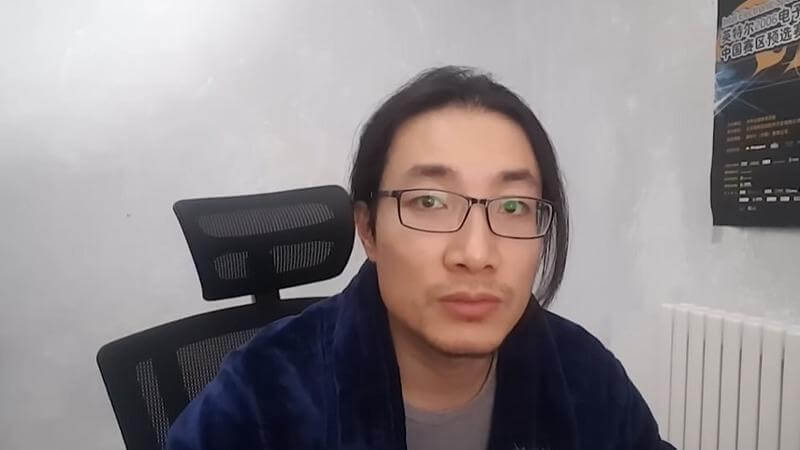
First things first: Heng Guan is an international human rights hero. He’s a man who chose, for no reason other than that he felt compelled to expose injustice, to put himself at grave personal risk in order to document the human rights violations—eventually described by the United States as a genocide—of the Uyghur people in China’s western Xinjiang province.
For going on a decade now, the Muslim Uyghurs have been rounded up into massive camps and compounds (estimates are 1 to 3 million in detention) by direct order of Beijing, “reeducated,” split apart, dispersed and suppressed. Knowledge of the human rights abuses has been tightly suppressed as well, through the Chinese government’s all-encompassing intimidation campaigns of mass surveillance and censorship, police violence and more. Heng Guan, a 38-year-old Chinese native of Henan Province, wanted to see what the truth was after bypassing online government firewalls, so he traveled the length of China with his camera in order to surreptitiously capture video of the camps—footage that would become instrumental to Pulitzer Prize-winning reporting about the Uyghur genocide. Guan did all of this while knowing that the result would very likely be that he would never see his family again, as he would be forced to flee China in order to escape government persecution if he published his videos. And so, he set out on a global journey to reach the United States, in order to share his footage. And now, just over four years later, and despite a progressing asylum case, the United States and ICE are preparing to deport Heng Guan to Uganda, where he will almost certainly then be sent back to China. And should that happen, to quote Guan’s own mother: “If he gets deported, he’s really dead.”
In a perfect encapsulation of the clumsy cruelty of the U.S. deportation apparatus, Heng Guan was arrested by ICE in August in a raid where he wasn’t even the target being sought. Immigration agents were instead looking for his roommate, but Guan was detained as well despite presenting his work permit, state of NY driver’s license and papers related to his asylum case. None of that mattered to ICE: All they cared about is that Guan had entered by sea and could not produce an I-94 entry record form. He’s been in detainment ever since, eventually at the Broome County Jail of Binghamton, NY. After an immigration hearing in NYC on Monday, the Department of Homeland Security has reportedly filed a motion to pretermit—to close Guan’s asylum application—after which it would deport him to Uganda … a strong strategic ally of China. In effect, it’s the equivalent of handing Guan straight back to Chinese authorities for summary execution.
You can’t truly appreciate the selfless actions of Heng Guan in gathering and sharing evidence of the Uyghur genocide in Xinjiang without understanding the commitment it required for him to travel to the United States and release his 20-minute, self-edited documentary, which is still available on YouTube. This man had to bounce around the globe, and eventually spend his life’s savings just to stumble out of a beach onto U.S. shores, having no idea what he would find there.
In order to get out of China, Guan first traveled to Hong Kong in July of 2021. From there, he flew to Ecuador, one of the few countries available to him that offered visa-free entry to Chinese tourists at the time. He ultimately stayed there for two months, in order to complete both doses of the COVID-19 vaccine that were necessary for further international travel. From Ecuador, he went to another country he could enter without a visa, the Bahamas. It was as close as he could get to U.S. shores, approximately 85 miles as a straight line to the southern tip of Florida. He needed a boat to cross that distance, and originally planned to order an inexpensive one from China, but his expiring temporary visa forced Guan to spend nearly the entirety of his remaining savings locally to buy a tiny inflatable boat and an outboard motor. The man had never sailed in his life, but that didn’t stop him from setting out vaguely westward, without the faintest idea of what he was doing. He drifted at sea for almost a full day, wondering if he would simply be arrested as soon as he reached the shore of a country where he’d never set foot before.
Heng Guan made landfall on the Florida coast the following morning. Panicking at the thought of apprehension, he left nearly everything behind except for a backpack with his technological equipment. As he hid in the bushes, watching a Coast Guard patrol boat pass by, he knew that at the very least, his video was already out in the world. Unwilling to leave anything to chance, and knowing that something could happen to him in the desperate final trek of his journey, he had scheduled it to post in advance.
“I didn’t know if I could safely reach the United States, and I couldn’t wait until I arrived to release it,” he told NGO Human Rights in China.
In the video itself, he offered his own justification for why someone would take so many risks, and completely upend their own life, just to publish this footage: “Those unwilling to be enslaved are also unwilling to see others enslaved.”
Deportation, or Death Sentence
Heng Guan is set to be a victim of the Donald Trump administration’s use of so-called “third-country deportations,” in which foreign nationals in the U.S. are sent not to their original home country but seemingly random locations that choose to receive them. Earlier this year, for instance, the Trump admin sent five migrants from Vietnam, Laos, Yemen, Jamaica and Cuba to the Southern African nation of Eswatini, which the DHS justified because “This flight took individuals so uniquely barbaric that their home countries refused to take them back,” because they had been convicted of crimes including murder, assault and robbery. Heng Guan, on the other hand, is accused of nothing but illegal entry, and the DHS lawyer at Monday’s hearing cited an agreement meant to protect asylum seekers who might be punished by their home countries to instead be deported to what the U.S. calls a “safe third country,” where they could theoretically apply for asylum again. The only problem: Uganda’s close ties with China mean they would probably simply hand him over to Beijing. That’s what Heng Guan’s lawyer, Chuangchuang Chen, argued, telling The New York Times that “It’s more likely than not for such a highly sensitive person like Mr. Guan that Uganda would send him back to China.”
This effectively makes the deportation of Heng Guan a case of the DHS doing China’s bidding for it, even though the U.S., during the very end of Trump’s first administration, agreed with Heng Guan in labeling China’s treatment of the Uyghurs as a genocide. Many in the high echelons of Trump’s administration have been equally critical of Beijing’s human rights violations here, particularly Secretary of State Marco Rubio, who has intensely criticized China on this issue. And yet, where are the defenders in the U.S. government to stand up for Heng Guan? Why is Rubio not stepping in here? This is the man who got us first-hand video footage of the indoctrination and reeducation camps in the first place. Buzzfeed would go on to win a Pulitzer Prize for parallel reporting on the Uyghur genocide that made use of discoveries in Heng Guan’s footage, which was itself based on some of Buzzfeed’s initial reporting. To Human Rights in China, the Buzzfeed team gave the following statement pleading for Guan to be spared from deportation:
“Mr. Guan provided crucial corroborating evidence for our investigation at great personal risk. His courage is extraordinary. . . He had no other reasonable reason to be near many of these detention sites, as they are typically located in remote areas. . . If caught, the danger he faced would have increased significantly,” the BuzzFeed team wrote in the letter. They specifically pointed out that the evidence provided by Guan Heng helped confirm the existence of the new Dabancheng prison—directly exposing the Chinese government’s lie that the “re-education camps have been closed.” The joint letter concluded: “We believe that if Mr. Guan is deported back to China, he will face great danger. Therefore, we call on the United States to grant Mr. Guan asylum and to end his detention and the threat of his deportation.”
The remaining family of Heng Guan in China have subsequently suffered on their own through interrogation and harassment, providing a hint of what might happen to him if he was returned by the U.S./Ugandan governments. His mother, Luo Yun, has lived in Taiwan outside of direct Chinese control for almost 20 years, but said that in eventually being able to contact him after his arrest by ICE, he was in an emotional state of “extreme panic and breakdown” at the threat of being deported to face reprisal for his act of heroism and epic journey in 2021.
“I’m heartbroken,” she said in a statement to The Guardian. “I’m not only crying for my child, but the situation that our family is facing. I just want my child to be well. He’s still young, and has a long life ahead.”
ICE has taken Chinese dissident Guan Heng into custody and is threatening to return him to China.
Guan Heng risked his life to film the Uyghur concentration camps—the same camps Secretary of State Rubio opposed when he sponsored the “Uyghur Force Labor Prevention Act” as a US senator.
— Leah McElrath (@leahmcelrath.bsky.social) Dec 13, 2025 at 11:58 AM