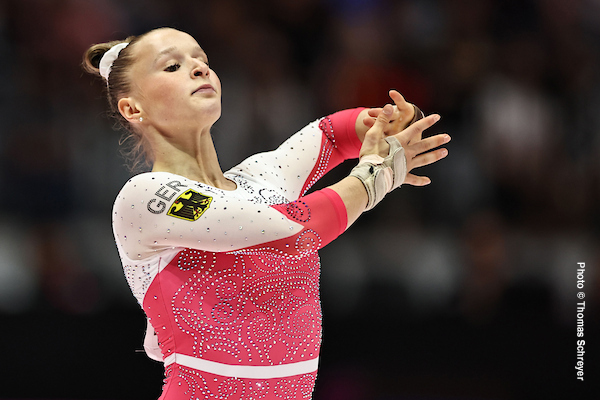
An all-around finalist in her world championships debut in Jakarta two months ago, Germany’s Silja Stöhr is already proving herself to others as the reliable competitor she aspires to be.
Stöhr, who placed 21st all-around in Jakarta, has enjoyed a steady and substantial emergence in the junior and senior phases of her career. She was a member of the bronze medal-winning German team at the 2022 European Junior Championships in Munich, and its gold medal-winning team in the junior division at the 2023 DTB Pokal in Stuttgart. Stöhr finished 38th all-around in qualifications at the 2023 Junior World championships in Antalya. She moved into the senior ranks last year, placing sixth all-around at the German Championships and helping Germany place sixth at the European Championships in Rimini.
Beyond Stöhr’s performance in Jakarta, her other 2025 results have been ample, as well. She advanced to her first World Cup final at the World Cup of Cottbus in February, placing eighth on uneven bars. Stöhr claimed three silvers (all-around, balance beam and mixed team) at the DTB Pokal in March, and took sixth place all-around and second on floor exercise at the German Championships in August. Last month she finished eighth all-around at the Arthur Gander Memorial in Switzerland.
Stöhr, who was born May 13, 2008, in Mannheim, represent SG Heddesheim, where she lives. She trains at TG Mannheim and also represents TG Mannheim in the Bundesliga (German gymnastics league). Stöhr’s coaches are Narina Kirakosyan on vault and balance beam, and Dmitri Loschakov on uneven bars and floor exercise.
In this International Gymnast Online interview, Stöhr shares the experience of her world championships debut, her personal and team goals for the rest of the Olympic cycle, her holiday plans and her hopes for the new year.
IGO: Heading into Jakarta, what were our specific goals? And, how would you rate your performance in the all-around final, in terms of the impression your made on the world and what you showed to yourself?
SS: My main goals were to show what I did in training, confident and clean routines. Making the all-around final at my first World Championships was a dream and I enjoyed every moment. In the all around final I would rate my performance solid, because everything went well except one mistake on bars. I’m still proud of how I did at my first world championships.
IGO: For some gymnasts, making a successful transition from the junior level into the senior level is challenging. Some former junior gymnasts do not match their earlier achievements. What do you believe has enabled you to make this transition smoothly?
SS: The transition from a junior to a senior is definitely challenging. In my case I was injured which didn’t make it easier but my coaches prepared me pretty well and I just trust in the plan and see how far I could come.
IGO: Germany was only 0.101 points from qualifying a team to the last Olympic Games. How do you think that “close call” motivate the gymnasts and coaches, to make changes and improvements that will assure Germany a team spot at Los Angeles 2028?
SS: The result was such a pity and so close. I think it motivated all of us, gymnasts and coaches, to improve every detail. It pushed us to work on our difficulty score but also on our execution score. Everyone is working with the mindset that we want Germany to be at LA 2028 with a full team.
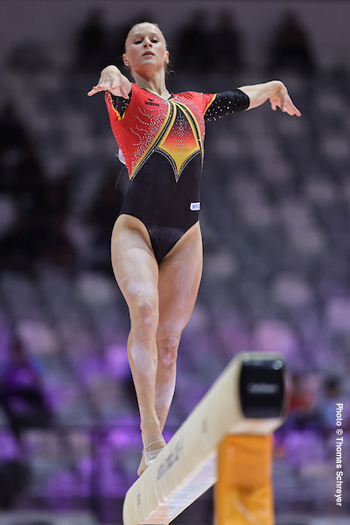 Silja Stöhr (GER)
IGO: You seem to have equal strengths across all four apparatuses, whereas some gymnasts have obvious “best” apparatuses. Is this a fair perspective, or do you indeed feel you have one or more strongest apparatuses?
SS: All four of my apparatus are really balanced I would say. But of course I have apparatus that feel more natural. My strongest events are beam and bars but it’s not a huge difference between the other events.
IGO: How have your coaches and you developed a training system that assures your strength as an all-arounder?
SS: My coaches and I have built a training week where each apparatus has a clear structure every day. We balance between strength, conditioning, technique and routine work.
IGO: At this point in the Olympic cycle, you, Karina Schönmaier and Helen Kevric appear to be Germany’s top all-arounders. Once Helen has recovered, there is likely to be a fight for the top two all-around spots in order for gymnasts to advance to all-around finals at the World championships, European championships and Olympic Games. What is your strategy for making your program as powerful and steady as possible, so you can earn one of those positions?
SS: My strategy is to focus on building routines that are not only difficult but also reliable. That means investing a lot of time into basics, strengthening my landings and improving my execution score. I want my program to be stable enough that the coaches can trust I will deliver when it matters.
IGO: With the holiday season upon us, what are your Christmas traditions and plans?
SS: Christmas is one of my favorite times of the year. I usually spend it with my family at my grandma’s house. This year my best friend Janoah and I will go to London for a weekend right before Christmas. During the holidays I have training free time, where I will go to vacation with my family and reset for the next year.
IGO: What are your new year’s resolutions, in and out of the gym?
SS: In the gym, my resolution is to keep increasing my consistency and add new upgrades. Outside the gym I want to enjoy my free time with friends, family and traveling, and of course stay happy.
International Gymnast Online’s other features on German gymnasts include: