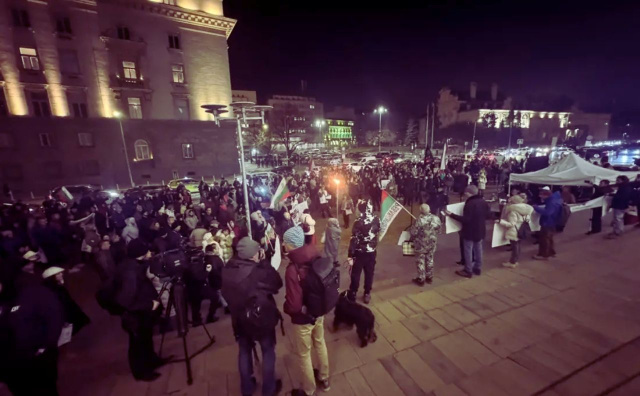
In Sofia, citizens gathered in front of the Bulgarian National Bank to protest against the adoption of the euro. The demonstration is organized by the civil association Doyran 2025 and has been officially registered with the Sofia Municipality. Participants carried banners reading slogans such as “No to the euro,” “It’s time to be heard, no to the euro,” “What is the euro for if we lose Bulgaria,” and “Direct democracy with referendums!!! Lev! With Russia.” Despite the protest, traffic in the area continues to flow, and police are present to maintain order.
The protesters are calling for the preservation of the Bulgarian lev as the national currency and are demanding broader justice and reforms in governance. They propose extending the period of simultaneous use of the lev and the euro from one month to six months, ensuring that banknotes and coins are not destroyed immediately. This measure, according to the association, would allow time for a potential referendum on the euro issue. Doyran 2025 has sent its proposals for changes to the euro adoption law to all parliamentary groups in the National Assembly as well as to President Rumen Radev. Similar protests are reportedly taking place in other cities across the country.
Further reading: More Than a Budget Crisis: Bulgaria’s Gen-Z Demands a Political Reckoning
Meanwhile, Prime Minister Rosen Zhelyazkov expressed confidence in Bulgaria’s upcoming entry into the eurozone, speaking from Brussels during the EU–Western Balkans Summit. He said he does not understand why the National Assembly initially put forward next year’s budget for consideration only to withdraw it, noting that the government’s adoption of the extended budget demonstrated its unwillingness to pursue policies lacking parliamentary support. Zhelyazkov emphasized that the country is clearly moving toward elections, and stressed the need for a new, stable government capable of passing a budget that reflects the mandate given by citizens.
Regarding the euro adoption on January 1, he stated that there are no concerns, as all necessary preparations,including the Euro Introduction Law, the established mechanisms, and relevant institutions, are in place. He expressed confidence that the future caretaker cabinet will be able to use these tools effectively to address any speculation or fears. Zhelyazkov also highlighted that a regular budget offers more flexibility for financing and greater clarity on social payments, something the extended, transitional budget cannot fully provide.
Sources:
Bulgarian News Agency (BTA)
Bulgarian National Television (BNT)
Nova TV