
Today, Eurostat released the European Statistical Monitor, a dashboard with short-term indicators covering different areas, such as economy, environment, business, health and work.
This monthly updated dashboard is designed to track developments within the EU as a whole and its members, as well as the EFTA countries, providing a holistic overview of key developments. It focuses on monthly and quarterly indicators, ensuring up-to-date insights and includes a commentary, focusing on recent changes and trends.
The EU economy on a moderate growth path with a stable labour market
The EU economy stayed on a moderate growth path, with a steadily expanding GDP and stable inflation. Economic sentiment slightly improved, although remaining below its long-term average.
Unemployment remained low, alongside a peaking employment rate and decreasing labour market slack, indicating a strong labour market. However, job vacancies continued to fall.
Looking at first-time asylum seekers, there was a slight uptick in their total number at EU level.
Among monthly business and trade indicators, industrial production increased slightly, while retail trade volumes and production in services remained unchanged. Furthermore, both imports and exports of goods decreased.
You can read the full analysis by opening the Eurostat commentary linked in the dashboard’s header.
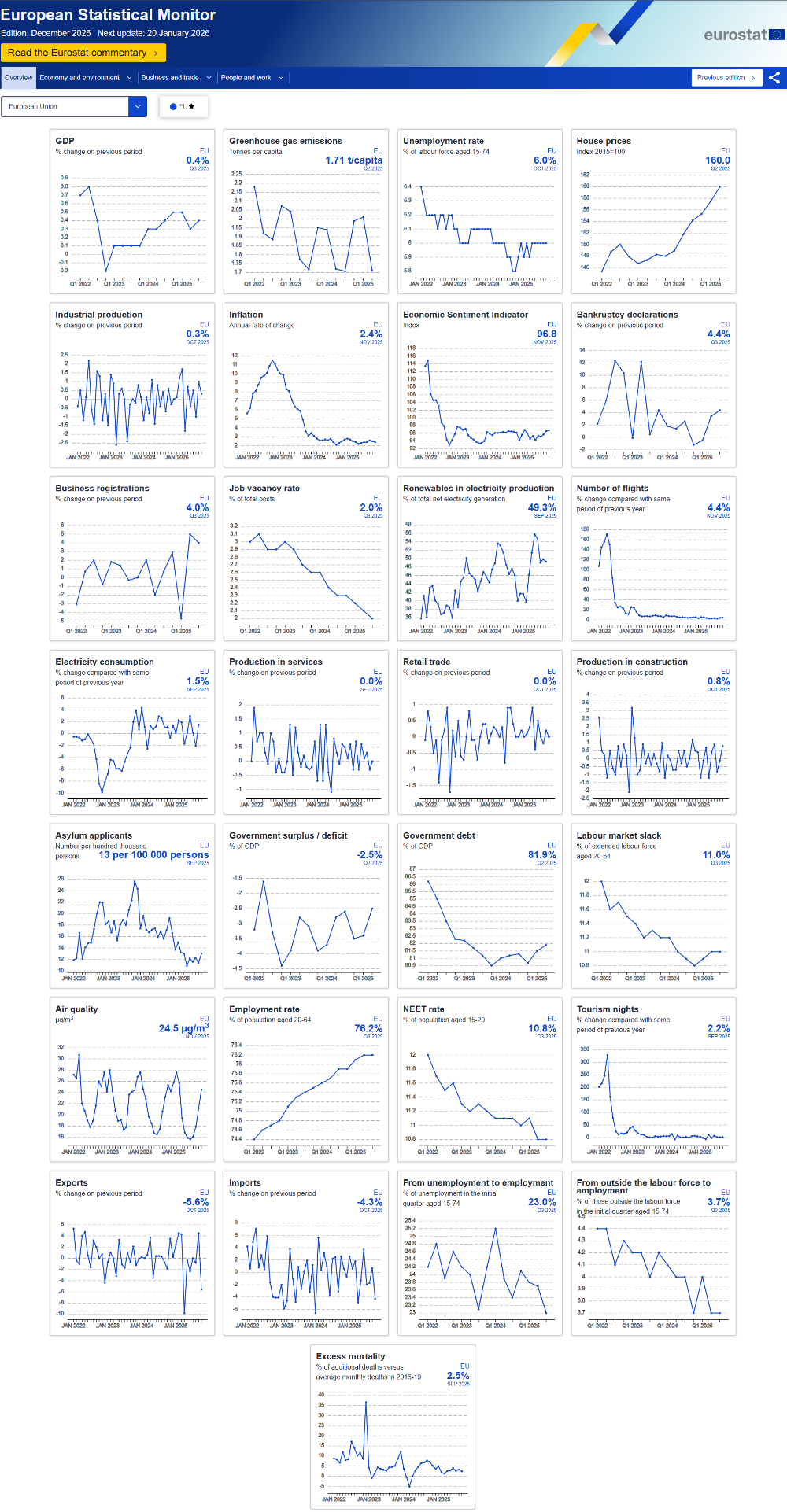
The European Statistical Monitor is updated every month with the latest available data for each indicator.