![Jeong Yeon-doo, right, vice minister for diplomatic strategy and intelligence at South Korea's Foreign Ministry, and acting U.S. Ambassador to South Korea Kevin Kim shake hands before their talks at the Foreign Ministry in Seoul on Dec. 16, to coordinate their North Korea policy. [MINISTRY OF FOREIGN AFFAIRS]](https://www.europesays.com/wp-content/uploads/2025/12/1766096823_ce1b05ec-2f19-4d25-ab8f-91d58b3bbb99.jpg)
![Jeong Yeon-doo, right, vice minister for diplomatic strategy and intelligence at South Korea's Foreign Ministry, and acting U.S. Ambassador to South Korea Kevin Kim shake hands before their talks at the Foreign Ministry in Seoul on Dec. 16, to coordinate their North Korea policy. [MINISTRY OF FOREIGN AFFAIRS]](https://www.europesays.com/wp-content/uploads/2025/12/ce1b05ec-2f19-4d25-ab8f-91d58b3bbb99.jpg)
Jeong Yeon-doo, right, vice minister for diplomatic strategy and intelligence at South Korea’s Foreign Ministry, and acting U.S. Ambassador to South Korea Kevin Kim shake hands before their talks at the Foreign Ministry in Seoul on Dec. 16, to coordinate their North Korea policy. [MINISTRY OF FOREIGN AFFAIRS]
[EXPLAINER]
Â
South Korea’s first follow-up talks with the United States on implementing a joint leaders’ fact sheet should have been an opportunity to follow up on the leaders’ summits. Instead, it has exposed unresolved chasms in Seoul over how North Korea policy should be coordinated with Washington — and which government agency should take the lead.Â
Â
The ROK-U.S. Consultation on Joint Fact Sheet Implementation, held Tuesday in Seoul, was a part of ongoing efforts to strengthen bilateral coordination on North Korea policy at a time when talks with Pyongyang are at an impasse despite the Lee Jae Myung administration’s hopes for North-U.S. talks to make headway next year. The ROK stands for the Republic of Korea, the South’s official name.
Â
The ministry said both sides agreed that close coordination would remain essential in pursuing future Korea Peninsula policy, and pledged to maintain communication at various levels going forward.Â
Â
Missing from the talks were any representatives from the Unification Ministry, which has indicated it intends to play a more proactive and leading role in inter-Korean dialogue and cooperation. This quickly turned what was meant to be a fruitful technical consultation into a broader political debate.
Â
U.S. experts said the controversy over alliance coordination reflects domestic political and bureaucratic tensions in Seoul, and warned that North Korea’s longstanding strategy has been to exploit precisely such divisions.Â
Â
![Jeong Yeon-doo, left, vice minister for diplomatic strategy and intelligence at the Foreign Ministry, holds talks with acting U.S. Ambassador to South Korea Kevin Kim at the Foreign Ministry in Seoul on Dec. 16, to coordinate their North Korea policy. [MINISTRY OF FOREIGN AFFAIRS]](https://www.europesays.com/wp-content/uploads/2025/12/66c24e7d-2cf3-4691-92f3-5e9a3782c75f.jpg)
Jeong Yeon-doo, left, vice minister for diplomatic strategy and intelligence at the Foreign Ministry, holds talks with acting U.S. Ambassador to South Korea Kevin Kim at the Foreign Ministry in Seoul on Dec. 16, to coordinate their North Korea policy. [MINISTRY OF FOREIGN AFFAIRS]
Â
�
Â
What were the talks about, and was the root of the controversy?
Â
Â
Tuesday’s meeting brought together officials from the foreign affairs and defense ministries on the South Korean side and representatives from the U.S. State and Defense departments, led by Jeong Yeon-doo, vice minister for diplomatic strategy and intelligence at the Foreign Ministry, and by the acting U.S. Ambassador to Seoul, Kevin Kim. Â
Â
The discussions covered a broad range of Korean Peninsula-related issues outlined in the joint fact sheet released after President Lee Jae Myung’s summit meetings with U.S. President Donald Trump in August and October. Those commitments include reaffirming the allies’ shared goal of the complete denuclearization of North Korea, cooperation to implement the 2018 Singapore joint statement, close coordination on North Korea policy and efforts to encourage Pyongyang’s return to dialogue and compliance with international obligations, according to South Korea’s Foreign Ministry.Â
Â
The meeting, however, triggered heated political reactions, invoking memories of the controversial Korea–U.S. working group launched in late 2018 during a brief thaw in inter-Korean relations following the PyeongChang Winter Olympics held in the South.
Â
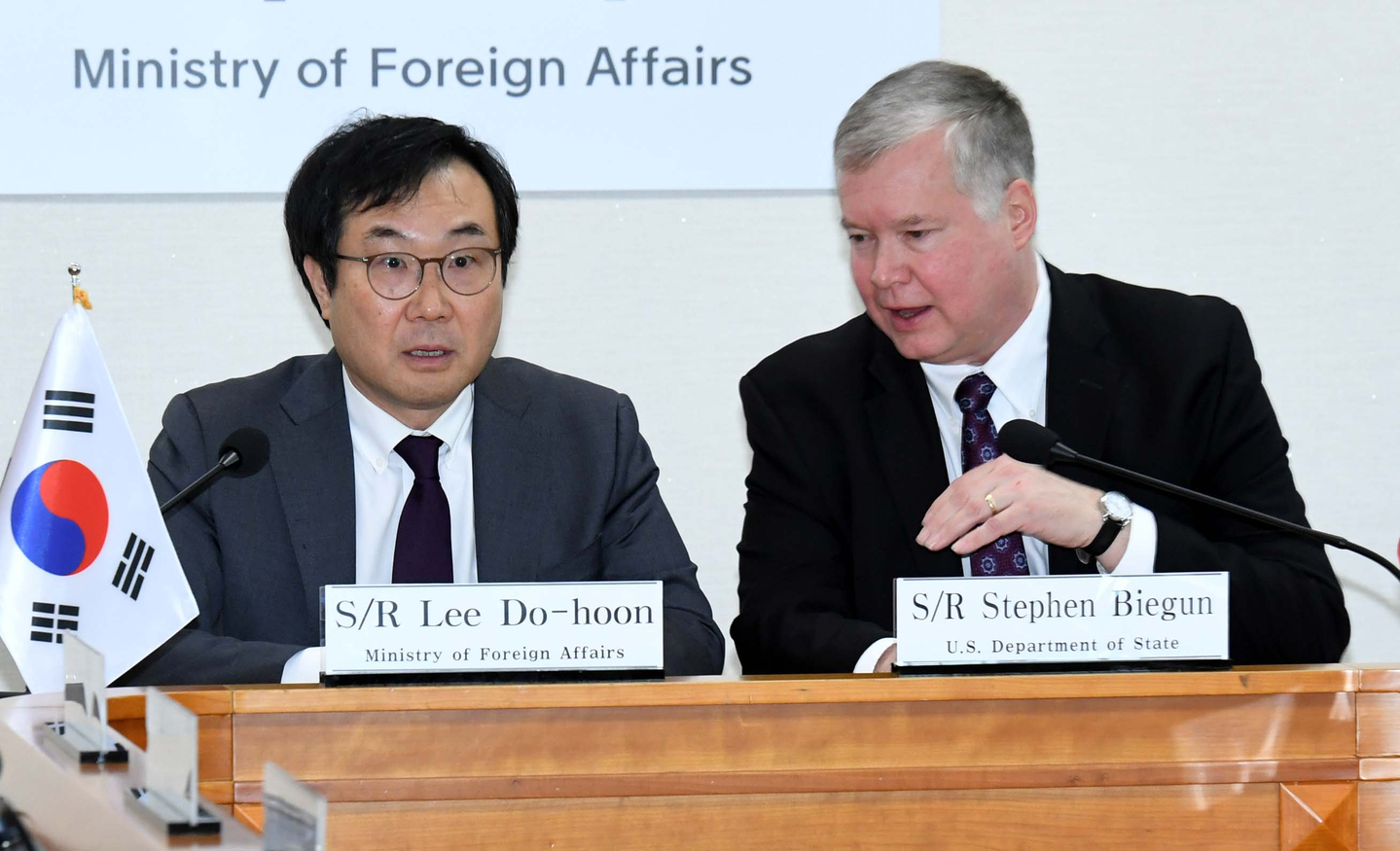
ì�´ë�„훈(왼쪽) 외êµ�부 한반ë�„í�‰í™”êµ�ì„본부장과 스티브 비건 ë¯¸êµ êµë¬´ë¶€ 대ë¶�ì •ì±…íŠ¹ë³„ëŒ€í‘œê°€ 10ì�¼ ì˜¤ì „ 서울 종로구 세종대로 외êµ�부 ì²ì‚¬ì—�ì„œ 열린 한미 워킹그룹회ì�˜ì—�ì„œ ëŒ€í™”í•˜ê³ ìžˆë‹¤. 2019.5.10 / 뉴스1
Though designed to ensure that expanding inter-Korean dialogue and cooperation did not violate UN Security Council sanctions on North Korea, the working group was criticized by some in then-President Moon Jae-in administration for blocking progress in inter-Korean relations for prioritizing sanctions coordination.
Â
One frequently cited example was an effort by the Moon administration to send influenza medication to North Korea on humanitarian grounds in 2019, which was delayed amid questions over whether transporting the aid by truck would breach sanctions. Â
Â
North Korea’s Kim Yo-jong, the powerful sister of leader Kim Jong-un, later accused Seoul of allowing what she called “pro-U.S. subservience hanging around their necks” as the reason the “excellent” inter-Korean agreements have not seen a single step forward.” The meeting ended in 2020.Â
Â
![Former President Moon Jae-in talks with North Korea's leader Kim Jong-un's younger sister Kim Yo-jong during a performance by North's Samjiyon Orchestra at the National Theater of Korea in Seoul in February 2018. [YONHAP]](https://www.europesays.com/wp-content/uploads/2025/12/b2fd9fb3-0449-44f5-adc7-7bc2dabe944a.jpg)
Former President Moon Jae-in talks with North Korea’s leader Kim Jong-un’s younger sister Kim Yo-jong during a performance by North’s Samjiyon Orchestra at the National Theater of Korea in Seoul in February 2018. [YONHAP]
A diplomatic source in Seoul said U.S. officials also conveyed during Tuesday’s meeting that the consultation should not be framed as a revival of the previous working group, expressing puzzlement over why such a narrative had emerged. Â
Â
Sydney Seiler, senior adviser and Korea Chair at Center for Strategic and International Studies (CSIS) and a former U.S. special envoy for the six-party talks, rejected the premise that the working group was responsible for the collapse of inter-Korean engagement.Â
Â
“There is no legitimate analysis of the events of 2017, 2018 and 2019 that blames the U.S.–ROK working group for the failure of progress in inter-Korean relations,â€� he said.Â
Â
According to Seiler, Pyongyang “lost interest in dealing with the Moon Jae-in administration once they had access to the United States� and repeatedly pressed Seoul to refrain from cooperating with the United States. In that context, Seiler said, the working group became “the scapegoat� — not the cause — of stalled diplomacy, echoing Pyongyang’s longstanding narrative.
Â
Senior Foreign Ministry officials stressed that the talks were neither about enforcing sanctions nor approving policy, but rather an exchange of assessments at a time when dialogue with North Korea remains stalled, and the regional geopolitical environment has grown more complex.
Â
“The establishment of the working group seven years ago was an exceptional case, created to address particular circumstances,� a senior Foreign Ministry official explained the following day, speaking on background. “[What we are doing now is] simply resuming director-general-level consultations to follow up on leaders’ agreements — nothing more and nothing less.�
Â
“The follow-up consultations on the Korea–U.S. joint fact sheet are fundamentally different in purpose and context from the previous working group,â€� the official added. “There was a clear understanding on both the Korean and U.S. sides from the outset, and that remains the case.”
Â
![South Korean Foreign Minister Cho Hyun, right, and Unification Minister Chung Dong-young attend a plenary session of the National Assembly’s Foreign Affairs and Unification Committee in Seoul on Aug. 18. [YONHAP]](https://www.europesays.com/wp-content/uploads/2025/12/18622bb4-a60d-4374-8172-d10de6eb98de.jpg)
South Korean Foreign Minister Cho Hyun, right, and Unification Minister Chung Dong-young attend a plenary session of the National Assembly’s Foreign Affairs and Unification Committee in Seoul on Aug. 18. [YONHAP]
Â
�
Â
Why did the Unification Ministry skip the meeting, and what does it mean?
Â
Â
Much of the domestic backlash centered on the Unification Ministry’s decision not to attend the talks.
Â
Former unification ministers from progressive administrations issued a rare joint statement warning against allowing diplomatic engagement with the United States to constrain South Korea’s autonomy in inter-Korean affairs. The statement was signed by six former ministers who served under the liberal administrations of Kim Dae-jung, Roh Moo-hyun and Moon Jae-in: Lim Dong-won, Chung Se-hyun, Lee Jae-joung, Cho Myoung-gyon, Kim Yeon-chul and Lee In-young.
Â
![Former unification ministers and inter-Korean affairs experts take part in a special roundtable evaluating the Lee Jae Myung administration’s unification and security policies at the Korea Press Center in central Seoul on Dec. 3. [NEWS1]](https://www.europesays.com/wp-content/uploads/2025/12/92cb785a-59c9-4341-bdbe-d87836628f9e.jpg)
Former unification ministers and inter-Korean affairs experts take part in a special roundtable evaluating the Lee Jae Myung administration’s unification and security policies at the Korea Press Center in central Seoul on Dec. 3. [NEWS1]
In unusually blunt language, the former ministers argued that South Korea’s Foreign Ministry lacked both the expertise and the historical understanding of inter-Korean relations to lead North Korea policy. They also said that in past episodes — including the establishment of the Kaesong Industrial Complex and discussions over sanctions relief — the Foreign Ministry had taken positions that were “more conservative than those of the U.S. government itself.â€�Â
Â
Such criticism echoes concerns expressed by current Unification Minister Chung Dong-young. Â
Â
Despite the public exchanges, both the foreign and unification ministries have formally denied that the episode reflects interministerial conflict, saying they are pursuing the same national interest through different approaches.
Â
In a press statement issued Monday — one day before the meeting — the Unification Ministry said it understood the consultation as a “follow-up discussion” on the joint fact sheet and characterized it as a “bilateral foreign policy consultation” rather than a coordination meeting on North Korea policy. The ministry added that issues related to inter-Korean dialogue and cooperation would be “handled separately” by the Unification Ministry as needed.
Â
On the day of the meeting, the ministry instead held a policy briefing for foreign diplomats and representatives of embassies and international organizations in Seoul, seeking support for its approach.Â
Â
The Foreign Ministry rejected the idea that the Unification Ministry had been sidelined.
Â
“The most important question is how to find a breakthrough for dialogue on the Korean Peninsula,â€� the senior Foreign Ministry official said. “That is a shared concern across ministries. The Unification Ministry has its own priorities and roles, and so does the Foreign Ministry. This does not mean there is a problem with communication.â€�Â
Â
The official added that the Unification Ministry, as well as other relevant institutions, could participate in future meetings if the agenda warranted it, and that information from the talks would be shared through existing government channels.Â
Â
![South Korean President Lee Jae Myung, right, is greeded by U.S. President Donald Trump upon his arrival at the White House on Aug. 25 in Washington. [AP/YONHAP]](https://www.europesays.com/wp-content/uploads/2025/12/5998f7eb-c838-49e4-9c05-95316defb3cd.jpg)
South Korean President Lee Jae Myung, right, is greeded by U.S. President Donald Trump upon his arrival at the White House on Aug. 25 in Washington. [AP/YONHAP]
Â
�
Â
How did Washington respond?
Â
Â
Behind the scenes, the episode also prompted a quiet sense of surprise in Washington.Â
Â
Diplomatic sources from Washington familiar with the matter told the Korea JoongAng Daily that some U.S. officials had expected broad interagency participation from Seoul, including the Unification Ministry, and were taken aback when internal differences in South Korea became publicly visible through media reports.Â
Â
While public friction between ministries is not ideal, experts suggested the current situation remains manageable and poses no fundamental obstacle to policy execution.
Â
“I would not worry that this is hindering or hurting or confusing our cooperation or formulation of North Korea policy,â€� Seiler said, noting that such bureaucratic dynamics are familiar territory for alliance managers in Washington.Â
Â
He stressed that North Korea policy has always been a complex, multiagency issue — the Unification Ministry oversees inter-Korean dialogue and exchanges, the Foreign Ministry manages diplomacy with allies and the presidential office, through the National Security Office, sets overall strategic direction — emphasizing that close coordination within the alliance has been routine for decades and that Washington’s so-called “Korea hands� are well acquainted with Seoul’s internal dynamics drawing on his experience.
Â
![President Lee Jae Myung observes areas of Kaepung County in North Hwanghae Province, North Korea, through a VR observation viewer at the Ganghwa Peace Observatory in Incheon on Oct. 3. [JOINT PRESS CORPS]](https://www.europesays.com/wp-content/uploads/2025/12/6c53c606-856f-442a-a3f4-da546f9fcd37.jpg)
President Lee Jae Myung observes areas of Kaepung County in North Hwanghae Province, North Korea, through a VR observation viewer at the Ganghwa Peace Observatory in Incheon on Oct. 3. [JOINT PRESS CORPS]
Â
�
Â
What challenges does this pose for Lee’s North Korea initiatives?Â
Â
National Security Adviser Wi Sung-lac sought to play down concerns on Tuesday, telling reporters before departing for the United States that the National Security Council was actively discussing and coordinating the issue.  Â
Â
“We will continue working to ensure the government responds to external issues with one voice,� Wi said.
Â
Lee’s administration, in its early months, has pledged to play a “peace-maker� and “pace-maker� role in reviving dialogue on the Korean Peninsula — language echoed in the joint fact sheet with Washington.
Â
Presidential spokesperson Kang Yu-jung acknowledged the difficulties facing that effort, saying during a press briefing on Monday that the process of reopening dialogue with North Korea had been “frustrating,â€� and that, under such circumstances, the Foreign Ministry and the Unification Ministry were exploring “various approaches.â€�Â
Â
Even the ruling Democratic Party (DP) weighed in on the apparent friction between the Unification Ministry and Foreign Ministry.Â
Â
On Wednesday, DP leader Jung Chung-rae refuted reports of an interministerial conflict.Â
Â
Jung still added he believed the policy direction chosen by Chung was “the right one,â€� adding that the party was moving to establish a special internal body to provide policy advice aimed at increasing South Korea’s autonomy in its alliance with the United States and its independence in managing inter-Korean relations.
Â
Calls have also emerged within the party for the presidential office to more clearly assert its role as a command center.Â
Â
DP Rep. Park Jie-won, a former chief of the National Intelligence Service, urged Seoul’s presidential office and the National Security Council to clarify the operational structure of the South Korea-U.S. consultation meeting, arguing that greater transparency was needed to reassure the public.
Â
Lee is expected to receive policy briefings from both the Foreign Ministry and the Unification Ministry on Friday, in a session that will be broadcast live. The briefings could offer clues as to whether the administration is moving toward more precise alignment or allowing space for parallel approaches.Â
Â
Even that moment of clarity, however, may be limited to Seoul.
Â
![North Korean leader Kim Jong-un [RODONG SINMUN]](https://www.europesays.com/wp-content/uploads/2025/12/92055598-f5b3-46c2-80c3-be23c11d7361.jpg)
North Korean leader Kim Jong-un [RODONG SINMUN]
As Lee has made a series of conciliatory gestures — from adjusting military activities to signaling openness to engagement — Pyongyang has yet to show any sign of response. While South Korean ministries debate how best to break through what the president has described as a “needle’s eye,â€� domestic pressure has grown to attribute the lack of progress to external constraints rather than North Korea’s own refusal to engage.Â
Â
“It provides a very easy excuse,â€� Seiler said, noting that such narratives allow critics to frame alliance coordination itself as the obstacle.Â
Â
The current debate in Seoul, he suggested, risks becoming part of a scenario Pyongyang has long anticipated.
Â
Seiler said North Korea has long sought to exploit internal divisions in South Korea and strain alliance cohesion, noting that in U.S. intelligence assessments, “one of North Korea’s longer-term objectives is trying to drive wedges in South Korea over time — and to drive wedges between the U.S. and the ROK, and to the degree they can, between Seoul, Tokyo and Washington.�
BY SEO JI-EUN [[email protected]]