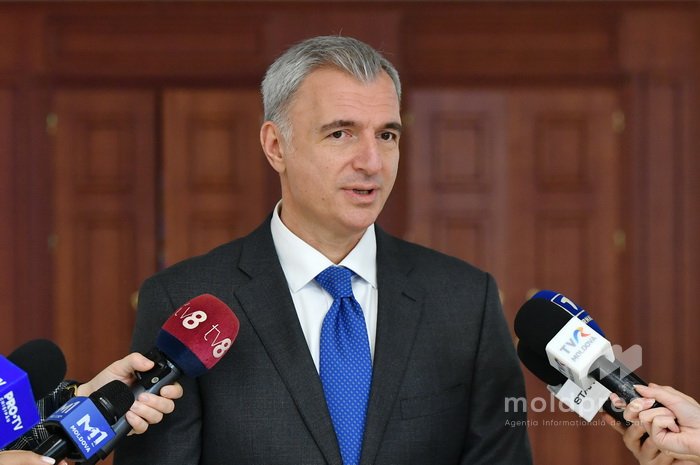
Over 2,200 enterprises of Moldova in 2024 sold their products on the European Union market, accounting for more than 70 per cent of the country’s total exporting companies. Deputy Prime Minister Economic Development and Digitization Eugeniu Osmochescu has unveiled figures to this effect in an interview given with MOLDPRES. In the interview, he referred to the decisive reorientation of Moldovan exports towards the EU market and the support provided to entrepreneurs aiming to strengthen their export capacity.
Deputy Prime Minister Eugeniu Osmochescu said that, in recent years, the exports of Moldova had undergone an essential transformation, specifically a decisive reorientation towards the European Union market. Thus, the value of goods exports increased to 3.5 billion dollars in 2024, compared to 2.3 billion dollars in 2014.
According to the official, this evolution has been accompanied by a deep structural change: while during 2001-2005, only 37.7% of Moldovan exports reached the EU market and over 54 per cent went to the Community of Independent States (CIS), in 2024, the European Union became by far the main destination, with about 68% of exports, while the CIS now represents just over 6%. Today, Moldova is clearly economically oriented towards the European market, says Eugeniu Osmochescu.
Presently, over 68 per cent of Moldova’s exports go to the European Union, and two sectors—electrical cables (automotive industry) and agri-food products—together account for almost 70 per cent of the total, according to data put out by the Ministry of Economic Development and Digitization (MDED).
“Moldovan exports are in a time of growth and opportunities, thanks to European integration and state support for companies’ adaptability to external market demands,” stated the deputy prime minister.
The economy minister emphasized that state institutions provided a complex package—financial support, technical assistance, regulation facilitation and promotion, in order to help entrepreneurs increase their export capacity.
“For local entrepreneurs, the message is the following: certification, digitization, participation in mentoring programmes, and accessing non-reimbursable funds should not be seen as additional costs, but as strategic investments that facilitate access to foreign markets and enhance competitiveness in the long term,” emphasized Eugeniu Osmochescu.
Moreover, Eugeniu Osmochescu noted that the authorities had launched more tools for the structural diversification of exports.
Among them, there is the Digitization and Innovation Programme of the small- and medium-sized enterprises (SMEs), which provides grants of up to 500,000 lei for refurbishment; the Business Internationalization Programme, through which entrepreneurs receive financing for participation in fairs, certifications and external marketing; the Development of Industrial and Regional Clusters, including in such areas as textiles, furniture, IT, electronics and construction materials, in order to connect local producers to European supply chains.
“We support companies through technological modernization programmes, training in European standards, certification facilitation, and access to financing for investments in production capacities. The local producers’ competitiveness growth programme has already generated a significant number of approved projects this year, contributing to the development of Moldovan products that meet European requirements. At the same time, we are strengthening the national quality infrastructure, in order to eliminate non-tariff barriers, extending support tools for exporters and developing economic diplomacy,” concluded Eugeniu Osmochescu.
Data by the National Statistics Bureau reveals that the exports of goods carried out in October 2025 had a value of 409.2 million dollars, increasing by 18.5 per cent compared to September 2025 and by 23.7 per cent against October 2024. The European Union stays the main destination for Moldovan products, with a share that has increased to 68.2 percent.