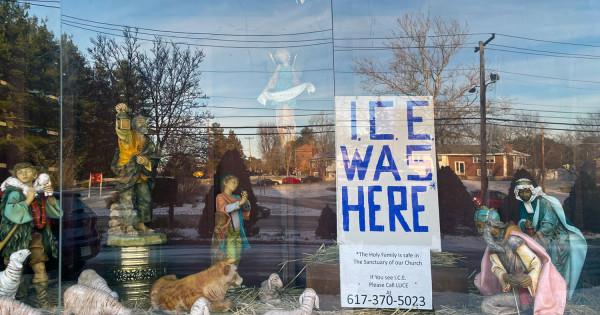
In a manger in front of Lake Street Church in Evanston, Illinois, the baby Jesus’ hands are bound with plastic zip ties. Roman centurions in sunglasses and camo jackets stand menacingly over him, while Joseph lies in the snow at their feet. The nativity scene is meant to evoke the onslaught of ICE deportations that have torn apart families and communities all over the Chicago area this year. Close to my own home, St. Susanna’s Parish in Dedham, Massachusetts, put up a nativity scene without the Holy Family at all. Where the family should be was a simple sign: ICE WAS HERE.
For Fox News host Sean Hannity, the Lake Street Church nativity scene was “horrifying” and “blasphemous.” The ICE director himself called the St. Susanna’s scene a “dangerous” incitement to violence. St. Susanna’s was even denounced by its own archdiocese, which condemned the “divisive political messaging” and pleaded for nativity scenes to be used “solely to foster faith and devotion.”
Nativity scenes tend to be anodyne kitsch. They rarely inflame any kind of passion at all, let alone fear. Back in 2023, the Evangelical Lutheran Christmas Church in Bethlehem put up a nativity scene that was also condemned as dangerous. Called “Christ in the rubble,” it displayed a plastic baby Jesus wrapped in a kaffiyeh, buried in rubble and tangled barbed wire while Mary and Joseph search for him in vain. Christianity Today called the scene “an obscenity” and The Times of Israel compared it to Nazi-era efforts to construct an “Aryan Jesus.”
All three nativity scenes were subject to backlash that described them as horrifying and violent, not because the scenes themselves threatened anyone, but because they depicted horror and violence that their detractors would rather stay hidden. The Archdiocese of Boston’s statement about St. Susanna’s is instructive: that nativity scene was “political,” which a good nativity scene should not be. A properly apolitical nativity scene, we’re led to believe, would tastefully decorate lawns and mantles, signifying nothing other than the common faith that transcends conflict over things like war and oppression and binds communities and families in a higher unity.
But what could possibly be more political than that?
The truth is that all nativity scenes are political. Putting up a nativity scene and saying, “we disagree about deportation and genocide but we will lay those disagreements aside and worship together because we are a family” is one of the most political things you can do. It is an act that marks a boundary between those whose suffering (even the mild suffering of a dinnertime argument) must be attended to, and those whose suffering (even the extreme suffering of a decapitated child) can be ignored. The anti-ICE and “Christ in the rubble” scenes are political, yes, but they are honest about it; they reveal the political fault lines that most nativity scenes try to paper over. They force us to consider that Christ might be found not where families and churches “come together” by turning away from violence as an awkward topic of conversation, but where that very violence reigns: the neighborhoods in America preyed upon by roving deportation squads, the families in Gaza in which parents mourn murdered children and children mourn murdered parents.
Christmas, more than any other holiday, reveals to us what our relationship really is to those “least of these” whom Christ warned were the only place we could find him. Who, to us, are the detainees in Alligator Alcatraz, forced to eat maggot-infested food and to unclog toilets with their bare hands? Who, to us, are the premature infants found abandoned and decomposing in their incubators in a bombed-out Gazan hospital? Do we treat them like the shepherds and wise men treated that other refugee family and that other shivering Palestinian infant? Do we bow in front of them and proclaim that in them we can glimpse the cause and principle of the universe? Or do we treat them like a depressing distraction that we should avoid thinking about so we can enjoy “what really matters?”
The anti-ICE and “Christ in the rubble” nativity scenes are not only theologically profound, they are also fully in keeping with the best Christmas traditions. In medieval England, the Christmas season was marked by putting on “Herod plays”: local productions depicting Herod the Great’s massacre of the innocents as described in the gospel of Matthew. Sort of a cross between nativity plays and community theater, the whole town would come together to act out the gospel narrative. But the historian Katharine Goodland notes that all of the surviving Herod plays deviate from the gospel text in the same way. They all contain scenes in which the mothers of the doomed children, played by women of the town, most of whom were themselves mothers, directly confront Herod and his soldiers. The mothers struggle in vain to protect their children, physically attack the soldiers, and call down divine vengeance: “Veniance I cry and call / On Herode and his knyghtys all: / Veniance, Lord, apon thaym fall.” Goodland points out that the most dramatic of these plays was performed in the garrison town of Chester, on the border of England and Wales, and that Herod’s soldiers would have been played by actual soldiers while the grieving mothers were played by women who lost their own children to war and poverty. Unlike medieval passion plays, which often reinforced fantasies of Christian unity by directing violence towards Jewish neighbors, the Herod plays were about naming the fissures that such fantasies repress. On stage, the women could tell the soldiers to their faces the truth in all its horror.
In medieval English towns like Chester, to celebrate Christmas faithfully was to unveil the violence lurking beneath the everyday. All year long, families were torn apart, children were left parentless, and parents were left childless by the violence of occupying soldiers and the predations of the rich. But at Christmastime, the Herod plays gave women a space to tell the truth about their world. “My chyld is dead; now I see / my sorrowe may not cease. / Thou shall be hanged on a tree / and all thy felowes with thee. / All the men in this contree / shall not make thy peace.” In this tradition, older than the Christmas tree, older than most carols, Christmas was a time for naming in detail that goodwill is lacking and there is no peace.
Nativity scenes today that depict the herding of immigrants into concentration camps or the genocide of the Palestinians are carrying forward this venerable Christmas tradition. They remind us, in what is supposed to be a season of hope, of the only shred of hope it is still decent to hold: none of this violence is necessary. It can stop, if those committing it would stop. Will they? And who will make them?