Facebook
Twitter
LinkedIn
Pinterest
Reddit
Email
Print
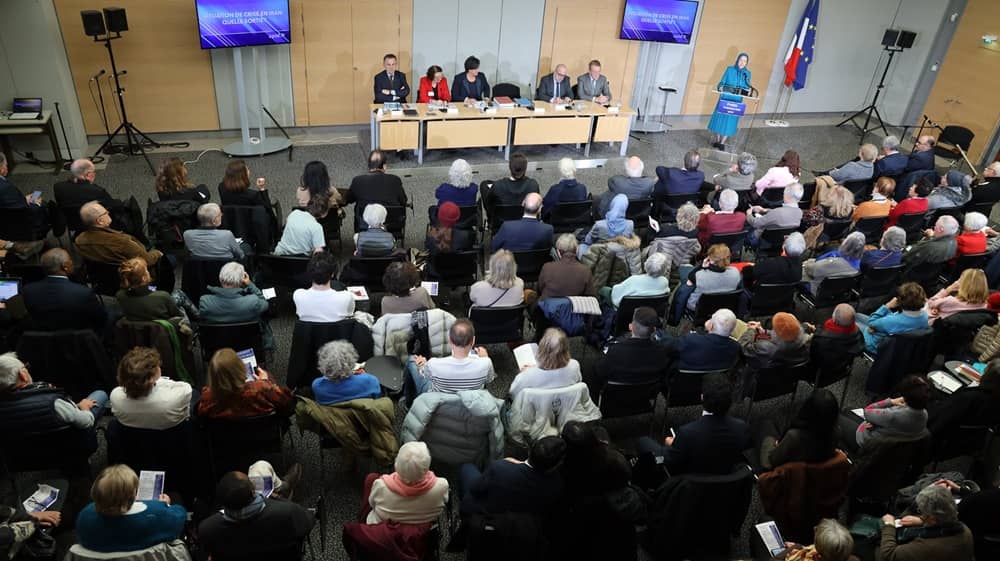 NCRI President-elect Maryam Rajavi addresses a conference at the French parliament on December 15, 2025
On Monday, December 15, 2025, the French National Assembly served as the venue for a pivotal conference aimed at addressing the escalating crisis in Iran and identifying a viable path toward a democratic future. Organized by the Parliamentary Committee for a Democratic Iran (CPID), the event, titled “The Current Crisis in Iran: The Possible Way Out,” brought together a diverse coalition of French parliamentarians from various political backgrounds, legal experts, human rights advocates, and distinguished former officials.
Presided over by MP Christine Arrighi, President of the CPID, the conference underscored the urgency of the situation in Iran, marked by an unprecedented surge in state-sponsored executions and internal repression. The gathering featured Mrs. Maryam Rajavi, President-elect of the National Council of Resistance of Iran (NCRI), as the keynote speaker. She was joined by a roster of prominent figures who convened to analyze the theocratic regime’s growing fragility and to voice support for an organized alternative.
The central theme of the conference revolved around the “Third Option”—a strategic approach rejecting both external military intervention and the failed policy of appeasement. Instead, the speakers advocated for a solution driven by the Iranian people and their organized Resistance Units. The discussions highlighted the regime’s rampant human rights abuses, specifically the targeting of women and political dissidents, and firmly rejected any return to the monarchical dictatorship of the past, aligning instead with the NCRI’s Ten-Point Plan for a secular, democratic, and non-nuclear republic.
Conference at France’s National Assembly: Condemning the ongoing human rights violations in Iran, calling for a firm policy toward the regime, and supporting the Iranian people and their Resistance in their quest for a democratic, secular, and free republic. Mrs. @Maryam_Rajavi… pic.twitter.com/IconcCzH6c
— SIMAY AZADI TV (@en_simayazadi) December 18, 2025
Delivering the keynote address, Mrs. Maryam Rajavi, President-elect of the National Council of Resistance of Iran (NCRI), provided a stark assessment of the internal situation in Iran, categorizing the regime’s current behavior as a desperate reaction to its impending collapse. She began by highlighting the horrific surge in capital punishment, noting that according to reports by the Iranian Resistance, over 2,000 individuals had been executed in Iran in 2025 alone. She emphasized that while not all charges were explicitly political, the machinery of death served a singular political purpose: to manufacture an atmosphere of terror capable of stifling a looming popular uprising.
Mrs. Rajavi pointed to the grim statistics of November 2025, during which the regime hanged 335 people—a record-breaking figure. She drew particular attention to the targeting of supporters of the People’s Mojahedin Organization of Iran (PMOI/MEK), noting that 18 political prisoners currently face death sentences for their affiliation with the Resistance. Despite this brutality, she argued that the strategy was failing. Rather than succumbing to fear, the Iranian population, inspired by the resilience of Ashraf-3 and the “No to Execution Tuesdays” campaign in prisons, has intensified its defiance. She cited the regime’s own admission regarding the expansion of Resistance Units in Tehran and other cities as proof of the movement’s growing strength.
Central to her address was the articulation of the “Third Option.” Mrs. Rajavi argued that the binary choice often presented to the West—war or appeasement—is a false dichotomy. She posited that the only viable path to ending the nuclear threat and regional instability is regime change enacted by the Iranian people themselves. She criticized Western governments for prioritizing commercial interests and succumbing to the regime’s hostage-taking diplomacy, urging them to instead trigger the “snapback” mechanism for UN sanctions.
Conference at the French National Assembly-
Western countries turn a blind eye to the executions, repression, and terrorism carried out by the regime. However, after the activation of the snapback mechanism and the reinstatement of the new UN Security Council sanctions, Western… pic.twitter.com/HrYiy7z7YO
— Maryam Rajavi (@Maryam_Rajavi) December 16, 2025
In her closing remarks, Mrs. Rajavi reaffirmed the NCRI’s commitment to a pluralistic future, stating: “The twelve-day war last June demonstrated the legitimacy of the ‘Third Solution’ proposed by this Resistance. This solution is neither foreign war nor appeasement, but regime change achieved by the Iranian people and their organized Resistance.”
She also addressed the historical context of Iranian governance, clarifying the people’s desire for a complete break from autocracy: “Today, the Iranian people reject all forms of dictatorship and declare: neither the Shah nor the cleric. The Iranian Resistance calls for the establishment of a democratic, pluralistic, non‑nuclear republic based on the separation of religion and state.”
Opening the session, Christine Arrighi, MP and President of the CPID, outlined the foundational principles of the committee she leads. She emphasized that the CPID has, for 16 years, stood on the side of those aspiring for a free, egalitarian, and democratic future. Arrighi was emphatic in her rejection of all forms of dictatorship, specifying that the Iranian people have moved past both the current theocracy and the monarchical system that preceded it.
She provided a harrowing update on the human rights situation, noting that since the beginning of January 2025, 1,950 people have been executed in Iran, a figure she described as unseen in thirty-seven years. She highlighted the tragic case of Zahra Tabari, a 67-year-old electrical engineer sentenced to death merely for supporting the PMOI and possessing a cloth with the slogan “Woman, Resistance, Freedom.” For Arrighi, such cases elevate the Iranian struggle beyond politics to a “human and moral requirement.”
Arrighi called upon her colleagues to support the “Third Option” advocated by Mrs. Rajavi—change from within. She noted that the current dictatorship has never been more fragile, conferring a greater responsibility upon French lawmakers to act. She concluded by posing a critical question to the assembly: how can France more effectively support the credible alternative embodied by the NCRI to ensure regional and global stability?
Lors d’un colloque au Parlement français @hsaulignac député de l’Ardéche a declaré:
En s’appuyant sur le rôle central de la résistance iranienne et sur des orientations politiques claires, notre comité, madame la présidente, a su adopter une position constante, fidèle aux valeurs… pic.twitter.com/d8CGQvPYYk
— Ali Momen (@AliMomen_) December 16, 2025
Hervé Saulignac, Vice-President of the CPID, spoke to the continuity and moral obligation of parliamentary support for the Iranian Resistance. Reflecting on his eight years with the committee, he described the cross-party mobilization as a duty inherent to the values of the French Republic—Liberty, Equality, and Fraternity. He noted that this support has remained consistent regardless of the shifting policies of successive French governments, often prevailing against adversity and intimidation.
Saulignac analyzed the regime’s recent behavior through the lens of its vulnerability. He argued that the unprecedented wave of executions was not a projection of strength but a symptom of fear. He pointed out that this figure was double that of the previous November and eleven times higher than in 2021. This escalation, he asserted, proves that the mullahs are haunted by the prospect of a popular uprising fueled by an exasperated society.
He urged Western governments to stop ignoring the reality of a regime that enriches uranium while massacring its citizens. Saulignac championed the Resistance Units as the vanguard of the coming change, stating:
“This figure of 335 executions, a terrifying number, illustrates a simple truth: the regime’s killing machine is correlated with the fear of its fall.”
Lors d’un colloque au Parlement français @AttiasDominique Présidente du Conseil d’administration de la Fondation des Avocats Européens, ancien vice-bâtonnière du barreau de Paris a declaré que :
Au-delà de son idéologie archaïque, le régime iraniens a pris conscience du fait que… pic.twitter.com/NX2LBdhUKd
— Ali Momen (@AliMomen_) December 16, 2025
Dominique Attias, former President of the Council of Bars and Law Societies of Europe, focused her intervention on the pivotal role of women in the struggle against the theocracy. She praised the NCRI’s Ten-Point Plan for its commitment to total gender equality and the separation of religion and state—values she noted are violently trampled by the mullahs. Attias shared insights from her visits to Ashraf-3 in Albania, where she met with women who have dedicated decades to the resistance, describing them as the force that terrifies the misogynistic regime.
Attias detailed the systematic violence directed at women, identifying Iran as the world’s top executioner of women. She cited that 60 women had been executed since the start of 2025. She brought the room’s attention to individual victims of this “medieval archaism,” such as Somayeh Rashidi, who died in Qarchak prison due to denial of medical care after shouting slogans against Khamenei, and Rana Faraj Oghli, a victim of domestic violence and forced marriage who was hanged in December.
She argued that the slogan “Woman, Resistance, Freedom” has become the central watchword for the regime’s downfall because women are leading the Resistance Units. Addressing the parliamentarians, she concluded:
“In Iran, violence against women is neither accidental nor marginal. It is systemic, institutionalized, and ideologically claimed by the regime.”
Lors d’un colloque au Parlement français, @patrickhetzel Ancien Ministre de l’Enseignement supérieur, de la Recherche et de l’Espace de France a déclaré.
le mois dernier, le gouvernement australien a également inscrit le corps des gardiens de la révolution islamique sur sa liste… pic.twitter.com/5BYCBwI9gM
— Ali Momen (@AliMomen_) December 16, 2025
Gilbert Mitterrand, President of the France Libertés – Danielle Mitterrand Foundation, invoked the memory of his mother, Danielle Mitterrand, and her deep bond with Maryam Rajavi, describing them as “sisters of resistance.” He framed the support for the NCRI not merely as political solidarity but as a demand for the right to truth and justice, particularly regarding the 1988 massacre and the 44 years of mass killings perpetrated by the regime.
Mitterrand challenged the narrative often pushed by the regime’s lobbyists that there is no viable alternative to the mullahs. He declared that the NCRI represents the most structured opposition in the world. He criticized the “diplomacy of impunity” that allows Iranian officials to escape accountability for their crimes while conducting trade with the West.
He also warned against the trap of creating false equivalencies or succumbing to smear campaigns against the Resistance, noting that past raids and accusations against the movement were often timed to coincide with commercial negotiations with Tehran. He urged full support for the Ten-Point Plan, stating:
“How can anyone say there is no opposition? There is one, it is right before your eyes; it is the most structured opposition in the entire world.”
Lors d’un colloque au Parlement français, @patrickhetzel Ancien Ministre de l’Enseignement supérieur, de la Recherche et de l’Espace de France a déclaré.
le mois dernier, le gouvernement australien a également inscrit le corps des gardiens de la révolution islamique sur sa liste… pic.twitter.com/5BYCBwI9gM
— Ali Momen (@AliMomen_) December 16, 2025
Jean-François Legaret, President of the Foundation for Middle East Studies (FEMO) and former Mayor of Paris’s 1st arrondissement, highlighted the grassroots support for the Iranian Resistance among French local officials. He presented a booklet containing the signatures of 1,500 mayors from across France—symbolically representing one mayor for each prisoner currently on hunger strike in Iran—who have formally condemned the regime’s human rights violations.
Legaret focused on the external aggression of the Iranian regime, citing a recent article in Die Welt that exposed the methods used by the IRGC to intimidate and spy on Iranian dissidents in Europe. He criticized European governments for their “indigence and indulgence” toward Tehran, arguing that a “lead weight” of silence has allowed the regime’s agents to operate freely on European soil.
He strongly condemned the strategy of “hostage diplomacy” used by Tehran to blackmail Western nations. Legaret called for the European Union to follow the example of Canada and the United States by designating the IRGC as a terrorist organization. He concluded by emphasizing the moral clarity of the CPID’s stance:
“The survival of the Iranian regime relies on this horrific ‘hostage diplomacy,’ coupled with an overt strategy of political blackmail to which too many governments have succumbed.”
Conference at the French National Assembly – December 2025@Maryam_Rajavi: Under the mullahs’ rule in #Iran, the crises have reached the point of no return#NoImpunity4Mullahshttps://t.co/V3qMG77GHf
— Iran Freedom (@4FreedominIran) December 16, 2025
Jean-Pierre Brard, a former MP and one of the founders of the CPID, delivered a speech rich in historical analogies. He compared the current situation to the French Resistance during World War II, noting that contemporary powers often look for pliable alternatives rather than genuine resistance movements. He stressed that De Gaulle succeeded because he had a concrete, credible structure—the National Council of the Resistance—just as the Iranian people today have the NCRI and the Ten-Point Plan.
Brard was scathing in his criticism of “intermittent humanists” and self-proclaimed experts who appear on television to discuss Iran without genuine knowledge or service to the cause. He warned of the regime’s reach, citing the assassination attempt on former European Parliament VP Alejo Vidal-Quadras in Madrid as proof that the mullahs are willing to use mafia proxies to target their enemies in the West.
He strongly rejected the notion of a return to monarchy, referring to the son of the Shah as a “kitten” compared to the “tiger” of the revolution, and dismissed those who prepare for a post-regime future based on personal interests or oil wealth rather than sacrifice. He urged the audience to look at the “record of service” of any proposed alternative:
“When you want to reach for the stars, you always jump higher than the others. We must keep that in mind, and it is this hope that makes us invincible.”
Patrick Hetzel, an MP from the Republican Party, placed his support for the Resistance in the lineage of his predecessors from the Alsace region, Adrien Zeller and Émile Blessig. He recalled the pivotal moment in 2008 when French parliamentarians first rallied behind Maryam Rajavi’s Ten-Point Plan, recognizing the legitimacy of the “third way” that eschews both foreign intervention and complacency.
Hetzel broadened the scope of the discussion to the regime’s destabilizing activities abroad. He detailed recent diplomatic incidents, including the Netherlands summoning the Iranian ambassador over interference, the arrest of an individual in London suspected of plotting violent action for the regime, and Australia’s listing of the IRGC as a terrorist entity.
He argued that these events prove the regime is not only a danger to its own citizens but a direct threat to European security and democratic allies. He called for increased vigilance against the regime’s demonization campaigns targeting the Resistance and urged his colleagues to sign the new declaration of support for a democratic Iran.
“These examples clearly demonstrate that the Iranian regime does not limit itself to repressing its own people,” he said. “It also threatens the security and [the stability] of European countries and allied democracies through its malicious activities and interference.”
The conference also provided a platform for Iranian activists and experts who illuminated the cultural and legal dimensions of the struggle against the mullahs. Their testimonies underscored how the regime targets not just political opposition, but the very cultural identity and legal standing of the Resistance.
Hamid-Reza Taherzadeh, a renowned musician and member of the NCRI, spoke movingly about the regime’s war on Iranian culture. Describing the mullahs as enemies of “music, art, life, and love,” he recounted the tragic history of his own family. His brother, a musician who composed for the legendary singer Marzieh, was repeatedly arrested and eventually died under torture at the age of 49. Taherzadeh explained that his presence was an effort to carry the voice of those silenced by the regime. He dedicated his musical performance to the political prisoners and women of Iran, framing art as a vital instrument of resistance that “speaks when words fail.” He thanked the committee for integrating culture into the political discourse, asserting that the Resistance has opened a horizon for artists to elevate their craft in the service of freedom.
Sarah Nouri, a lawyer and legal expert, provided a forensic analysis of the regime’s so-called “Trial of the 104″—an ongoing in-absentia prosecution of PMOI members initiated in Tehran in 2023. Nouri dismissed the proceedings as a “judicial sham” and a political operation designed not to establish facts but to impose a narrative of “terrorism” and “cultism.” She argued that the trial has three objectives: to intimidate Iranian youth by threatening death for supporting the Resistance; to terrorize the diaspora into silence; and to blackmail European hosts into restricting opposition activities.
Nouri also exposed the regime’s sophisticated disinformation machinery. She pointed to a recent technical glitch on the X platform (formerly Twitter) which revealed that numerous accounts posing as independent critics, monarchists, or dissidents based abroad were actually operating from within Iran. This, she argued, proved the existence of a coordinated “cyber-army” tasked with manufacturing fake opposition and demonizing the NCRI. She concluded that the regime’s obsession with the PMOI and the “Trial of the 104” is a paradoxical admission of weakness—proof that the mullahs view the organized Resistance as the only credible threat to their survival.
The conference at the French National Assembly concluded with a unified message: the crisis in Iran has reached a point of no return. The speakers, representing a broad spectrum of French political life, concurred that the unprecedented wave of executions is a symptom of a regime in its death throes, terrified of a population that has rejected both theocratic and monarchical dictatorship.
By endorsing the “Third Option,” the participants made clear that the solution lies neither in foreign war nor in continued appeasement, but in recognizing and supporting the Iranian people and their organized Resistance. The event served as a clarion call for Western governments to proscribe the IRGC, hold the regime accountable for its crimes against humanity, and stand firmly with the NCRI’s vision for a free, democratic, and secular republic. As the regime’s fragility grows, the consensus in Paris was that the international community faces a moral and strategic imperative to support the only viable alternative capable of bringing peace and democracy to Iran.