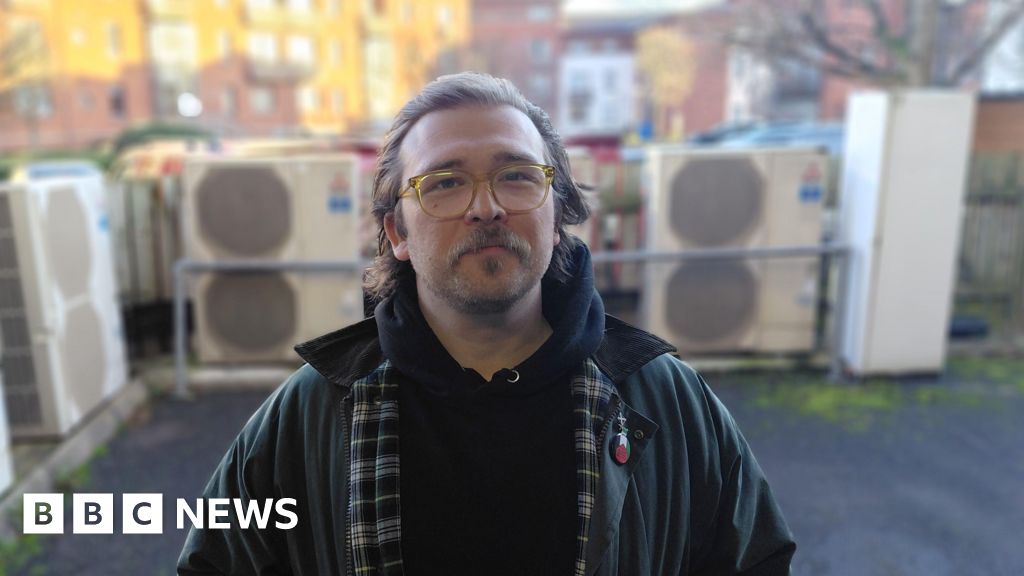
Adam MandevilleBBC News NI

 JR McCormick
JR McCormick is co-creator of The Bad Articles
Artists in Northern Ireland have told BBC News NI that the lack of funding for audio dramas is an obstacle for working-class creatives’
Currently, the Arts Council of Northern Ireland (ACNI) does not fund audio dramas in Northern Ireland.
Actress and comedian Amelia Price said such funding would mean the medium becomes “more accessible”.
A spokesperson for the ACNI said they offer a “broad range of fair, competitive funding schemes open to all eligible organisations and individuals across Northern Ireland”.
Audio dramas, which are dramatised performances that are exclusively acoustic, have existed for about a century.
While the industry seems to be on the rise, artists in Northern Ireland have said they struggle to obtain funding for their work.
Amelia Price, a cast members of the audio drama Back to Dunbracken, said their rising popularity has “democratised” art in Northern Ireland.
“People can buy audio equipment and make their own product,” she said.
Price said that the low entry costs mean it is an easier industry to break into for working-class artists.
But she would like to see the industry more funding from arts bodies.
‘Little understanding of audio dramas’
Max Blair, showrunner of Last Dance which he describes as “like Game of Thrones for your ears” agrees that audio dramas give another route for working-class artists to join the industry.
He said that, as someone from a working-class background that accessibility can be a challenge, but believes funding audio dramas is the best way to showcase talent.
“As far as I’m aware, Northern Ireland is the only Arts Council [in the UK] that will not fund audio drama,” he said.
Blair applied for funding for Last Dance, which was nominated for a British Podcast Award, from the ACNI in 2025, but was unsuccessful.
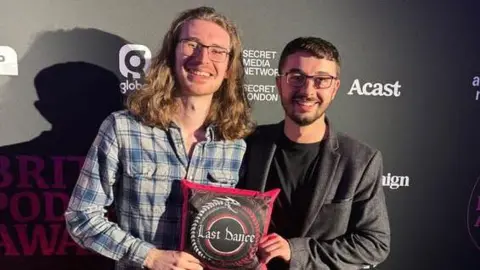 Max Blair
Max and Mark are the creators of Last Dance
Max’s colleague, Mark McKibbon is in charge of the technical aspects of Last Dance emerging talent.
“A lot of the time, emerging creatives are limited to 20 minutes – audio drama has the potential to fill gaps that no other medium really can at the minute,” he said.
McKibbon believes that the lack of funding may be down to “very little understanding of what audio dramas are”.
In a statement, the ACNI said they had “received a few queries in the past year relating to audio drama but neither of those queries coincided with the submission of a funding application”.
No ‘bag full of cash’
JR McCormick, co-creator of the audio drama The Bad Articles, said he was inspired to make the show by a love of Ireland’s “local beasties”.
It is an improvised comedy show set in the 90s, in which “a supernatural agency deals with otherworldly things” in Ireland.
He said the team “never had the audacity to reach out to a funding body because we knew they wouldn’t give it to us”.
“There really isn’t anyone else standing there with a bag full of cash for you, unless you’re the Archers – or Joe Rogan,” he said.
McCormick said that the lack of funding available for audio dramas is “wild”.
He said funding could be used for promotion which “could then find a route to monetisation” and ultimately being able to pay the cast.
Co-creator Aidan Kelly feels there is “no real justification” for the lack of funding from public bodies.
He said that other funding options can require additional commitments from creators beyond the product.
 JR McCormick
Conleth McVeigh thinks audio dramas are a great entry point
Conleth McVeigh, creator of Back to Dunbracken, said his show is a comedy set in a small fictional Irish town.
“Audio drama is maybe the easiest entryway point into producing something,” he said.
“The entry point is definitely low compared to everything else.”
McVeigh said funding would be helpful due to the costs involved with making audio dramas but feels it is “pointless” to apply for funding.
“Any funding is hard in Northern Ireland, but it’s also the fact that we’re in a niche that isn’t well known.”
He claimed that the ACNI “don’t care about comedy” and “don’t really understand audio drama”.
McVeigh said that, when he applied for funding for a previous audio drama, he felt that the ACNI did not understand what he “needed a budget for”.
The Arts Council of Northern Ireland said comedy receives support through a “broad range of venues and festivals”.
“In addition, we fund comedians who work in theatre, and actors and companies whose work contains elements of stand-up or sketch comedy.”
The statement added: “The Arts Council is concerned with work of predominately artistic intention, and while each application will be assessed on its merit we recognise that much comedy is commercially viable and self-sustaining.”
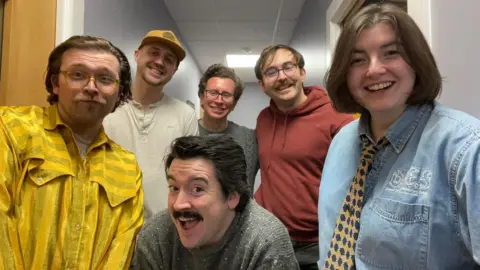 JR McCormick
The cast and crew of the Bad Articles audio drama
‘Rapidly diminishing pots of money’
Phil Ramsey, a lecturer in the School of Communication and Media at Ulster University, said arts councils across the UK and Ireland have “relatively small pots of money” and lots of demand.
“In Northern Ireland, we don’t have enough funding going into these sectors as it is,” he said.
“We have rapidly diminishing pots of money.”
He added that there are organisations in Northern Ireland, such as the BBC and NI Screen, who already fund audio dramas, and therefore there is an argument that the Arts Council should focus on sectors who don’t have access to other sources of money.
However, he also admitted that there is “merit in funding” audio drama.
“There’s a beauty in audio drama in that it can be done with much lower entry costs,” he said.
He added that this is an advantage of audio dramas as “across the UK, there has been a lot of concern about how people from working-class background are being priced out of the arts”.
“We need all voices represented,” he added.
In a statement, the Arts Council of Northern Ireland (ACNI) said several targeted programmes are place that support artists and organisations across artforms.
“Writing audio dramas may be eligible for funding support and this would be assessed for eligibility against funding programme guidance notes.
“However, ACNI does not fund or co-fund radio drama broadcasting or assist the writing of radio dramas, there are other funding sources for such assistance.”