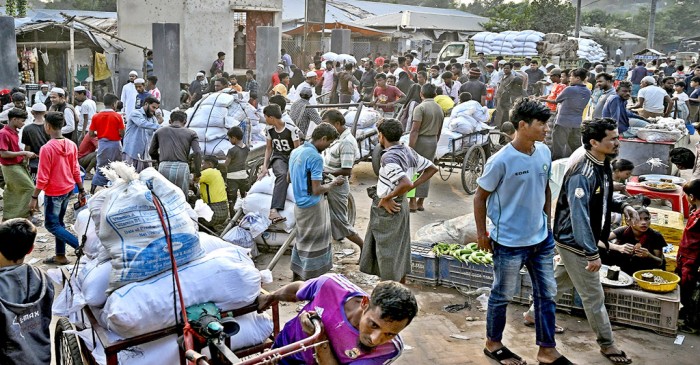
Rohingya refugees gather in front of a relief distribution point at the Balukhali refugee camp of Ukhia in Cox’s Bazar on December 17. | Agence France-Presse/Munir uz Zaman
The international law protects the right to an education, but for the Rohingyas, this right is mostly a theory. There is an enormous impact between the law in theory and the law in practice when it comes to refugee education, writes Samanta Azrin Prapty
THE rights of refugees have gone beyond national borders and become a significant issue in discussions about rights around the world. The situation of the Rohingyas in Bangladesh is an essential example of how sovereignty, international law and human rights may work together, especially when it pertains to education. Bangladesh has taken in more than a million Rohingyas who were escaping violence in Myanmar, but the laws that govern their access to schooling are still quite tricky.
Many international legal documents recognise education as a human right, but it is, nevertheless, hard to apply to refugees, especially those who have been forced to leave their homes. For those who have been forced to leave their homes, like the Rohingyas, education is more than just a fundamental right. It is also a necessary tool for survival and future stability. The Universal Declaration of Human Rights and the International Covenant on Economic, Social and Cultural Rights additionally stipulate that people ought not be discriminated against in education. This constitutes a very important principle that should protect everyone’s right to education, irrespective of their status. Bangladesh’s legal strategy for refugee education fails to satisfy these international standards when it comes to the Rohingyas.
Bangladesh’s international commitments within these frameworks, theoretically explicit though, have not resulted in effective policy execution. International law guarantees everyone the right to education, but this is growing harder to do in practice, especially when displacements are considered through the prism of security and sovereignty issues instead of rights and humanitarian standards. The Rohingya refugees are not only denied their fundamental rights under the international law, but they are additionally unable to get a good education. Their status as legal entities as refugees deprived of a national or acknowledged legal personality renders it substantially more difficult for these individuals to acquire an education.
The international rights legislation cares a lot for education precisely because it is the basis for many other rights such as the ability to work, get involved in life in society and make one’s own decisions. Article 26 of the Universal Declaration of Human Rights and Article 13 of the International Covenant on Economic, Social and Cultural Rights protect the right to education. This shows how important education is for achieving equality and individual freedom. This is especially true for the Rohingyas, who have not only been denied access to education because they are not legally recognised and the political climate in Bangladesh is hostile, but they have also had to deal with an education system that is ad hoc and heavily reliant on the charity of humanitarian groups.
Not letting displaced people go to school is not only an issue of keeping them out of school systems. It is also a matter of taking away an entire generation’s ability to overcome the structural impediments that keep them displaced. The lack of an education policy for refugees in Bangladesh indicates a more general failure to acknowledge the educational rights of underprivileged groups within a legal framework. The international law asserts that the right to education is essential for other rights to be realised. The reality that Bangladesh is unable to guarantee the rights of the Rohingyas shows that its refugee protection plan is not functioning correctly.
The international human rights law makes it evident that every person, including refugees, has the right to education. The Universal Declaration of Human Rights, according to Article 26, states that everyone has the right to education. The International Covenant on Economic, Social and Cultural Rights, which Bangladesh is a state party to, expands even further by claiming that states will ‘have to take measures to achieve the full realisation of this right.’ The 1951 Refugee Convention provides refugees with certain privileges, such as the right to education under Article 22. This means that refugees should have the same educational rights as those from the host country. But the problem comes when these theoretical legal duties run against the political and administrative realities of Bangladesh. The international law provides us with a complete set of rules, but there are significant gaps in how these rules are followed.
Bangladesh has signed critical international agreements, including the Refugee Convention and the International Covenant on Economic, Social and Cultural Rights. However, there is still a big problem with the gap between these international commitments and how they are carried out in Bangladesh. The Bangladesh constitution is silent about the educational rights of refugees and there is no national law that explicitly addresses the academic needs of people who have been forced to leave their homes. This means that there is no clear and enforceable domestic legal framework that guarantees the right to education for Rohingya refugees although Bangladesh is required to do so by the international law.
In practice, this means that there are no official legal barriers stopping refugees from getting an education. However, because there is no structured and formalised policy, refugees have to depend on the sporadic and often inadequate educational programs offered by humanitarian organisations. Without official funding, educational programs for the Rohingya are not well-organised or planned. The legislation does not protect the rights of the Rohingya refugees to an education because there isn’t a legal framework in place for refugee education.
Another thing to think about is whether or not international responsibilities for refugee education can be enforced. Bangladesh has to give refugees an education according to the international law, but there are no legal ways for refugees to keep the government accountable. Because there are no enforceable regulations and official agencies have a lot of freedom, the Rohingya typically have no way to fight the lack of education in court. Justiciability is an integral part of every legal duty. Refugees cannot go to court to get their right to an education enforced, thus, they cannot get justice for the violation of their rights. Because the government has the power to make decisions and there are no precise legal requirements, refugee education is more a matter of political will than a protected right. Humanitarian groups and non-governmental organisations have tried to fill this discrepancy, but their attempts are sometimes not enough and are not consistent. They do not provide the full support that the Rohingya need to have long-term educational possibilities.
International organisations and actors still have a big say in how education for refugees in Bangladesh is run. Although it has made promises to the world, the Bangladeshi government has not taken the complete responsibility for educating refugees. This setup lets international groups like the Office of the UN High Commissioner for Refugees and various non-governmental organisations offer educational services, but it does hot have any formal legal authority or responsibility. Bangladesh does not have a clear set of laws concerning refugee education; hence, the legal jurisdiction over it is scattered and vague. This makes the Rohingya refugees even more vulnerable because they are at the mercy of foreign organisations instead of getting the full legal safeguards that the host state should give them. The state and foreign organisations should work together to run refugee education, but without legislative accountability tools, this balance is off, and the refugees’ rights are still not fully protected.
The Rohingyas are unable to attend school as they do not possess a legal personality. Refugees who do not have legal status are generally not allowed to use public services such as schooling. Issues with nationality, statelessness and registration make it so that many refugees are unable to obtain the documents they need to go to school. Refugees in Bangladesh have a hard time getting to school because of the logistical obstacles they face in getting the proper paperwork or legal status. This is especially bad for the Rohingyas, who are not acknowledged as legal residents and are therefore not allowed to go to school or get any other kind of official education.
Bangladesh’s treatment of the Rohingyas refugees in schooling demonstrates how challenging it has been to apply international human rights standards to domestic policy. The international law protects the right to an education, but for the Rohingyas, this right is mostly just a theory. There is an enormous impact between the law in theory and the law in practice when it comes to refugee education. For example, there are gaps in domestic legal frameworks, international responsibilities that cannot be enforced and a lack of legal accountability for both state and non-state actors. As Bangladesh keeps accommodating the Rohingyas, the authorities should bolster their legal framework, ensure that international obligations are part of domestic law and take responsibility for the educational attainment of refugees. This will make sure that their right to education is acknowledged in both law and practice.
Samanta Azrin Prapty is a researcher and writer.