Radiant’s Spectacular Day; Nuclear Startup Raises Over $300 Million
Last Energy Lands $100 Million Series C
Samsung’s Novel Concept for a Floating SMR Design Certified by ABS
Swedish Nuclear Startup Blykalla Raises $50 Million for SMR Work
ARC Clean Technology Announces Closing of Series B Financing
China’s Linglong-1 is First Land-Based SMR To Begin Operation
Risch Bill to Boost U.S. Nuclear Energy Competitiveness Signed into Law
EDF Cost Estimate For Six New-Generation EPR2 Nuclear Plants is $86 Billion
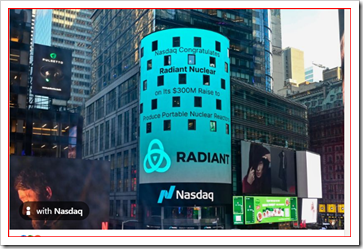
Radiant’s Spectacular Day; Raises Over $300 Million
 Radiant Nuclear, a developer of portable, mass-produced nuclear microreactors, announced that it has raised more than $300 million in a new round of funding.
This latest capital raise, coming just six months since closing its $165 millipn Series C earlier this year, Put together in just a few weeks, the new funding will support the scaling of commercialization efforts as Radiant prepares to break ground early next year on its recently announced R-50 factory in Oak Ridge, TN.
This new round, led by Draper Associates and Boost VC, also includes additional financial commitments from current investors, reinforcing their continued confidence in Radiant’s positioning in the microreactor space. As part of this latest capital raise, Radiant also received additional investment from Founders Fund, ARK Venture Fund, Chevron Technology Ventures, and others. Radiant Nuclear is privately held.
Doug Bernauer, CEO and Founder of Radiant, said, “This funding enables us to build our factory and keep to our DOME schedule, where we will achieve self-sustained chain reaction on a reactor designed by, built by, fueled by, and operated by Radiant alongside our partners at the Idaho National Lab.�
Radiant said it is on track for next year’s startup of its first reactor – the Kaleidos Demonstration Unit (KDU), at Idaho National Laboratory’s Demonstration of Microreactor Experiments (DOME) facility.
Radiant’s factory-built, transportable nuclear generators are designed to provide always-on power for defense, disaster response, remote industry, and critical infrastructure- applications where traditional energy systems fall short.
The company says it expects to deliver its microreactor for customers in 2028. The firm has a contract with the US Air Force. In August 2025 it signed an agreement with the Defense Innovation Unit (DIU) and the Department of the Air Force, under the Advanced Nuclear Power for Installations (ANPI) program.
In a November 20, 2025, report the stock analysts at the Motley Fuel wrote, “As a privately held company, Radiant isn’t subject to the same financial reporting requirements as publicly held companies. Consequently, investors don’t have much insight into the company’s financial position. If the company proceeds with an IPO, it will have to file Form S-1 with the U.S. Securities and Exchange Commission (SEC), at which point investors will have a better sense of where the company stands financially.�
In terms of customers for the Radiant microreactor, the firm has a deal for 20 Kaleidos microreactors with Equinix. Radiant signed a deal, with deposits, with a leader in digital infrastructure to purchase 20 reactors.
Recent Milestones
Strengthened leadership through key hires: Radiant has brought on board some of the best and brightest from inside and outside the nuclear industry, including: Dr. Rita Baranwal, the former Assistant Secretary for Nuclear Energy, as Chief Nuclear Officer; Dr. Mike Starrett, as Chief Revenue Officer; and almost a dozen VP and Director hires across engineering, manufacturing, and supply chain organizations.
Selected by the U.S. Department of Energy to test at INL: Radiant was selected to conduct the first test of its Kaleidos microreactor, with testing scheduled to begin in Summer of 2026 – making it the first new U.S. reactor design to be tested at INL’s new DOME facility.
Radiant has made steady progress on the regulatory front to stay on track for this summer’s first test at INL. Quick progress on the regulatory front includes:
Submission and approval of its Nuclear Safety Design Agreement (NSDA)
Acceptance for review of its DOE Authorization Request for Kaleidos (DARK) to meet the intent of the Preliminary Documented Safety Analysis (PDSA),
Selection for New Reactor Pilot Program: Radiant was selected to join the President’s Nuclear Reactor Pilot Program, with the goal of being one of the first to utilize the Department of Energy’s streamlined approval process for deployment of new reactors.
First company to sign a contract with DOE for HALEU fuel: Radiant became the first reactor company to sign a contract with the U.S. DOE for High-Assay Low-Enriched Uranium (HALEU) fuel for next year’s test at INL.
First binding commercial contract for HALEU enrichment: Radiant signed a deal – the first binding commercial contract by a U.S. advanced reactor developer for Western commercial HALEU enrichment services – with Urenco
Radiant factory announced in Tennessee: Radiant announced that they will be building the world’s first factory to mass-produce portable nuclear reactors in a spot where the nuclear industry began: Oak Ridge, TN. The factory, called R-50, is a nod to the historical name of the site and the ambitious mission for it to scale production to 50 reactors per year within a few years of the beginning of production in 2028.
Previously, the company had plans to build a separate reactor fuel station in a remote area north of Casper, WY. The firm cancelled that project due to opposition from the Wyoming State Legislature over fears related to bringing spent nuclear fuel to that facility.
First reactor assembly begins with delivery of the pressure vessel and the first order of nuclear-grade, American-made graphite extruded in over a decade, Radiant began assembly on its first nuclear reactor ahead of startup next summer at INL’s DOME facility.
& & &
Last Energy Lands $100 Million Series C
Financing Round Secures Capital For Pilot Reactor And Positions Company For First DeploymentÂ
Last Energy, a nuclear reactor technology company, announced it has closed an oversubscribed Series C of more than $100 million led by the Astera Institute, with participation from JAM Fund, Gigafund, The Haskell Company, AE Ventures, Ultranative, Galaxy Interactive, and Woori Technology Co., Ltd., among others.
“We believe this financing will fully capitalize us through our DOE pilot project and position us to transition into commercialization of our production power plants,� said Bret Kugelmass, Founder and CEO of Last Energy.
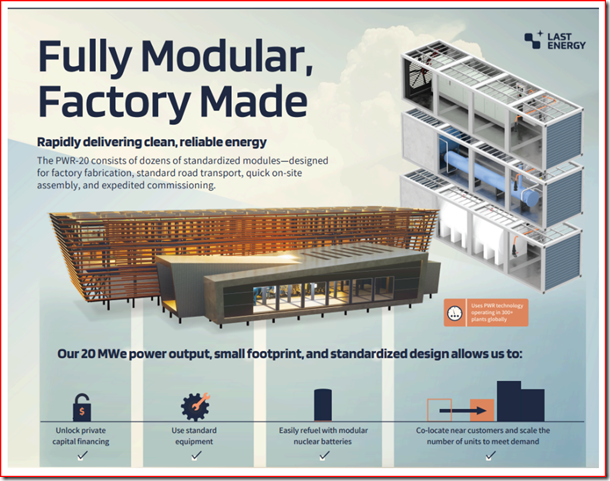
Following this round, Last Energy is focusing on completing its PWR-5 pilot reactor, further developing its PWR-20 commercialization, and strengthening its footprint in Texas through expanded investment in manufacturing capabilities and engagement with partners.
In August 2025, the company was selected for the U.S. Department of Energy’s (DOE) Reactor Pilot Program and, leveraging a previously procured full core load of fuel, secured a lease at the Texas A&M–RELLIS Campus, and signed an Other Transaction Agreement (OTA) with DOE in preparation for an anticipated 2026 criticality demonstration. In the United Kingdom, Last Energy has completed a Preliminary Design Review.
At the core of Last Energy’s approach is a fully integrated, hermetic steel containment built around proven pressurized water technology (PWR) and off-the-shelf fuel LEU, transforming its nuclear steam supply system into a supply-chain-ready, factory-manufacturable product.
The company is targeting electric and heat-only applications with data center and industrial customers, and is positioning the company to scale its technology internationally.
& & &
Samsung Novel Concept for a Floating SMR Design Certified by ABS
(WNN) South Korea’s Samsung Heavy Industries has received ‘Approval in Principle’ from the American Bureau of Shipping (ABS) for a floating marine nuclear power platform featuring two SMART100 small modular reactors developed by the Korea Atomic Energy Research Institute.
Â
As part of the Novel Concept Class Approval process, the American Bureau of Shipping (ABS) grants an Approval in Principle (AIP) at an early conceptual design phase to assist the client in demonstrating project feasibility to its project partners and regulatory bodies.
Approval in Principle confirms that the proposed novel concept which includes the new technology complies with the intent of the most applicable ABS Rules and Guides as well as required appropriate industry codes and standards, subject to a list of conditions.
Under the certification process, Samsung Heavy Industries was responsible for the integration of the small modular reactors (SMRs) with the floating structure, the overall design of the nuclear power generation facilities, and the development of a multi-barrier reactor containment system. The Korea Atomic Energy Research Institute (KAERI), meanwhile, adapted the land-based SMART100 SMR for offshore applications.
Although the Approval in Principle granted by the ABS is for a floating platform incorporating two SMART100 reactors, Samsung Heavy Industries said the concept can be adapted so that different SMR designs can be used. The SMART100 is a PWR type SMR.
“The FSMR (Floating SMR) is expected to be advantageous for commercialization as it is a universal floating nuclear power facility model that can be equipped with various types of SMR,� the company said.
“FSMR is characterized by the application of the so-called ‘compartment design’, which groups and places the reactor and power generation facilities by function, and by changing the design of only the compartment where the SMR is placed makes it possible to develop FSMR with various types of SMRs applied.�
In addition, the reactor and safety system – the core components of the floating nuclear power plant – have been modularized within a single containment vessel to enhance safety, and the SMR can be placed within the containment vessel to allow testing on land before being installed on board, thereby shortening the construction period, Samsung Heavy Industries added.

Floating SMR equipped with SMART100 (Image: KAERI)
“This AIP is an important milestone for pioneering the offshore nuclear power generation market,� said Ahn Young-kyu, vice president and head of technology development at Samsung Heavy Industries.
Cho Jin-young, head of KAERI’s Advanced Nuclear Reactor Research Institute, said: “This acquisition of AIP using SMART100 proves the innovativeness of our nuclear power technology.�
The SMART100 (System-integrated Modular Advanced Reactor 100) is an advanced version of the original SMART design, which became the world’s first SMR to receive standard design approval in mid-2012. SMART is a 330 MWt pressurised water reactor with integral steam generators and advanced safety features. The unit is designed for electricity generation (up to 100 MWe) as well as thermal applications, such as seawater desalination, with a 60-year design life and three-year refuelling cycle.
Along with these safety enhancements, SMART100 also offers increased thermal output, rising from 330 MWt to 365 MWt, while its electrical output has been boosted from 100 MW to 110 MWe, significantly improving efficiency while maintaining a compact design.
& & &
Swedish Nuclear Startup Blykalla Raises $50 Million To Accelerate Work On SMR
Investors include Sam Altman-backed advanced reactor company Oklo
(NucNet) Swedish nuclear startup Blykalla has raised $50m (€42m) of fresh capital to accelerate its work on a small modular reactor (SMR) that could help power data centres and other big tech or industrial facilities.
The round was co-led by US advanced reactor company Oklo, Sweden’s Norrsken Launcher and Armada Investment AG, Blykalla said in a statement on 12/18/25. Investors also included hyperscalers – companies with massive data centres that support everything from big data to AI and streaming services.
Blykalla said the fundraising was a significant step towards meeting the urgent demand for clean, reliable power to accelerate the industrialization and commercialization of its advanced lead-cooled reactor, the Sealer.
The company said it is now financed to undertake the three next critical tracks toward deployment.
First is scaling the testing and validation program at an advanced reactor testing site near an existing large-scale commercial nuclear power station in Oskarshamn, Sweden.
Second, comes the design and engineering of the first nuclear units.
Thirdly, Blykalla wants to accelerate commercial and regulatory efforts to secure a site and license the first Sealer project.
The statement said that by aligning two of the fastest-moving reactor developers globally, Blykalla and Oklo, which is backed by OpenAI founder Sam Altman, are together shortening critical paths to deployment, reducing schedule risks and unlocking supply chain efficiencies.
Lead-cooled nuclear plants such as that being developed by Blykalla are not yet operating, but are being developed as next-generation, or Generation IV, reactors.
Blykalla is focused on two projects – the construction of an electric non-nuclear prototype test reactor at Oskarshamn and the development of a proposed flagship advanced reactor design demonstrator known as the Sealer-One.
The company will use the Sealer-One prototype to prepare for mass production of the 55-MW Sealer-55, which will be used for both industrial processes and electricity production. Due to their modular structure these SMRs can be produced in factories and shipped to their final locations.
In October, Blykalla signed a memorandum of understanding with Evroc and Studsvik to explore developing Sweden’s first nuclear-powered data centre at a Studsvik-run site south of Stockholm.
Prior coverage on this Blog
Three advanced nuclear reactor developers have announced plans to develop advanced fuel fabrication and manufacturing infrastructure in the United States. Newcleo said in a joint press statement it plans to invest up to $2 billion via a Newcleo-affiliated investment vehicle. Blykalla, Sweden’s advanced nuclear technology developer, is co-investing in the same projects, and plans on procuring fuel related services from the projects. The project is intended, in the US, to support the domestic expansion of Oklo’s fuel and fast-reactor technologies.
None of the three firms were forthcoming in identifying sources of investment to raise the $2 billion, the timing of the construction and operation of the nuclear fuel infrastructure,, nor identify the US locations of fuel fabrication facilities. The press release says, “Specific projects and investment amounts will be detailed in forthcoming definitive agreements.�
Memorandum of Understanding signed between Blykalla and leading global engineering company ABB to collaborate on small modular reactor (SMR) technology to support clean electricity production and decarbonization goals.
The collaboration will initially concentrate on constructing an electrical SMR pilot facility near the coastal town of Oskarshamn, approximately 340 km south of Stockholm, to test proof of concept before expanding to future plants.
Within the scope of the MoU, ABB will explore how its automation, electrification and digitalization solutions can support Blykalla’s SMR prototype SEALER, which features an electric lead-cooled reactor. This includes cyber security frameworks to ensure compliance with nuclear safety regulations.
& & &
ARC Clean Technology Announces Closing of Series B Financing
ARC Clean Technology), a developer of advanced small modular reactors, announced the successful closing of its Series B financing round. The round attracted a new and existing investors from across the energy, infrastructure, and technology sectors.
The investor group is comprised of the corporate venture capital arm of a major energy company, multiple venture capital funds, strategic investors, existing investors and large family offices. Participants include Xplor Ventures, Hennessy Capital Group, Cleantech Ventures, Core Synergy and Banpu Ventures. The firm declined to disclose the amount of Series B funding raised from investors.
ARC will use the proceeds to proceed with commercialization programs for the ARC-100, its 100 MWe advanced sodium-cooled fast reactor. The design is based on the Integral Fast Reactor developed and operated at Argonne West in Idaho in the 1990s.
Additionally, the funding will support ARC’s ongoing work with the U.S. Department of Energy (DOE), its collaboration agreement with Korea Hydro & Nuclear Power (KHNP) for global SMR fleet deployment, and continuation of its Canadian project development supported by Hatch, a strategic partner.
“Hatch has been working closely with ARC since 2022, and we are pleased to see the significant progress the company has made toward deploying the ARC-100,� said Amar Jolly, Managing Director, Power at Hatch.
“Its high-temperature, zero-emission design is ideally suited to power hyperscale data centers and heavy industry, and we look forward to continuing our partnership as ARC advances toward commercial deployment.�
As the company moves into this next phase of commercialization, James Wolf has been appointed CEO. Bob Braun will continue to lead ARC operations in Canada.
“This investment reflects strong confidence in ARC’s progress and the capability of the ARC-100 to deliver reliable, clean heat and power for energy-intensive industries and next-generation data centers,� said James Wolf, CEO of ARC Clean Technology. “The financing enables us to accelerate our deployment with our partners in the United States, Canada, and internationally.�
In the United States, ARC is a grant funding awardee of the US Department of Energy Advanced Reactor Demonstration Program to develop and deploy the ARC-100 in the United States.
In Canada, ARC has been working with New Brunswick Power on a commercial demonstration of the ARC-100 at the Point Lepreau site. In 2023, New Brunswick Power submitted a License to Prepare Site application to the Canadian Nuclear Safety Commission (CNSC) for the ARC-100 project, and in 2025 ARC successfully completed Phase 2 of the CNSC’s rigorous Vendor Design Review process. ARC is the only advanced reactor technology in Canada to have achieved both milestones.
In 2025, ARC announced the formation of NuARC, a partnership entity with Calgary-based Nucleon Energy to develop and deploy the ARC-100 starting in Alberta, Canada with evaluation of potential sites in progress.
Prior Coverage on this blog
The ARC-100, a 100-MWe/286-MWth Generation IV sodium-cooled fast reactor derived from the Integral Fast Reactor, which operated at Argonne West in Idaho. The ARC-100 uses liquid sodium as a coolant, a fast neutron spectrum, and metallic uranium-zirconium fuel which supports atmospheric pressure operation, high thermal efficiency, and inherent safety characteristics. The design targets a 20-year core life without refueling and a 60-year plant operating life.
& & &
China’s Linglong-1 Set To Become First Land-Based SMR To Begin Operation
(NucNet) China will start commercial operation of its indigenous small modular reactor (SMR), the Linglong-1, in the first half of 2026 according to an official statement by the research arm of China National Nuclear Corporation (CNNC).Also known as the APC100, the Generation III reactor was the first SMR to be approved by the International Atomic Energy Agency in 2016 and looks set to be the world’s first onshore commercial SMR to begin operation. Russia is operating commercial SMRs on the floating nuclear plant Akademik Lomonisov.
Construction of Linglong-1, began in July 2021 at the Changjiang nuclear power station site in Hainan province, southern China. CNNC originally aimed to start building the plant in 2017, but the project was subject to regulatory delays.
CNNC said in October it had completed cold functional testing at Linglong-1. Cold testing verifies that welds, joints, pipes and components in the primary circuit are able to withstand pressures higher than those during normal operation. It paves the way for subsequent hot testing, fuel loading and commissioning. CNNC has said earlier that the demonstration plant will verify the design, manufacture, construction and operation of the technology.
According to the China Nuclear Energy Association, the 125-MW reactor unit will generate around 1 billion KWh of electricity annually, supplying power to about 526,000 households.
 & & &
Risch Bill to Boost U.S. Nuclear Energy Competitiveness Signed into Law
U.S. Senator Jim Risch (R-Idaho) announced that his bill to support the U.S. domestic nuclear energy industry’s leadership and offset China and Russia’s growing influence on international nuclear energy development was signed into law. Senator Risch’s International Nuclear Energy Act was included as part of the Fiscal Year 2026 National Defense Authorization Act.
“Idaho, and the U.S. as a whole, has long been a leader in nuclear energy development,� said Risch. “Now that my International Nuclear Energy Act has been signed into law, the U.S. will have the tools to continue to outcompete China and Russia and build long-lasting nuclear energy deals that benefit our economy and national security.�
The International Nuclear Energy Act provisions include;
Support U.S. civil nuclear exports strategy by establishing financing relationships; promoting regulatory harmonization; enhancing safeguards and security; promoting standardization of licensing framework; and creating a nuclear exports working group;
Create programs to facilitate international nuclear energy cooperation to develop financing relationships, training, education, market analysis, safety, security, safeguards, and nuclear governance required for a civil nuclear program;
Require a cabinet-level biennial summit focused on nuclear safety, security, and safeguards, and to enhance cooperative relationships between private industry and government; and
Establish a Strategic Infrastructure Fund Working Group to determine how to best structure a Fund to finance projects critical to national security.
Risch was joined by U.S. Senators Chris Coons (D-Del.), Mike Lee (R-Utah), and Martin Heinrich (D-N.M.) in introducing the International Nuclear Energy Act.
Idaho is home to the Idaho National Laboratory (INL), the flagship laboratory for civil nuclear energy research and the first place in the world to generate electricity with a nuclear reactor. INL is driving significant progress in new nuclear research by collaborating with industry to demonstrate advanced technologies like small modular reactors, microreactors, and safer, more efficient nuclear fuels. These efforts, made possible through public-private partnerships at INL, will contribute to the nation’s energy independence and strengthen U.S. leadership in civil nuclear energy around the world.
Senator Risch has long advocated for domestic nuclear energy production and the commercialization of advanced nuclear technologies. In a Washington Times editorial, Senator Risch underscored the critical role of nuclear energy in powering America’s current and future energy needs.
& & &
EDF Cost Estimate For Six New-Generation EPR2 Nuclear Plants is $86 Billion
Company says target date for commissioning first reactor at Penly is set for 2038
(NucNet) The provisional cost estimate for EDF’s program to build six new-generation EPR2 nuclear reactors at the Penly, Gravelines and Bugey sites in France is €72.8 billion ($85.4 billion), the company told its board of directors on 12/18/25.
The EPR2 reactor is an optimized and industrialized version of the EPR technology, which integrates experience feedback from EPR work sites in Finland and Chaina and the operating French nuclear fleet. It is based on standardization, with a simplified 1,670 MWe design. The reactors will be built in pairs to reduce costs. The units will have an operating life of 60 years
The sites selected to host the first 3 pairs of EPR2 are Penly (Normandie), Gravelines (Hauts-de-France) and Bugey (Auvergne-Rhône-Alpes).
Framatome is in charge of designing, manufacturing, installing and commissioning the primary loop of the nuclear reactors (the nuclear steam supply system) as well as the instrumentation and safety control-command system for EPR2, namely:
6 reactor pressure vessel,
24 steam generators,
24 reactor coolant pumps + 1 spare,
6 pressurizers
6 sets of main coulant lines for the primary circuit,
534 control rod drive mechanisms,
6 nuclear instrumentation and safety control-command systems.

Conceptual image of an EPR2. Image: Framatome
The French state power company said in a statement the provisional budget will be audited in the first quarter of 2026 by the Interministerial Delegation for New Nuclear Energy, a government body established to oversee and coordinate the nation’s ambitious nuclear new-build plans, especially the EPR2 reactor program.
EDF said the target date for commissioning the first reactor at Penly is set for 2038, with a schedule of 12 to 18 months for the commissioning of subsequent unit.
Key French government measures include a subsidized loan to finance at least half of the construction costs, a 40-year contract for difference (CfD) and a risk-sharing arrangement between the state and EDF. A CfD is a subsidy model that guarantees a specific price – known as the “strike price� – per unit of electricity once a nuclear plant up and running.
EDF has already submitted an application for authorization to build two EPR2 plants at Penly in Normandy, northern France. A second pair of EPR plants is being planned for Gravelines, about 170 km northeast of Penly.
EDF said in October that it was planning to submit an application for an environmental permit and begin preparatory work as early as 2027 for a two EPR2s at the Bugey site, in southeastern France. Bugey would be the third project in a major French plan to deploy new EPR2 units.
Macron Aiming For ‘Rebirth’ Of Nuclear Industry
The plans were announced by president Emmanuel Macron during a speech in 2022. He said the new units would be part of a program for a “rebirth� of France’s nuclear industry with the possible construction of 14 EPR2 units and operating extensions for older nuclear plants from 40 years to 50 years or more.
In addition to the six EPR2 units at Penly, Gravelines and Bugey, another eight could also be built on existing sites.
Macron is bullish on nuclear. His government has asked state nuclear operator EDF to accelerate efforts to complete its plans to build the six new EPR2 plants.
France’s share of generation from its fleet of 56 nuclear plants last year was about 62% – the highest in the world. However, it only has one commercial plant under construction, the Flamanville-3 EPR plant, a project which has been hit by cost overruns and delays. Flamanville-3 was connected to the grid in December 2024, but has not yet begun full commercial operation.
# # #
Discover more from Neutron Bytes
Subscribe to get the latest posts sent to your email.