Despite living together in Iceland for almost a decade now, my partner and I still return to England each Christmas.
This is not out of some national preference, but rather because I suspect my mother would struggle emotionally if I attempted to partake in the festivities over a Zoom call. (In other words, I would struggle emotionally.)
Despite my cynicism, Christmas in England is something I continue to cherish, which might surprise you to read in an online magazine about Iceland.
Let’s avoid getting too soppy here, but as someone who chooses to live away from their country of birth, a visit back makes for quality time I can spend with family, a chance to meet the latest nieces and nephews, and eat so much food that I return to Iceland one-third heavier than when I left. Generally, this is what the holiday season means to me.
Bringing my Icelandic partner home with me each year results in a gentle collision of two worlds, ensuring that many parts of the English Christmas experience have become, by osmosis, more Icelandic.
What’s the difference?
To understand these two approaches, it helps to know that Christmas in Iceland tends to be rather Lutheran in its sensibilities; a little formal, a bit reserved, quite unlike the sloppier, more indulgent festivities enjoyed across the pond.
Though my partner brings with her an ethereal Nordic presence, it must now emanate inches away from, say, an inflatable novelty penis or, perhaps even more graphically, a takeaway Chinese meal.
Things of that nature are deeply embedded in my family’s idea of Christmas, and, I suspect, in that of a fair chunk of the British population more broadly.
She has, over time, learned to accept these customary differences. Now she doesn’t blink twice at the sight of family members eating takeaway in their dressing gowns. It is a far cry from the suit-and-tie celebrations that make up the more frigid, but still warm Icelandic Christmas dinner experience.
Saying that, my family now takes part in Icelandic traditions too, such as the gifting of books, inspired by Jólabókaflóðið. Despite being thirty-four years old, I believe I was given a Teenage Mutant Ninja Turtle annual last year. (You might think that asking for a Teenage Mutant Ninja Turtles annual is the saddest part of that anecdote; actually, the saddest part is that said annual does, technically, constitute a book.)
But, in the spirit of the season, there is one element of Icelandic Christmas that I have failed to mention; one that now accompanies us on trips back to Britain each year.
For that reason, I think it’s worthy of a mention here.
Going Home Anyway
We usually leave in mid-December, travelling back with an almost empty suitcase.
This deliberate use of space is mainly because we buy our presents in England—much cheaper than acquiring them here—and, even more importantly, so that we can later return to Iceland weighed down by the various things gifted to us on the morning of December 25th.
On that note; we in England tend to exchange gifts at the traditional time, which is to say not after the 6 PM church bells on Christmas Eve… as some strange nations and Royal Families are wont to do…
Anyway, I say our suitcase is almost empty because there is one rather hefty item I am obliged to bring back with me. Initially, this was because my girlfriend considered the idea of Christmas without this certain Icelandic item to be nothing short of heresy.
Nowadays, I bring it back of my own accord, its place in my retinue so valued that I’m suddenly in the habit of checking and rechecking its presence in my bag as if it were a passport.
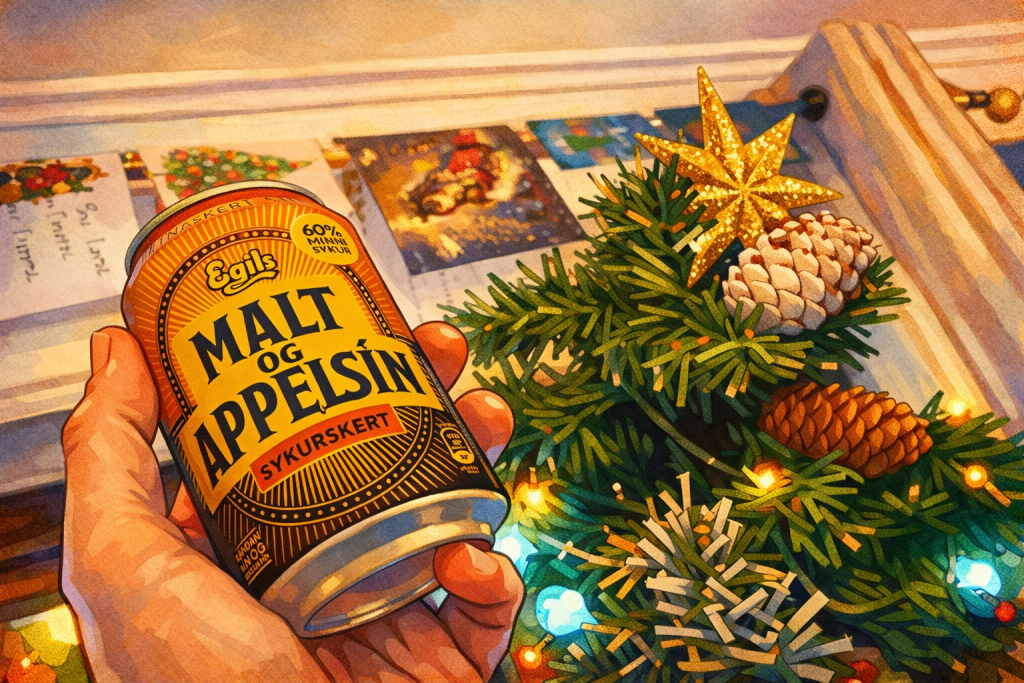
Obviously, I speak of a 12-pack of Egils Malt og Appelsín. A non-alcoholic beverage, uniquely Icelandic, made up of half malt—think a lighter, sweeter Guiness—and Appelsín orange soda.
From the Heart
The reason those iconic orange and brown cans accompany us back each year is simple. It is the unique taste they offer; a fruity, earthy, creamy, slightly fizzy sort of drinking experience that many of us living on this quiet Nordic island now deeply associate with the festive season.
I think I could go so far as to say it is an acquired taste, both in the physical and cultural sense, but one that has, over the years, become part and parcel of my own personal yuletide tapestry.
And it might surprise some readers to learn, especially those that keep a close eye on the site, that this particular post is not in any way sponsored, merely an example of a writing style that has become warped by an editorial necessity to sell.
Actually, Egils’ marketing department should treat this column as something like a Christmas miracle… rather than the cheap plea for free Malt og Appelsín that it comes off as.
A Drink That Shouldn’t Exist
Mixing malt and orange soda is not a particularly normal thing to do in the United Kingdom, nor, I suspect, in the wider Commonwealth, the United States, or most other places for that matter.
If attempted at most house parties in any of those countries, you would almost certainly be reprimanded by the host for tampering with their bottles.
Here in Iceland, one of the more useful explanations of how this particular mixture came to be appears not in folklore or advertising, but in a 2002 response archived on the University of Iceland’s science website.
Asked directly why people began mixing malt with orange soda, Guðmundur Már Magnússon, then brewmaster at Ölgerður Egils Skallagrímsson, offered a notably practical answer.
According to Guðmundur, the custom likely dates back to around 1940, when malt drinks were comparatively expensive and often diluted with whatever soft drinks were available at the time.
Egils’ orange soda did not yet exist in its modern form, but the habit of stretching malt with sweeter, more accessible mixers was already common.
When Egils’ Appelsín entered the market around 1955, it quickly became the preferred pairing. By 1960, he notes, mixing malt and orange had become fairly widespread.
Everyone Mixes It Differently
Nowadays, Egils’ ready-made versions can be found in most supermarkets, appearing in abundance during the winter months.
But I am told there remains plenty of nuance in mixing one’s own. In fact, the DIY approach is still considered by most Icelanders to be the preferred method of preparation and consumption. Some families favour a little more malt in their glass, others more orange soda, and a few even top it off with the tiniest splash of Coca-Cola.
Whatever the case, the secret—and admittedly, it’s not much of a secret—is that one must pour the orange soda into the cup first, then the malt, so as to not create a miniature malty volcano.
A Useful Companion
My family, for their part, does not like Malt og Appelsín at all, treating it with the same fear and suspicion that English people often treat unfamiliar things from abroad. Or, perhaps, they simply remain unaccustomed to the tastes of Iceland that have become almost second nature to me.
Either way, those cans serve another useful purpose, especially now that I keep from the more intoxicating aspects of Christmas, and that is providing a measured alternative to the copious amount of alcohol that tends to lubricate this time of year.
In other words, when my brother is a few pints in and begins rambling on about his latest theories to do with Hyperborea, I can sip gently at my reassuringly familiar Malt og Appelsín, allow the conversation to wash over me, and daydream about simpler things, like Donatello taking out a mouser with his Bō staff.
If that is not what Christmas is all about, then frankly, I am not sure what is.