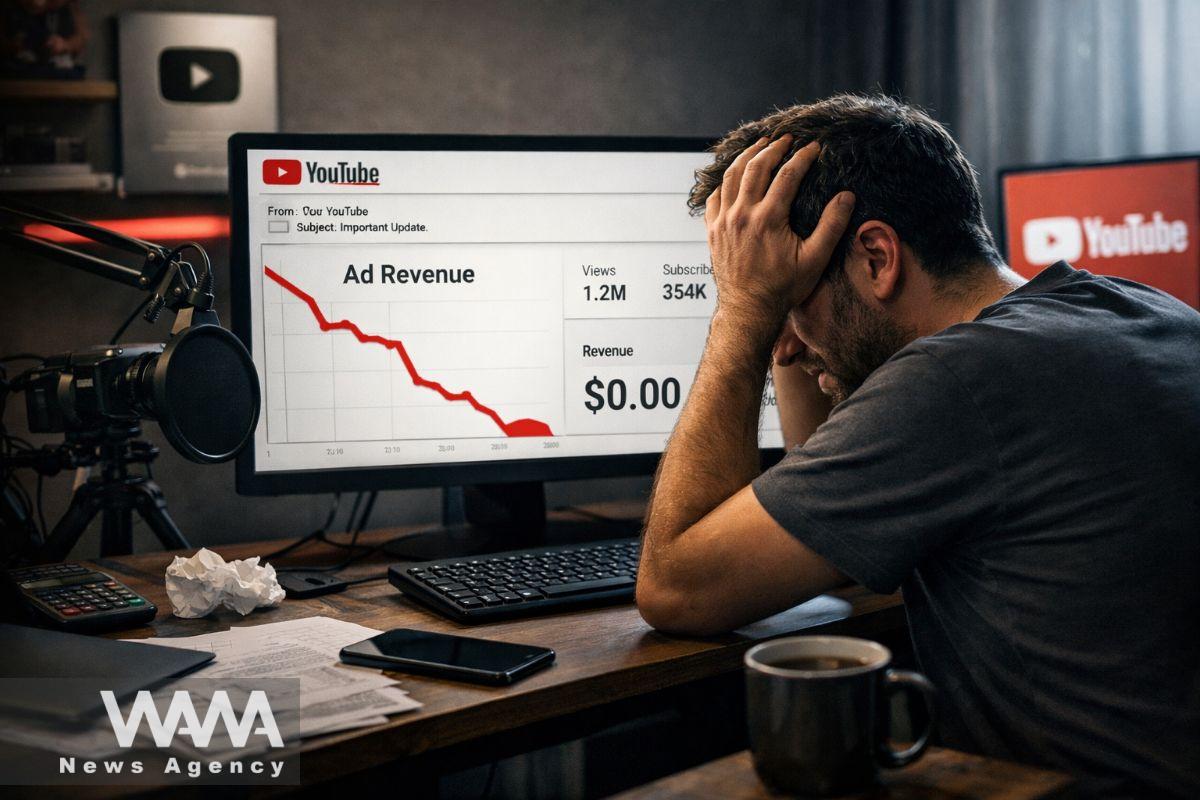
WANA (Dec 22) – Imagine that you have been active on YouTube for years. You have thousands, perhaps even hundreds of thousands of subscribers, your view charts are acceptable, and your dollar income—although highly volatile—is stable.
Then one day, you receive an email from YouTube. You check the dashboard, look at the charts, and suddenly realize your ad revenue has dropped almost to zero—not a minor dip or temporary fluctuation, but a free fall.
This scenario is no longer hypothetical; it is a disaster that has happened to many Persian-language YouTubers.
An 80% Income Drop
In recent days, numerous reports from Iranian YouTubers have been published showing that their income has decreased by up to 80 percent. This issue quickly turned into one of the hottest topics on Persian-language social networks.

Aria Keoxer, one of the most well-known Persian YouTubers, was the first to officially confirm this in a video. After that, others reported their income falling to one-fifth or even one-tenth of previous levels, putting their ability to continue professionally in serious doubt.
But What Is The Reason?
YouTube’s new update and detection of Iranian users
According to investigations and statements by people active in this field, YouTube has become more accurate in its latest update at identifying users inside Iran—especially those who access the platform via VPNs.
As a result:
Views coming from Iran with frequently changing IP addresses
are identified as low-value traffic,
and the ad revenue generated from ads shown to these users has dropped by up to 80%.
YouTube’s goal with this change is to identify real and effective audiences for advertisers; however, in Iran, this policy reaches a dead end.
 Iran: A Heaven for Hackers Due to Filtering and VPN Usage
WANA (August 07) – The extensive use of VPNs and the ongoing internet filtering policies have turned Iran into a global heaven for hackers. Since the autumn of 2022, the use of VPNs in Iran has tripled. On average, each Iranian user spends 4 hours daily using VPNs. Statistics indicate that the national internet […]
Sanctions: The Missing Link
In Iran, because YouTube is filtered, users are forced to use VPNs, and constant IP changes create distrust in the advertising algorithm.
On the other hand, due to sanctions, Iranian users practically cannot purchase from international marketplaces like Amazon, nor can they easily promote and sell Iranian products abroad.
As a result, ads shown to Iranian users rarely lead to purchases and have little economic value for advertisers, pushing YouTube to significantly reduce payments to Persian content creators.
Who Is Less Affected?
According to people active in this field, these changes do not affect everyone equally. YouTubers who:
Use stable VPNs with fixed IPs
Have more non-Iranian audiences
Produce English or non-verbal content
 The Shadow Economy of VPNs in Iran
WANA (Jan 05) – In recent years, extensive internet filtering in Iran has profoundly altered not only user behavior but also the information technology market. One of the most significant outcomes of these policies has been the explosive growth of the VPN market and unprecedented profits for sellers of these tools, with far-reaching economic, social, […]
Have experienced less income loss, or in some cases, no change at all. In contrast, YouTubers whose main audience is Persian speakers inside Iran have effectively faced a shutdown of ad revenue. This is why the phrase “Persian YouTube is dead” is being heard so often online.
YouTubers’ Reactions: Three Paths, Three Dead Ends?
In response to this crisis, Persian-language YouTubers have fallen into several groups:
Language migration: launching a new English-language channel to attract a global audience (a difficult, time-consuming, and highly competitive path, especially for those who have created content in their native language for years).
Platform migration: moving to platforms like KICK or similar networks (with uncertain income and smaller audiences).
Exiting the dollar-income game: continuing without hope of revenue or leaving YouTube entirely.
Meanwhile, some users have suggested normalizing direct sponsorships for Iranian products and services in videos. This solution mainly benefits large channels and is not very effective for newer YouTubers, since brands prefer high-view channels and are also likely to pay for ads in Iranian rials rather than foreign currency.
Could Unblocking This Platform In Iran Be A Solution?
With renewed debate over lifting internet filters in Iran, the question arises: can unblocking YouTube solve Iranian YouTubers’ income problems? The short answer is no.

Even if YouTube is unblocked, international sanctions on Iran will remain in place, a direct connection to YouTube’s financial system will still be impossible, and YouTubers will continue to bypass sanctions to receive dollar income.
The only real benefit of unblocking would be easier access and a reduced risk of user data leaks caused by unsafe VPNs.
The Content Economy In Iran: The Absence Of A Real Monetization Model
Currently, earning income in Iranian rials is usually possible through three paths:
Direct product advertising in videos
Selling services (training courses, consulting, etc.)
Selling products
However, the fourth model—direct monetization from platform ads, which exists on YouTube—is practically absent on Iranian platforms.
In this context, a content revenue-sharing document has recently been proposed as a major policy to support the content economy in Iran. This document requires domestic platforms to transparently share part of their revenue with content creators.

Iranian Social Media Platforms. Social media/ WANA News Agency
If properly implemented, this could create a stable income model, partially offsetting Iranian YouTubers’ losses, and turn content creation from a high-risk hobby into a more predictable profession.
Why Is Dollar Income Important In Iran?
Due to the declining value of Iran’s national currency, earning in dollars is an economic necessity for many Iranians. An income considered average elsewhere can create a significantly better lifestyle in Iran. A clear example is Aria Keoxer, one of the oldest Persian gaming content creators, with over 1,600 videos.
According to SpeakRJ, his annual income was estimated at about $57.8K, and his channel, ARIA KEOXER, with 756K subscribers, ranked among the top earners in Persian YouTube. However, even such channels have not been spared from recent changes and have seen sharp income declines.
In conclusion, YouTube is still accessible to Iranians, and monetization remains possible, but the path is more complex, the risks are higher, and the future of Persian YouTube is more uncertain than ever. The remaining question is whether Iran’s content economy can offer a real alternative before Persian YouTube fades completely or not.

Aria Keoxer, Persian gaming content creators’ YouTube Channel. Social media/ WANA News Agency