
Copyright © Emerce 2023
Shareholders at carmaker Tesla recently approved a stock bonus worth no less than 1,000 billion dollars for Elon Musk. That reward is needed to keep Musk on as Tesla’s chief executive for at least another 7.5 years. Otherwise, Musk threatened, he would walk away.
Shareholders reacted indignantly. They believe the board listens far too much to Musk. If Musk is paid 1,000 billion in shares, his stake in Tesla will rise to around 25 per cent and his influence on the company will become even greater.
The stock bonus is remarkable for a man who claims not to care about possessions. Musk does not even own his own home and usually sleeps in his office.
According to Bloomberg’s Billionaires Index, Musk is already the richest person in the world, with a fortune of 460.6 billion dollars. With the planned stock market listing of SpaceX – announced recently – Musk’s stake in SpaceX alone could be worth more than 625 billion dollars, up from 136 billion dollars at present.
The year for Musk naturally began with DOGE, the controversial advisory body of the US government that was supposed to deliver hundreds of billions in spending cuts, and that was led by Musk. He was permanently based in the White House.
DOGE (Department of Government Efficiency) was set up in January, a few weeks after the Trump administration took office. Trump stated that DOGE’s task was to reduce bureaucracy and make government function better. “This is the chainsaw for bureaucracy,� Musk said in February, triumphantly holding a chainsaw above his head. Almost daily, Musk reported that he had uncovered some fraud or other in departmental figures, but those accusations were often completely unfounded.
Numerous government agencies were downsized. In April it emerged that 280,000 civil servants had lost their jobs because of DOGE. The State Department was particularly hard hit by the termination of international aid programmes run by USAID.
In July, DOGE claimed that more than 200 billion dollars had been cut, but according to news site Politico those figures are based on nothing at all. Nor is it clear what costs the government incurred for DOGE and to what extent the US economy has been damaged by the drastic programme of cuts and lay-offs. Quietly, civil servants have been rehired because the work proved impossible to carry out with too few staff.
Afterwards, Musk said he would never do it again. He was so busy with DOGE that his other activities began to suffer. Above all, Tesla drivers increasingly started to be annoyed by Musk’s extreme behaviour. In the run-up to the German elections, Musk went on to publicly pledge his support to the far-right AfD.
Calls to boycott Tesla grew louder and some Tesla owners said they were downright ashamed of their car because of Musk. All over the world, dealerships, charging stations and customers’ vehicles fell victim to vandalism. Sales plummeted, especially in the Netherlands.
Musk left DOGE at the end of May, a day after he criticised Trump’s plan to push through the biggest tax cut ever. Little remained of the bromance between President Trump and Musk. The two fought out their quarrel over the US budget deficit both on X and publicly in front of the cameras in the Oval Office. Musk was also unhappy about the scaling back of financial support for sustainable projects (including Tesla’s cars).
Musk eventually even began slinging mud. He suggested that Trump’s name appears in the file of Jeffrey Epstein, who was suspected of trafficking underage girls, and threatened that space company SpaceX would withdraw from transporting personnel and goods for the US government.
In July, Musk even announced the creation of a new political party. With the so‑called America Party, he wanted to give Americans their freedom back. Little has come of it since, perhaps because Musk realises that, in setting up a new party, he can expect serious legal resistance from both Democrats and Republicans.
Amid all these preoccupations, Musk also fell out with Sam Altman. Altman and Musk founded OpenAI together in 2015. Three years later Musk left after his proposal to take over the company was rejected. Since then, Musk has sued the company several times, arguing that OpenAI’s original principles are no longer being observed. The AI company was founded as a non-profit, but in the meantime a commercial arm has been added. Earlier this year Musk surprised friends and foes alike by making an offer of almost 100 billion dollars to take over OpenAI. OpenAI’s board of directors firmly rejected the proposal.
Things were not going well with Musk’s messaging platform X either. Earlier this month the company was hit with a 120 million euro fine for breaching European rules, including misleading users about blue ticks. The billionaire flew into a blind rage, unleashing an endless series of tweets about the terrible Europe as a result.
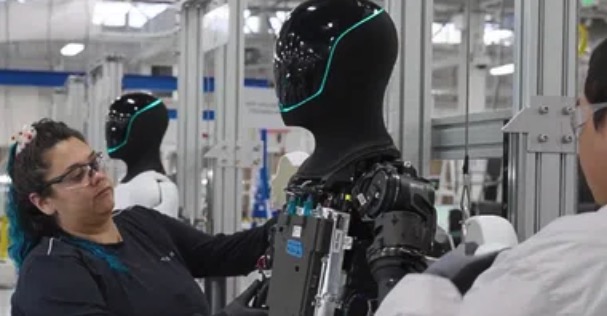
Another setback: Optimus, the humanoid robot that had been announced with great fanfare, embarrassingly lost its balance and toppled over during an Autonomy Visualized event in a Tesla store in Miami. As recently as January, Musk had estimated the potential turnover of his robotics company at more than 10 trillion dollars.
First in a series of retrospectives on tech in 2025
© The Content Exchange, source News