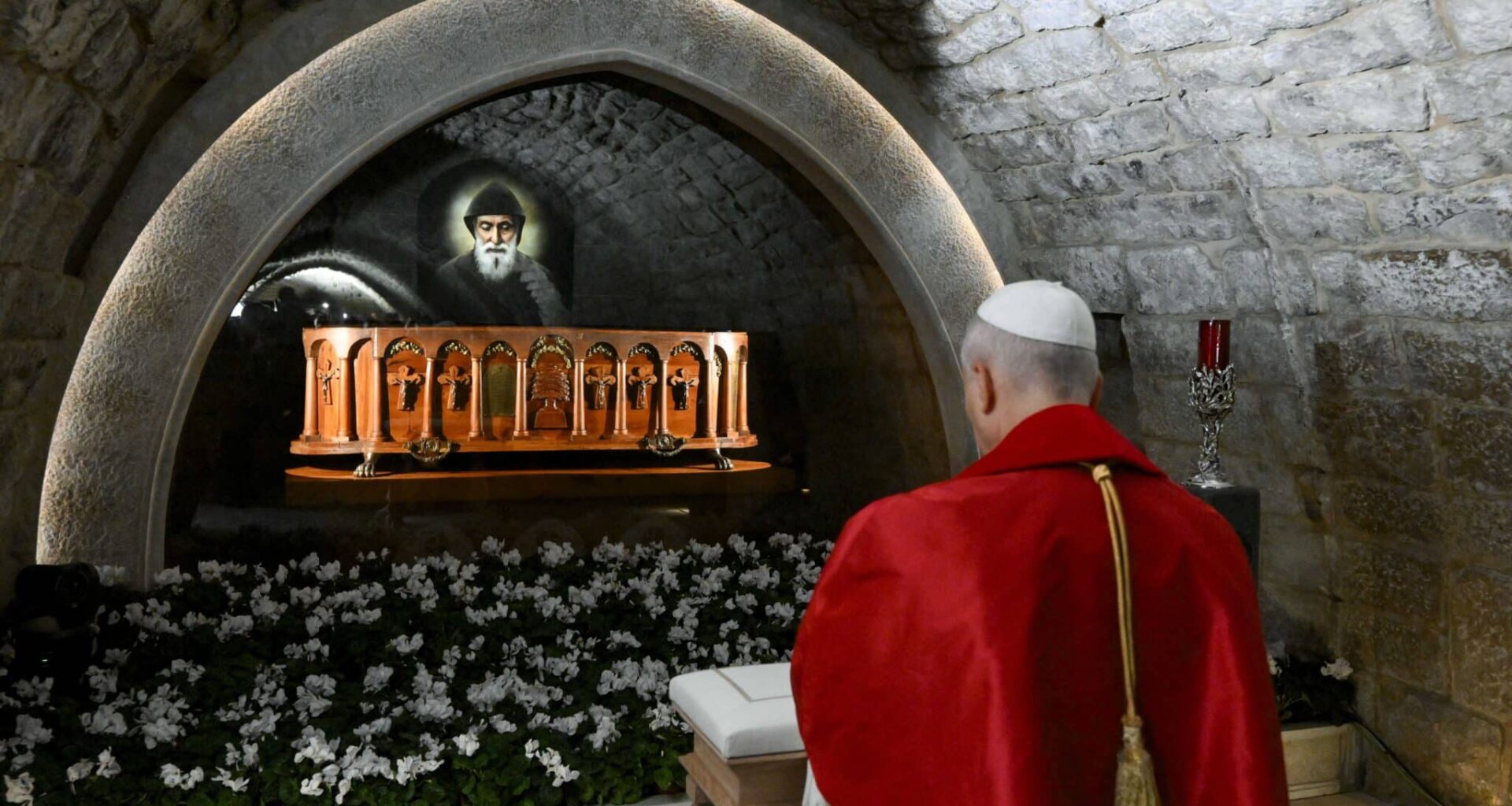
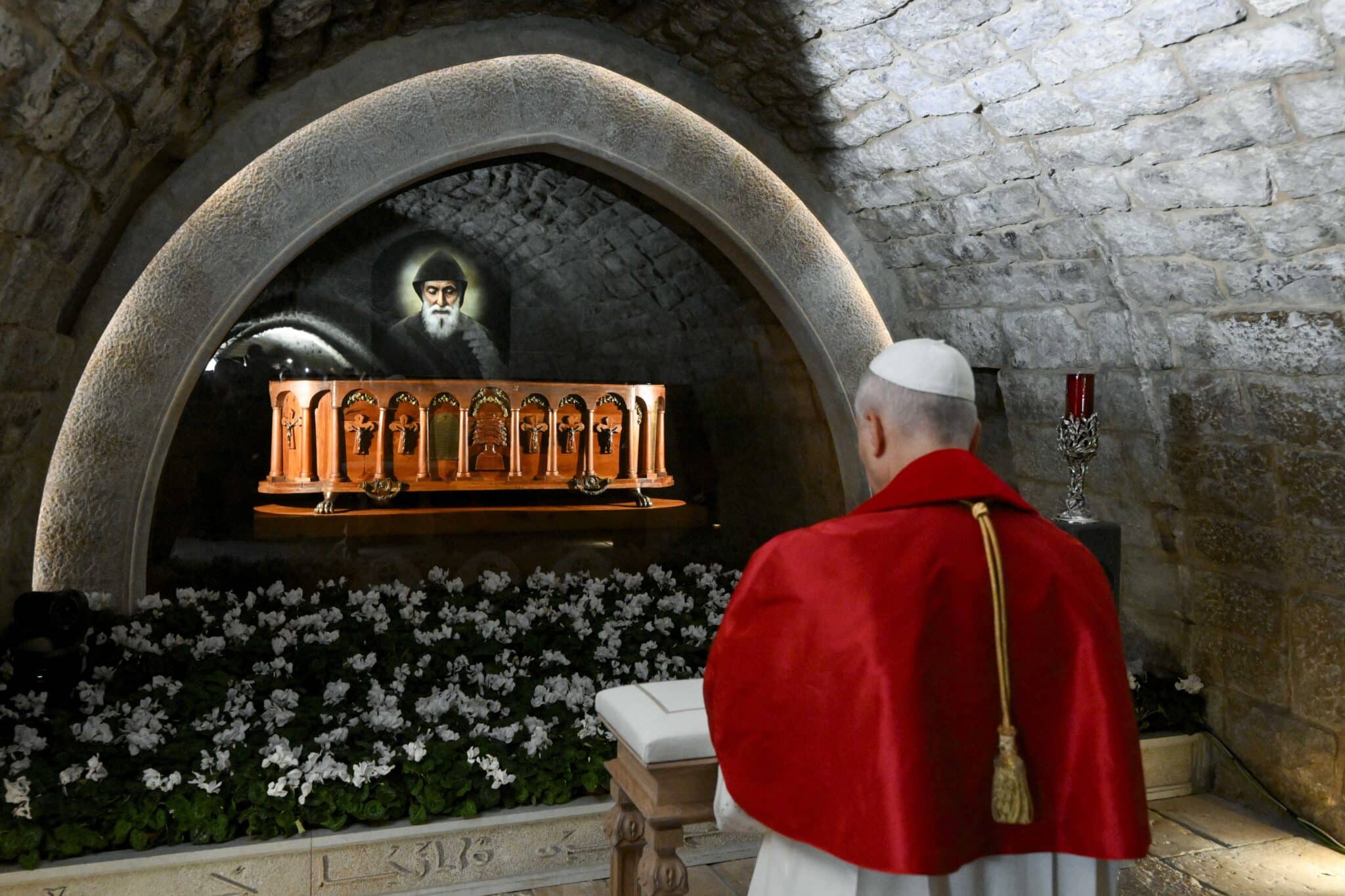
 Pope Leo XIV prays in silence before the tomb of St. Charbel Makhlouf at the Monastery of St. Maron in Annaya, Lebanon, Dec. 1, 2025. (CNS photo/Lola Gomez)
By Rachelle Mazraani
When Pope Leo XIV chose Lebanon as his first international destination after being elected, the world took notice, but for us, a group of young Maronite pilgrims travelling from Australia, it became far more than a moment in history. It became an encounter with our faith, our identity, and a homeland many of us have only ever known through the stories of parents and grandparents.
Our pilgrimage began with an extraordinary privilege: I, along with five others from our delegation, were chosen to greet the Holy Father at the airport upon his arrival in Beirut. Standing on the tarmac as the papal aircraft touched down, and hearing the applause, chants, and rising emotion of the crowd, felt surreal. When Pope Leo XIV stepped onto Lebanese soil, he greeted us with warmth and simplicity, offering a gentle smile and a blessing. That brief encounter set the tone for the entire journey: personal, intimate, and deeply spiritual.
One of the most powerful moments unfolded during the historic Papal Mass in Beirut, where 150,000 Catholics gathered in prayer. The sheer size of the crowd was overwhelming: there were families holding rosaries, youth waving flags and elderly men and women who had waited hours just to get a glimpse of the pope. As the Eucharist was elevated above a sea of the faithful, Beirut felt transformed. A city known for its wounds became, even if only for a moment, a city of hope. The hymns, the prayers, and the unity of its people created an experience we will never forget.
Equally unforgettable was the youth gathering at Bkerke. Thousands filled the patriarchal seat, the headquarters of the Maronite Catholic Patriarchate, with colour, song, and joy, creating an atmosphere that was electric. You could feel the heartbeat of Lebanon’s Christian youth pulsing through the crowd. When Pope Leo XIV arrived, the cheers were deafening, not from excitement alone but from years of longing. Many cried. Many smiled. Everyone listened. His message to us was both clear and deeply felt:
“Young people of Lebanon, you are not only the future – you are the strength of your nation today. Do not abandon the land that gave you your faith.”
For young Lebanese navigating life between opportunity abroad and hardship at home, these words struck with particular force.
Throughout the pilgrimage we travelled to Harissa, Byblos, and the sacred valleys where our monastic tradition was born. At Our Lady of Lebanon in Harissa, overlooking the Mediterranean, we prayed for peace and protection over our homeland. Yet one of the most meaningful moments came during the clergy gathering in Harissa, where Pope Leo XIV addressed priests, bishops, and consecrated religious. His words to them were powerful:
“The shepherds of Lebanon have carried the cross with extraordinary courage. The strength of the church here is not in numbers, but in the fidelity of its servants. Stand together, support one another, and remain close to your people.”
He reminded them – and all of us – that the universal church stands with Lebanon, and that their mission to preserve the faith, accompany the suffering, and safeguard Lebanon’s Christian identity is vital not only for Lebanon, but for the entire Middle East.
Everywhere we went, we witnessed the same resilience. Lebanon may be wounded, but its people remain unbreakably hopeful. Through hospitality, faith, and quiet strength, they reminded us why Lebanon holds such a sacred place in the hearts of its diaspora.
This pilgrimage did more than strengthen our connection to the land; it clarified our mission as young Maronites living abroad. Pope Leo XIV’s visit reminded us of the responsibility we carry: to support Lebanon through prayer, involvement, and unity; to honour our heritage; and to live our faith boldly wherever we are planted.
As we boarded our flight back to Sydney, one thought echoed among our group:
This wasn’t just a trip. It was an awakening.
Pope Leo XIV’s visit reminded Lebanon that it is not forgotten – not by the church, not by its diaspora, and not by its youth. And for us, it reaffirmed that Lebanon is more than a birthplace or a memory. It is a home we carry, a heritage we honour, and a faith we strive to live every day.
Rachelle Mazraani, from Zahle, Lebanon, is the Maronite Youth of Australia Coordinator.