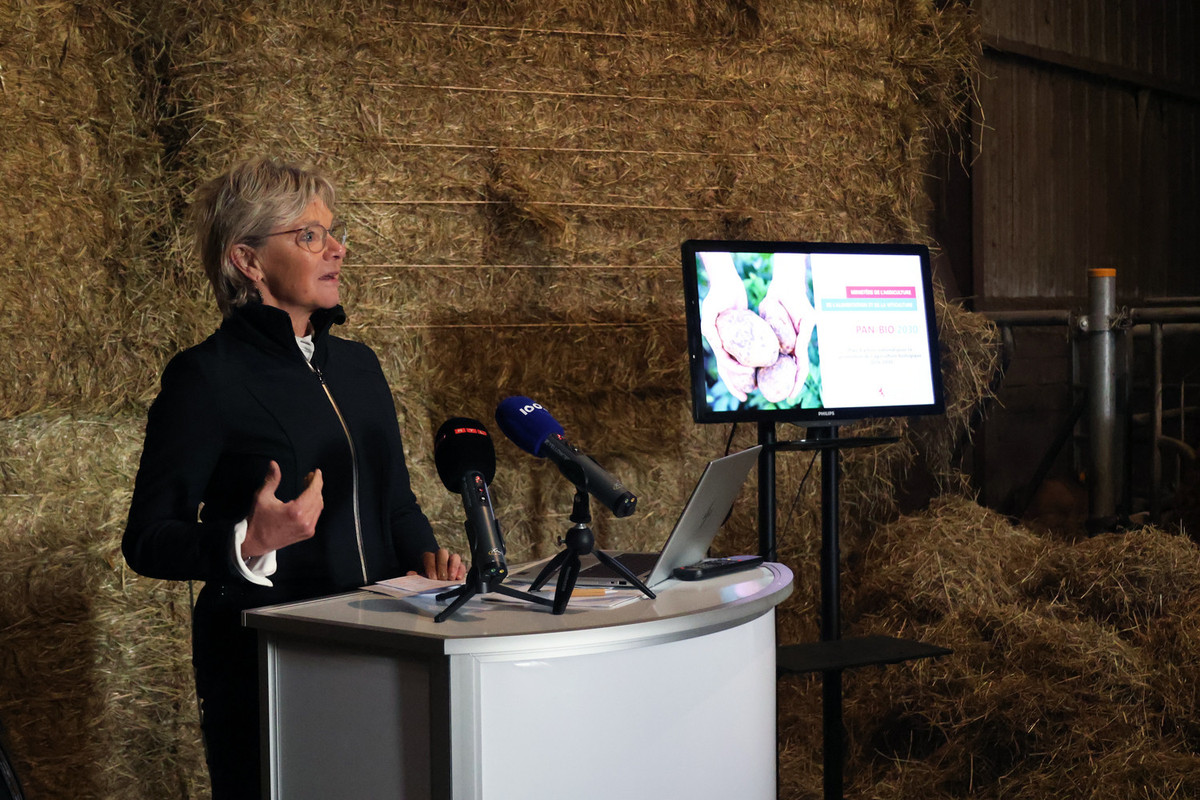
Organic farming continues to gain ground in Luxembourg, but without going into overdrive. This is the central message of Pan-Bio 2030, the new national action plan for the promotion of organic farming over the period 2026-2030, supported by the Ministry of Agriculture headed by (CSV). After a Pan-Bio 2025 that was deemed structuring but overambitious, the government is adjusting the cursor and now favours gradual, controlled and economically sustainable growth.
The balance sheet for the previous period nevertheless remains solid. Between the end of 2020 and December 2025, the organic agricultural area rose from 6,429 to 12,264 hectares, an increase of more than 90%. The number of organic farms registered with the Administration des services techniques de l’agriculture (Asta) rose from 158 to 253, while the number of organic processors, traders and importers increased from 172 to 217. This is real momentum, but not enough to achieve the initial target of 20% of utilised agricultural area (UAA) under organic farming in just five years.
Rather than forcing the accelerator, Pan-Bio 2030 therefore sets out a new trajectory: to increase the share of organic farming by around 1 percentage point per year, in order to reach 15% of UAA by 2030. A target in line with the trend seen in recent years and presented as more credible against a backdrop of pressure on costs, volatile agricultural markets and still uneven demand.
Complete value chains rather than a race for hectares
The plan is based on four strategic priorities, starting with a strengthening of governance. The Executive Committee is confirmed as the central steering body, with an annual reporting system and regular consultations with the sector. Around the Ministry of Agriculture, this committee brings together the main administrations involved in organic farming, from Asta to the Rural Economy Service, including the ANF and the Institut viti-vinicole. A body conceived as a control tower, responsible for monitoring the implementation of the plan and adjusting its trajectory. The stated aim is to better monitor the implementation of the measures and adjust the trajectory according to the data on the ground, rather than multiplying announcements.
Particular emphasis is being placed on demand, long identified as the Achilles heel of organic farming in Luxembourg. Targeted communication, events on demonstration farms, interactive maps to locate regional organic products, as well as the production of statistical data on : the idea is to give producers visibility and secure outlets before encouraging new conversions.
Pan-Bio 2030 also strengthens support structures, advice and research. Certification costs will continue to be partially covered, particularly for small farms and beekeepers, while training, specialist advice and agronomic trials will be stepped up. The plan also assumes a closer link with applied research and innovation, via targeted calls for projects.
Collective catering as a central lever
But the most structuring change concerns the development of value chains. The new plan focuses on the creation of complete value chains, linking production, processing and marketing, with the ambition of analysing one or two priority value chains per year. The products most in demand by mass caterers are clearly targeted, and cooperation with the Greater Region or the Benelux countries is encouraged, where it makes economic sense.
This makes mass catering a central lever. Pan-Bio 2030 sets a precise target: 30% organic products from Luxembourg in the canteens managed by Restopolis by 2030, and 80% local products in total. A direction that could offer stable outlets for producers, provided that supply follows in terms of volume, regularity and price.