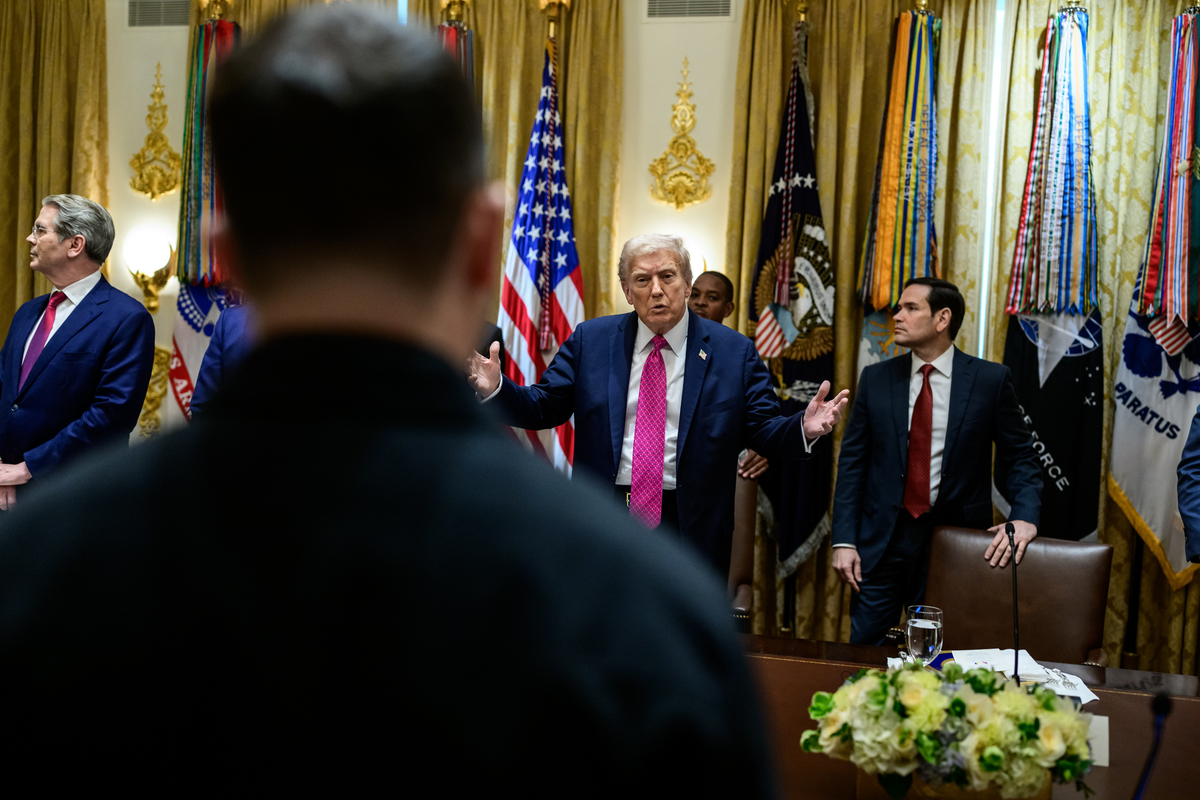
WASHINGTON DC – On paper, the outlines of a Ukraine peace framework are beginning to take shape. In practice, the distance between a “solid” 20-point draft and a ceasefire that actually holds remains vast.
Following weekend negotiations in Miami, Kyiv and Washington projected cautious momentum on Monday. Ukrainian officials stressed that the core draft documents are largely complete – even as they acknowledged that several provisions remain unacceptable to both sides.
Follow our coverage of the war on the @Kyivpost_official.
US President Donald Trump, speaking Monday at an event in Palm Beach, Florida, struck a similarly general note. Asked for an update on the Ukraine-related talks that took place in Miami over the weekend, Trump offered little detail, saying only that negotiations are continuing.
“The talks on Ukraine-Russia are going along,” Trump said, adding, “We are talking, the talks are going okay.”
Pressed on whether a trilateral meeting would be the next step – or whether he was still pushing for a Christmas Day deadline – Trump again avoided specifics. “I’ll do whatever I have to do,” he said, adding that “everyone’s tired of that war.”
The lack of clarity from the White House mirrors the broader state of play: momentum without precision, progress without enforceability.
Behind the scenes, veteran national security officials warn that without credible monitoring, verification, and enforceable security guarantees, the entire process risks unraveling almost as soon as a ceasefire is announced.
Other Topics of Interest
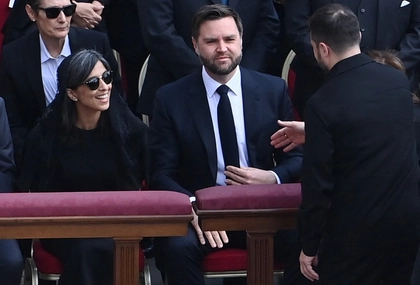
Vance Suggests Trump Administration Won’t Be ‘Shipping Off Money to Ukraine’
Rather than being invited to peace talks, Vance has been shipped off to the desert to fire up the so-called “Christian” right-wing base.
The challenge, they argue, is not diplomatic intent but operational reality: who verifies compliance, how violations are attributed in real time, and whether guarantors are prepared to act decisively when – not if – Russia tests the limits of any agreement.
Zelensky’s framing
Ukraine emerged from the Florida talks sounding guarded but constructive. As Kyiv’s negotiating team was returning from Miami, President Volodymyr Zelensky on Monday took to social media to describe the draft texts as “quite solid and dignified,” emphasizing that all possible work on the initial documents had been completed.
The framework, Zelensky noted, consists of 20 points. He acknowledged that “not everything is perfect,” conceding that some provisions remain unacceptable to Kyiv – just as others will be unacceptable to Moscow.
Still, he characterized the documents as joint working drafts prepared by Ukraine and the US, arguing that the cooperation itself signals the sides are “very close to a real outcome.”
At the center of the framework are security guarantees involving Ukraine, European partners, and the US. Zelensky confirmed the existence of a separate bilateral Ukrainian-American security document, which would require review and approval by the US Congress. Certain details and annexes, he noted, remain classified.
According to Zelensky, the proposed security architecture rests on three pillars. The first is Ukraine’s own armed forces, envisioned as an 800,000-strong military requiring sustained domestic and partner funding.
The second is progress toward EU membership, including access to economic and security programs. The third is a “Coalition of the Willing,” involving roughly 30 countries – with some providing direct military presence across air, land, and sea, and others contributing to energy, financial, and civilian resilience.
Zelensky said discussions are ongoing over the nature of a US backstop, including air defense, aviation, intelligence, and deterrence packages.
Crucially, he stressed that legally binding guarantees approved by Congress would distinguish this arrangement from past efforts such as the Budapest Memorandum or the Minsk process.
US officials, Zelensky added, are continuing parallel talks with Russian representatives and are expected to relay feedback to Kyiv – placing the Trump administration at the center of both tracks.
Reality beyond the drafts
Even as diplomats trade texts, Zelensky struck a more somber note about conditions on the ground. He warned that Russia had rejected proposals for a Christmas ceasefire and appeared to be preparing intensified strikes during the holiday period.
Ukrainian intelligence, he said, had been instructed to step up monitoring, with air defense elevated as the top priority amid persistent shortages of systems.
“We want the war to end,” Zelensky said, “and we will continue to strengthen ourselves,” pointing to ongoing negotiations with the US for additional Patriot air defense systems through multiple procurement channels.
The disconnect between diplomatic optimism and battlefield reality underscores the pressure on Trump’s team as it balances speed, optics, and substance.
Skepticism from veteran of past deals
That guarded optimism collides with deep skepticism from officials who have worked on previous ceasefires and security arrangements.
In an exclusive interview with Kyiv Post, Michael Carpenter, former senior director for Europe at the White House National Security Council, warned that the most underestimated risk in the current process is the monitoring and verification framework itself.
“If a ceasefire were miraculously agreed, the Russians would certainly try to test it,” Carpenter said, noting that Moscow has done so in every ceasefire since 2014.
Violations conducted with drones or other ambiguous tactics, he cautioned, would make attribution extremely difficult for the US and its partners – potentially dooming an agreement within days.
Weak monitoring provisions, Carpenter added, would also create strong incentives for false-flag operations, particularly in the early stages of a ceasefire, when political narratives are still forming and facts are hardest to establish.
Even more consequential, Carpenter argued, is the credibility of the security guarantees the US and its allies are willing to put on the table.
“Are they rehashed Budapest Memorandum language dressed up with a ‘Sense of the Senate’ resolution?” Carpenter asked.
He questioned how serious US commitments would be in practice, including whether Washington would pledge to arm Ukraine with high-end weapons – such as Tomahawk missiles – in the event of a renewed Russian attack.
That credibility gap, Carpenter suggested, extends beyond Washington to Europe – and nowhere more visibly than in Berlin.
It has been more than a year since the US provided Ukraine with long-range ATACMS missiles, a decision that undercut one of the central arguments against supplying Germany’s Taurus cruise missiles. Yet Berlin has continued to withhold them.
“There is no valid argument against providing the Taurus,” Carpenter said.
“Similar weapons have been provided to Ukraine for over a year, and only internal German politics – and specifically the fear that the AfD will capitalize on a positive decision – can explain why this decision hasn’t yet been taken,” he emphasized.
The delay, he added, is “long overdue and demonstrates, in spite of everything else Germany is doing, a striking lack of solidarity and burden sharing.”
Carpenter also cast doubt on European willingness to follow through on deployments to Ukraine, arguing that Russia would almost certainly veto any agreement containing truly credible security guarantees.
As a result, he said, the way these commitments are articulated – and operationalized – in the draft text will ultimately define both the quality and durability of any deal.
If talks fail
Carpenter argued that if the framework collapses, the political fallout could matter as much as any immediate battlefield shift.
Russia, he said, will seek to pin the blame on Ukraine, while Kyiv is deliberately positioning itself as constructive – a posture designed to ensure responsibility lands squarely on Moscow.
If it becomes clear that Vladimir Putin is to blame, Carpenter said, Ukraine would be better positioned to sustain support in the US Congress, regardless of the White House’s impatience for a deal.
Failure, he predicted, would also likely accelerate European involvement – which he described as having been “shockingly passive” to date.
The road ahead
For now, drafts are circulating, envoys are shuttling, and Trump is publicly signaling progress without committing to timelines.
Zelensky has been explicit that the documents remain works in progress – solid at the core, unresolved at the edges.
Whether the framework evolves into a durable peace or collapses under the weight of its own ambiguities may hinge less on the 20 points themselves than on what happens in the first days after a ceasefire: when violations are hardest to prove, narratives harden fastest, allies hesitate, and the credibility of US-backed security guarantees is tested not in theory, but under fire.
In the end, the risk is not that the talks fail loudly – but that they succeed quietly, only to unravel just as quietly, leaving Ukraine exposed and the West scrambling to explain why another agreement proved easier to sign than to sustain.