
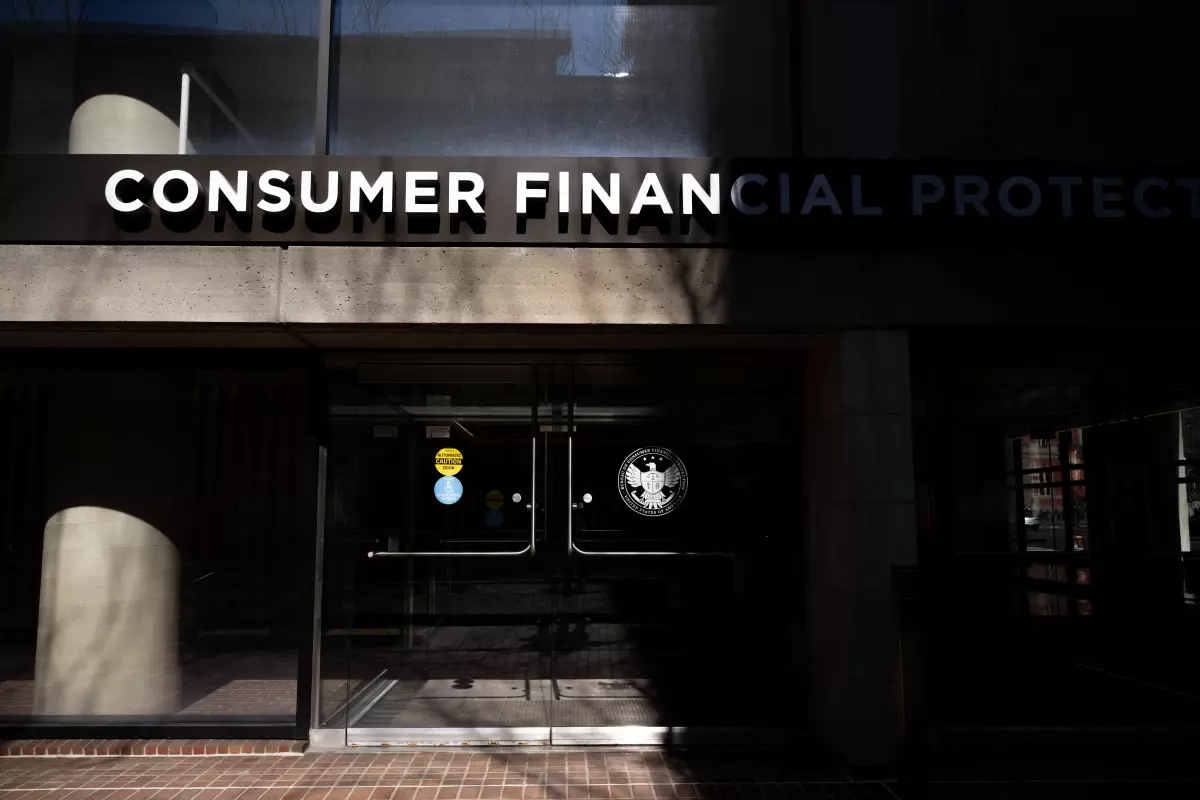
A coalition of 21 states along with the District of Columbia sued the Trump administration on Monday to prevent it from defunding the Consumer Financial Protection Bureau, which says it will run out of money in a few weeks.
The consumer watchdog agency is funded by the Federal Reserve — unlike many other federal agencies — to insulate it from political whims. But under Acting Director Russell Vought, the CFPB is refusing to accept money from the Fed.
The CFPB argues that the law that established the agency says it must get funding from the Fed’s “combined earnings,” or profits made by the Fed. But the Fed doesn’t have those earnings, the Trump administration says, because it’s paying out more money than it’s taking in, or operating at a loss.
The attorneys general suing the administration — and some Democratic lawmakers — reject that argument. They say the CFPB is narrowly defining “combined earnings” as profits, whereas lawmakers had intended the term to mean the wider funds — or proceeds — coming into the Fed.
In their suit, filed in the U.S. District Court in Oregon, the states argue Vought and CFPB are using “an unreasonable and unlawful interpretation of ‘combined earnings.'” The agency’s stance puts the “CFPB at risk of losing all of its funding as early as January 2026,” the states argue.
Such a loss of funding would hurt their residents, the attorney generals argue.
In a statement, New York Attorney General Letitia James — who is leading the coalition of states — argues that the CFPB is legally required to “collect and process consumer complaints and share that complaint data with states,” which the agency can’t do if it isn’t funded.
“Defunding the Consumer Financial Protection Bureau will make it harder to stop predatory lenders, scammers, and other bad actors from taking advantage of New Yorkers,” James said in the statement.
“My office and attorneys general across the country rely on the CFPB for consumer complaints and other data to get justice for consumers,” she added.
Under the Trump administration, much of the CFPB has been gutted, with the agency preventing many of its staff from doing their work. The administration also has tried to fire most of the CFPB’s staff, though those attempts have been blocked by the courts.
Since its creation in the aftermath of the 2008 financial crisis, the CFPB has been the target of many conservatives. They argue the agency is too aggressive when it comes to enforcement and that it’s not accountable enough to Congress.
Transcript:
AILSA CHANG, HOST:
The federal government’s consumer watchdog is running out of money. That’s because the Trump administration is not asking for more funds. A coalition of states is now suing over that decision, calling it unconstitutional. NPR’s Camila Domonoske has been covering all this and joins us now. Hi, Camila.
CAMILA DOMONOSKE, BYLINE: Hello.
CHANG: OK, so can you start with what the Trump administration is doing here, or rather not doing here?
DOMONOSKE: Yeah, it’s a not doing. What they’re not doing is they are not requesting more money to fund the Consumer Financial Protection Bureau. Now, the CFPB, it exists in order to protect ordinary Americans from scams and fraud, keep an eye on banks and finance companies. It was created back in 2010 after the financial crisis, in part to prevent another financial crisis in the future. And the CFPB has returned billions of dollars back to consumers who were cheated. But, you know, from the perspective of the businesses that are watched by this watchdog, that scrutiny is not always welcome. The Trump administration has called the agency woke and weaponized.
And Congress knew there might be political backlash to the CFPB, and it was set up, for that reason, to be funded in a really unusual way. It gets money directly from the Federal Reserve’s earnings. So it can’t get tied up in congressional debate over budgets. The money should just always be there.
CHANG: Should always just be there. Wait, so then how can the Trump administration just stop requesting the money?
DOMONOSKE: Well, I said that money comes from the Fed’s earnings. And the Trump administration is now arguing that earnings means profit. Over the past few years, the Fed has generally had more money going out the door than in, so if it were a business, it wouldn’t have any profit.
CHANG: Yeah.
DOMONOSKE: And the administration is saying that means there’s no money available for the CFPB, so they aren’t asking for funds. And that’s why a coalition of states, led by the attorney general of New York – that’s why they’re suing in this lawsuit filed today.
CHANG: OK. And what is the argument that the states are making here?
DOMONOSKE: Well, before I get into that, I want to note it’s not just the states that are opposing this. A bunch of members of Congress, including the authors of the Dodd-Frank Act that created the CFPB, have gone on record to say they meant revenue. The whole point was this was stable funding, so why would they write it in a way that it could just go away? Five former Fed officials have also said the very concept of profit doesn’t really translate to a central bank. And then there’s also a case that actually the Fed is, quote-unquote, “profitable” right now.
But this lawsuit from the states, it mentions all that, but it’s really making a much more fundamental point, which is that Congress gave the CFPB work to do. So if the Trump administration doesn’t ask for funding, it can’t do the work, which is unconstitutional, these states say – separation of powers, right? Congress passed the law creating the CFPB, the executive branch is supposed to execute that law, is the argument.
CHANG: Right. OK. Well, this lawsuit has been filed. What comes next at this point, then?
DOMONOSKE: Well, obviously we will see what the judges have to say, not just in this case but in several other cases that are pending about the CFPB’s future. Russell Vought, who leads the budget office and is also now the acting head of the CFPB, he has said he wants to close the agency. He already tried to fire everybody, which was blocked by the courts.
You know, the CFPB declined to comment for this article – for this story, but the bureau is already much diminished. It has said it’s transferring its legal work to the Department of Justice. It’s halted most of its investigations into banks. And last month, the agency announced that if and when it resumes that kind of oversight, it will be more limited and more collaborative with companies – an unusual statement coming from this consumer watchdog.
CHANG: That is NPR’s Camila Domonoske. Thank you so much, Camila.
DOMONOSKE: Thank you.