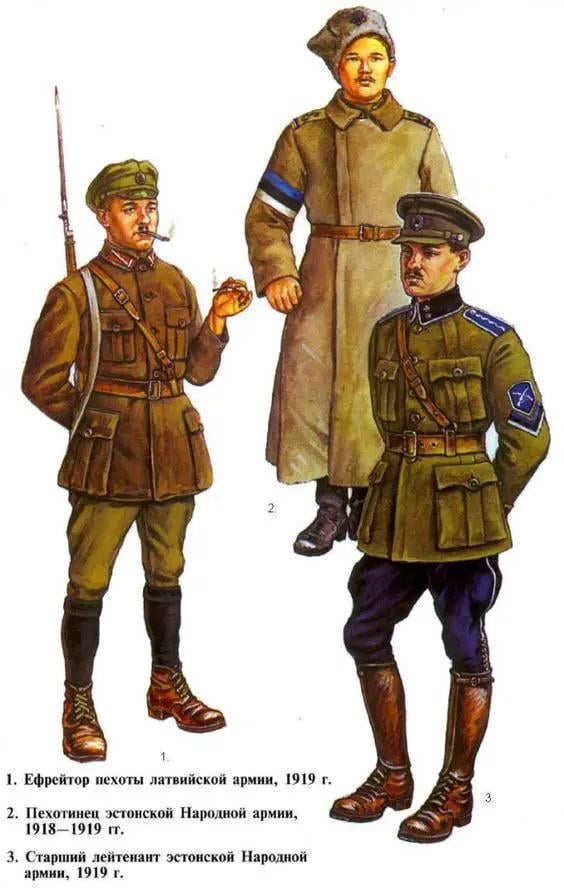
I found this image and I’m curious about the authenticity of the designs shown here. Did they actually look like this (If so, cool) or was the artist taking certain liberties? It would be interesting to see if any of you guys have some of those period uniforms still around to share here or even any inter-war stuff. Thanks
by GridAlien99
6 comments
try this forum and translate it with browser:
[https://www.rindeleht.ee/foorum/phpBB2/viewtopic.php?t=6318&start=75](https://www.rindeleht.ee/foorum/phpBB2/viewtopic.php?t=6318&start=75)
I’m not well versed in military history, but generally speaking at the beginning of the War of Independence Estonian military wore whatever they could get their hands on. By the second half of 1919 they mostly looked like a real military. The drawing on the right looks, in general, like Estonian officers seen from the pictures of the era. As for the blue-black-white armband of the soldier, I think especially at the beginning of the war simply white armbands were often used (as the enemies were reds). You can google “Vabadussõda” and get many pictures of the era.
Looks accurate. Perhaps ideal form, not all officers could get different pants all the time but generally good representation
https://preview.redd.it/8ej25wcuyx8g1.jpeg?width=640&format=pjpg&auto=webp&s=c3970e157576435c55713c942e3bd5e7ff2d2061
In the beginning it was mostly people with their own cloths and czar army uniforms with Estonian insignia. Later all kinds of British and US uniforms also. Image is generally about right approximation.
[https://www.postimees.ee/4085437/vaata-eesti-sojavae-esimesi-vorme](https://www.postimees.ee/4085437/vaata-eesti-sojavae-esimesi-vorme)
https://preview.redd.it/o8he6o4bzx8g1.png?width=692&format=png&auto=webp&s=5766d1240e4cd5bd33ded5c901799158fd1d1c3b
This is accurate. There were a lot of different clothes and equipment, depending on which exact year you look at. Started off as mostly Russian/civilian clothes and equipment, then some German stuff captured in battle, lend-lease from mainly the UK and USA and then our own clothes.
During WWI there were no Estonian military uniforms around. Estonians who volunteered or were drafted to the Russian Imperial army (around 100 000 all together, incl. ca 2000 promoted officers by 1917) wore Russian uniforms during the Great War, sometimes with various Estonian national insignia added.
Later in the war, smaller Estonian expeditionary units were formed by the Brits in Arkhangelsk, as well as the French in France, that wore, respectively, British and French uniforms.
At the start of the Estonian War of Independence which broke out in late November 1918, after the capitulation of Germany, Estonian troops wore a combination of various available uniforms (mostly German and Russian, as well as the uniform of the Defence League) and civilian clothing. Estonian standard uniforms, drawing from German and British models, only appeared by late 1919.
Comments are closed.