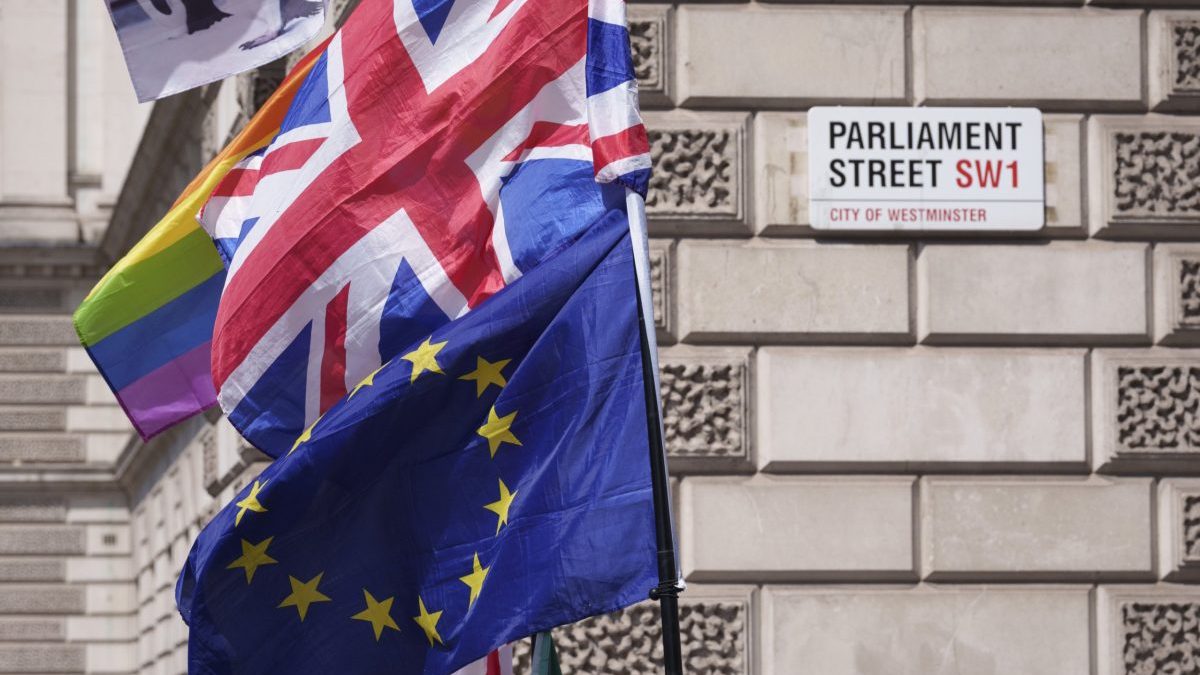
Wes Streeting has reignited a debate around whether Britain should re-enter the continent’s major trading system
Wes Streeting has reignited a debate over whether Britain should rejoin the EU’s customs union in a post-Brexit world.
In an interview, the Health Secretary appeared to go further than the Government’s current position by leaving the door open to the idea of a customs union.
He told the The Observer that a “deeper trading relationship” with Europe would help to boost the UK’s economic growth.
New FeatureIn ShortQuick Stories. Same trusted journalism.
This is a departure from the Prime Minister’s position, after Sir Keir Starmer ruled out a change in the Government’s policy towards a customs union at the start of December.
But what would rejoining the customs union mean for the UK economy? Here’s everything you need to know…
What is the customs union?
The EU customs union creates a single tariff area for all goods imported from outside the European Union, allowing the goods to move freely between member states.
It means that member states do not impose customs duties internally on goods traded between them. Once goods have passed customs, they can circulate freely within the EU without additional tariffs or border checks.
Member states also have a uniform system for handling the import, export and transit of goods.
The EU has a common external tariff which it applies to all imports coming into the bloc.
If the UK were part of a customs union, it would charge the same external tariffs as EU member states on imports from outside the EU.
When the UK was an EU member, it was part of the customs union, but when it left in 2020 Boris Johnson decided to withdraw from the customs union as part of the overall Brexit deal he agreed with Brussels.
It means that the UK now decides what tariffs it wants to apply on imports.
What did the Health Secretary say?
In his interview, Streeting said the UK had taken a “massive economic hit leaving the European Union”.
He added that “the best way for us to get more growth into our economy is a deeper trading relationship with the EU”, and that the reason Brexit was so damaging was “because of the enormous economic benefits that came with being in the single market and the customs union”.
He added: “This is a country and a Government that wants a closer trading relationship with Europe. The challenge is any economic partnership we have can’t lead to a return to freedom of movement.”
Streeting’s words have been interpreted as an endorsement of the customs union, because while rejoining the single market would require embracing freedom of movement, membership of the customs union would not.
However, Downing Street has ruled out the move, saying that a customs union is one of the “red lines” Labour will not cross while resetting relations with the EU.
What are the benefits of joining the customs union?
The UK could join the EU’s customs union or could negotiate a bespoke arrangement with Brussels – Turkey already has a such as deal.
The main advantage to a customs union is that the external tariff removes the need for goods traded within the EU to prove their origin.
This would cut much of the bureaucracy created by Brexit, with UK exporters no longer having to meet rules of origin to qualify for tariff-free trade with the EU, cutting administration costs.
According to the think-tank UK in a Changing Europe, proving compliance with these rules is estimated to add 2 to 8 per cent to the cost of exporting goods.
As a result, some firms have ceased trading with the EU or opted to pay EU tariffs rather than absorb the red-tape costs.
If a customs union deal were to improve economic growth, it would be likely to boost UK jobs and wages. Higher sales would increase the profitability of British exporters and allow them to take on extra staff.
What are the downsides of a customs union?
Rejoining the customs union would not remove all post-Brexit border checks and red tape, because the UK would still be outside the single market.
The UK would also have to give up the freedom to strike its own trade agreements.
Given Starmer and his ministers have been trumpeting the deals they have signed with the US, India and more recently South Korea, they would be loath to do this.
Britain would have to accept EU external tariffs without helping to decide them.
If the UK had a Turkey-style deal, we would also not benefit from trade deals negotiated by the EU.
Currently, Turkey has to accept goods from countries with which the EU has signed a free trade agreement, but does not benefit from reciprocal access to the markets of these third countries.
How much would it boost the economy?
A claim that a customs union would deliver a 2.2 per cent boost to GDP “should be taken with a pinch of salt”, UK in a Changing Europe says, given that this is based on a scenario where Britain would have deep alignment on goods and services.
The think-tank does not believe this is possible because it would essentially amount to rejoining the single market without freedom of movement.
Pre-Brexit government analysis had suggested that leaving the customs union would reduce long-term GDP by about 1 per cent.
Given the UK would have to unwind post-Brexit trade deals which are estimated to add half a per cent to GDP by the end of the next decade, UK in a Changing Europe thinks that the net benefit of rejoining the customs union might amount to 0.5 per cent of GDP, or £15bn a year.