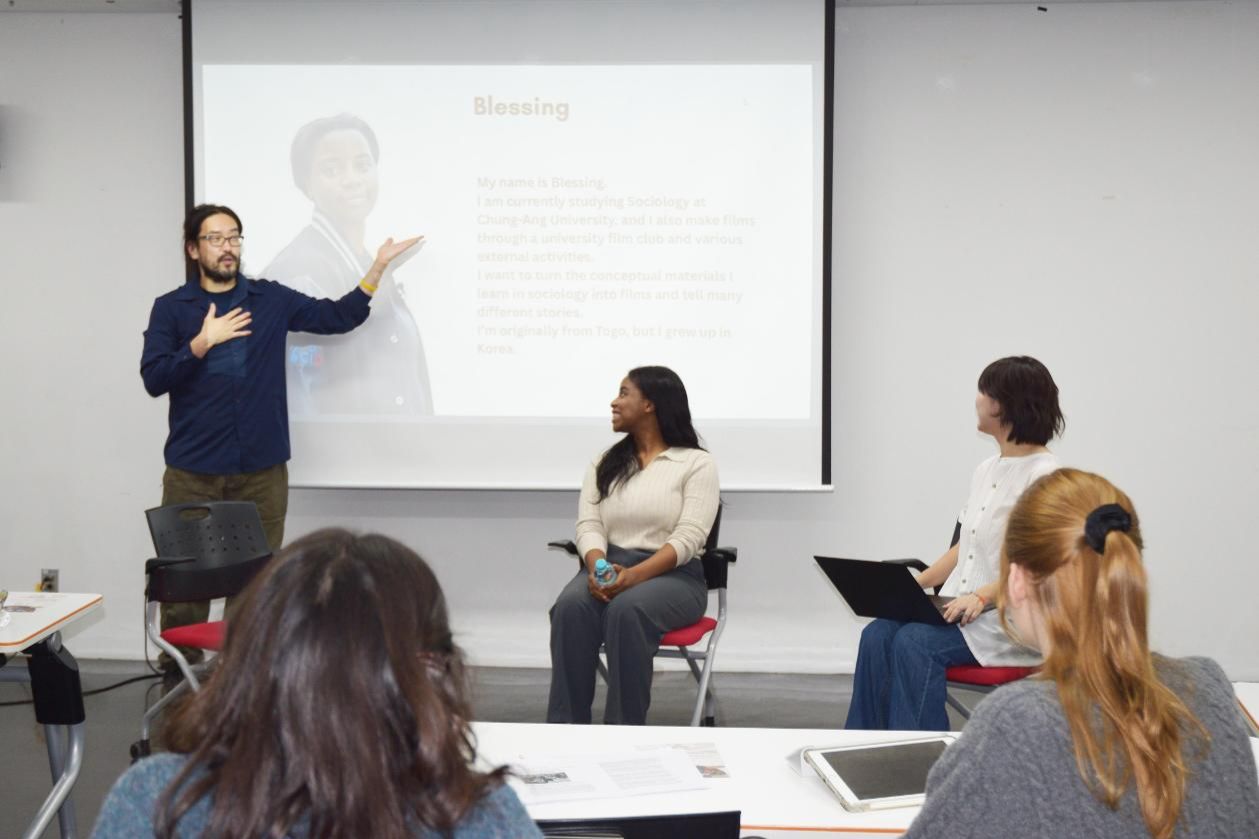
Tae Conan Kim, left, introduces Chung-Ang University student Yovo Blessing Grace during a special lecture, titled “Portrayal of Refugees in Korean Media,” at Korea University’s Graduate School of International Studies (GSIS), Nov. 10. Courtesy of Bereket Alemayehu
The Korean media’s persistent tendency to frame refugees as security risks continues to fuel public fear and distort policy debates, overshadowing the far less visible human stories of people fleeing conflict.
That was the conclusion at a special lecture, titled “Portrayal of Refugees in Korean Media,” organized by the Human Rights Society (HRS) at Korea University’s Graduate School of International Studies (GSIS) in collaboration with the refugee-led initiative Hanokers at Seoul Startup Hub on Nov. 10.
The event explored how different media outlets strategically frame news about refugees and how it impacts policies and public perception in Korea, providing a rare opportunity for Korean and international students to gain insight into the lived experience and perspective of migrants living here with a refugee background.
The portrayal of refugees in Korean media plays a major role in shaping public perception and political debate. It offers a mix of fear and sympathy, while historically leaning toward risk-focused political narratives, especially conservative ones, that frame refugees as a potential threat by focusing on crime, cultural conflicts and exaggerated safety concerns.
Tae Kim Conan, Hanokers’ co-representative, said that while coverage varies across media outlets, certain narratives appear repeatedly when new groups of asylum seekers arrive in the country, particularly in 2018 after Yemeni refugees started arriving on Jeju Island. He highlighted that overall, media representation emphasizes security risks and cultural tensions over humanitarian concerns, creating a narrative that refugees bring instability.
“Examples of bias against refugees, from the subtle to the downright hogwash, inundate the media in this society,” Kim said. “They feed into the culture of xenophobia and vice versa, propelling a malicious loop. In this relatively free society, the citizens, in a broad sense of the term, are the only effective guardians of ethics and humanity. We must educate ourselves — not only to filter out the anti-refugee propaganda, but also to demand and to help foster wide coverage of real-life refugees as full human beings. Only when we make a genuine effort to relate to ‘newcomers’ in real-life contexts can society begin to forge workable solutions for how its constituencies, the old and the new, can coexist.”
While less widespread, the country also has progressive newspapers and media outlets, along with independent journalists and documentary filmmakers that portray refugees in a more compassionate and humanizing way. They highlight stories of families fleeing conflict, personal testimonies of trauma, young refugees navigating Korean schools and asylum seekers contributing to Korean society. However, these narratives generally receive less attention than fear-driven coverage.
After reading sample news articles published in the Korean press, students from Hankuk University of Foreign Studies, Yonsei, Sogang and Korea University discussed how framing refugees as ‘illegal’ or ‘dangerous’ can reinforce harmful stereotypes and distort public discourse. They also explored positive examples to talk about the role media can play in telling more balanced and humanizing stories.
Yovo Blessing Grace from Togo, currently studying sociology at Chung-Ang University, gave a talk during the event about her experiences. She has spent nearly her entire life in Korea, having arrived at the age of 3 with her parents as they were seeking asylum. Korea is where she grew up, studied and discovered the career she hopes to pursue.
She attended every level of schooling in Korea, yet despite living most of her life in the country, she was not fully aware of her residency status during her childhood. Her parents, concerned about the emotional burden it might place on her and her brother, chose not to explain the details. She only recalls being whisked around between countries, without knowing why.
“When I was in my third year of high school, I learned about the Ministry of Justice’s relief measures and immediately applied for residency,” she said. “Thanks to my residency status, I was able to join the university. Now, I am active in film clubs and attend international forums as a presenter, enjoying my school life.”
That residency application opened the door to university education, granting her a full scholarship, and she now hopes to pursue a career as a writer or film director, or continue her studies and eventually become a professor.
Nathalie Marver-Kwon, a visiting researcher at Hankuk University of Foreign Studies who studies inbound immigration from the Korean diaspora, raised the question of how to tell who is a foreigner now, when Korea’s demographics are changing quickly.
“What the presentation showed is that you can’t,” she said. “Blessing, the main speaker of the event, has spent most of her life in Korea. Although she was born in a different country, her family, friends and future are here. What it means to be Korean is changing. ‘Koreanness’ is more than a question of race and geography, but also individual choice: the choice to come to Korea and make a life here, to put down roots, to be part of society. It’s people that cross borders, and people that transcend them. But it’s not just the choice of immigrants to come here that matters — it’s also a matter of word choice. Rather than using words like ‘foreigner’ to describe all racial outsiders to Korea, we should move towards language that recognizes the possibility of permanent residence.”
She pointed out the media’s importance when it comes to framing minorities in headlines. “The media plays an important role in how it labels ‘outsiders’ in images and headlines,” she said. “Even the word ‘multicultural’ … implies that different cultures stay separate, when in fact they interact with and influence each other. As Korean culture spreads abroad, it becomes shaped by the local audiences who interact with it. The same is true here as foreign cultures make a home in Korean spaces.”
Follow @hrs_kugsis on Instagram.
Bereket Alemayehu is an Ethiopian photo artist, social activist and writer based in Seoul. He’s also the co-founder of Hanokers, a refugee-led social initiative, and freelance contributor for Pressenza Press Agency.