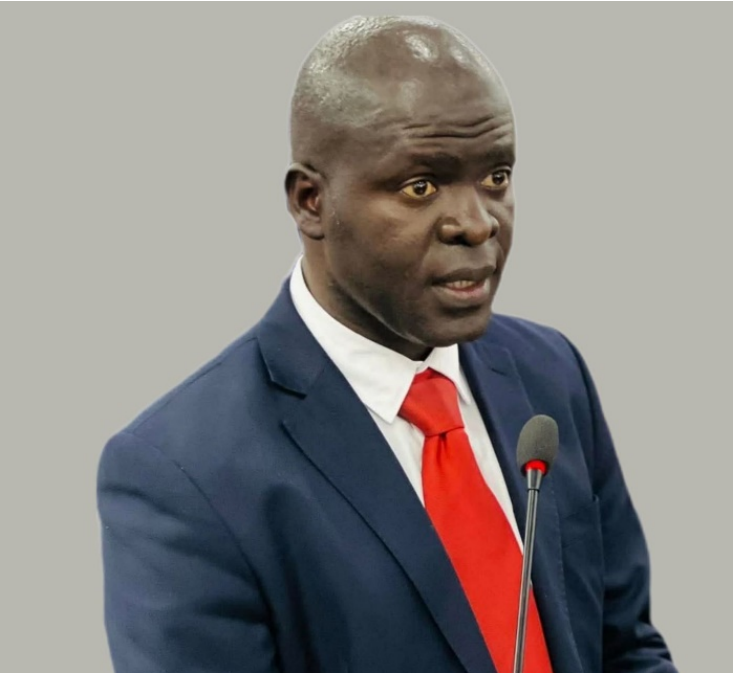
 EPA Boss Dr. Emmanuel K. Urey Yarkpawolo
The Environmental Protection Agency (EPA) of Liberia has concluded the 2025 work year with what Executive Director, Dr. Emmanuel K. Urey Yarkpawolo, described as a “defining chapter” in the institution’s history, marked by strengthened environmental governance, credible enforcement, and bold climate leadership.
By Emmanuel Weedee-Conway
Delivering a year-end closing address at the EPA’s headquarters in Mamba Point, Dr. Yarkpawolo boasted that 2025 was a year of “consolidation, credibility, and courage” for Liberia’s environmental regulator.
The ceremony also doubled as a Christmas celebration for EPA staff, was occasioned by the presentation of a cow, rice, and soup items donated by the office President Joseph Nyuma Boakai Sr.
“This occasion is not merely ceremonial. It is a moment of reflection, accountability, gratitude, and recommitment to our mandate and to future generations whose well-being depends on the decisions we make today,” said Dr. Yarkpawolo.
Stronger Enforcement and Rule of Law
According to the EPA Executive Director, one of the agency’s most notable achievements in 2025 was the full enforcement of the Environmental Protection and Management Law, restoring public confidence in environmental regulation. Over the course of the year, the EPA issued 257 environmental permits, verified 167 project sites nationwide, and rejected more than 70 permit applications due to non-compliance.
The agency also conducted 140 enforcement actions, imposed US$303,300 in environmental fines, and generated over US$200,000 in government revenue. In addition, the EPA developed 11 new environmental regulations, trained and certified 101 environmental evaluators, and held 34 Environmental and Social Impact Assessment (ESIA) conferences.
“These actions reaffirm a simple but powerful principle,” Dr. Yarkpawolo emphasized. “Environmental protection is not optional—it is the law.”
A major stride in 2025, he asserted, was the completion and operationalization of a state-of-the-art EPA environmental laboratory, capable of analyzing water, soil, air, marine samples, and supporting pollution and oil spill investigations.
The facility, including a mobile monitoring unit, significantly reduces Liberia’s dependence on external laboratories and strengthens national ownership of environmental data.
He revealed that EPA also launched the Natural Capital Atlas of Liberia, the first of its kind in post-war Liberia. The Atlas documents the country’s forests, wetlands, biodiversity, minerals, and ecosystems and supports national development planning under the ARREST Agenda and Liberia’s updated climate commitments. The Atlas has already been showcased at international platforms, including COP30.
Climate Leadership on the Global Stage
Dr. Yarkpawolo announced that the EPA successfully led the revision of Liberia’s Nationally Determined Contribution (NDC 3.0) under the Paris Agreement, integrating climate adaptation, mitigation, job creation, and a just transition.
In 2025, Liberia also increased its visibility in global environmental diplomacy, participating in the United Nations General Assembly, the UN Ocean Conference in Nice, France, and COP30 in Belém, Brazil, where Liberia hosted its own pavilion. At the Ocean Conference, Vice President Jeremiah Kpan Koung formally presented Liberia’s ratification of the BBNJ Agreement.
“Liberia is no longer on the margins of environmental diplomacy. Liberia is shaping the global conversation.”
Community Impact and Decentralization
At the national level, the EPA expanded its footprint across all 15 counties, deploying environmental inspectors, establishing County Environmental Committees nationwide, and intensifying community engagement through radio, social media, and grassroots outreach. These efforts helped address pollution incidents and promote environmental stewardship at the local level.
Investing in People and Partnerships
The EPA Executive Director credited the agency’s success to institutional reforms and human capital development, including staff training, scholarships for 150 Liberians valued at US$270,000, and international academic opportunities negotiated with Princeton University for master’s and PhD programs. The EPA also signed a memorandum of understanding with the Sierra Leone Environmental Protection Agency to strengthen regional collaboration.
Dr. Yarkpawolo expressed gratitude to President Boakai, the EPA Board and Policy Council, and international partners including the UNDP, AfDB, GEF, GCF, EU, FAO, US Embassy, Government of Canada, and others for their continued support.
Looking Ahead to 2026
Outlining priorities for 2026, Dr. Yarkpawolo said the EPA will focus on automating the ESIA system, strengthening legal enforcement, exploring the establishment of an Environmental Court, developing a Climate Change Trust Fund, introducing green taxes, and leading the drafting of Liberia’s Nuclear Act.