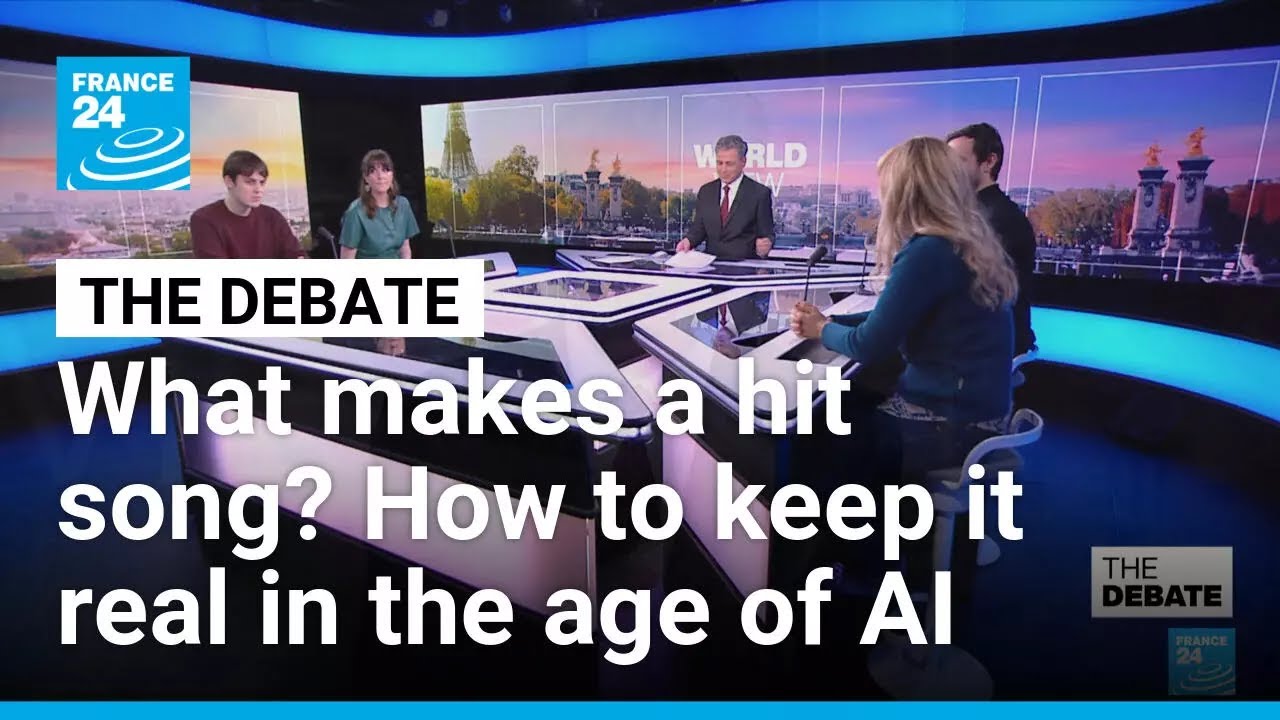
What makes a hit song? How to keep it real in the age of AI • FRANCE 24 English
There’s nothing more innately human than humming a tune. Especially when it’s made by humans. But don’t bother trying to see The Velvet Sundown in concert: the band doesn’t exist. The sounds are produced with artificial intelligence. Worse, most listeners can’t tell the difference with the real thing. If humans are going to continue to rule artistic creation, then our panel needs to answer one simple question: what makes a hit song?
#music #AI #TheVelvetSundown
Read more about this story in our article: https://f24.my/BdRp.y
🔔 Subscribe to France 24 now: https://f24.my/YTen
🔴 LIVE – Watch FRANCE 24 English 24/7 here: https://f24.my/YTliveEN
🌍 Read the latest International News and Top Stories: https://www.france24.com/en/
Like us on Facebook: https://f24.my/FBen
Follow us on X: https://f24.my/Xen
Bluesky: https://f24.my/BSen and Threads: https://f24.my/THen
Browse the news in pictures on Instagram: https://f24.my/IGen
Discover our TikTok videos: https://f24.my/TKen
Get the latest top stories on Telegram: https://f24.my/TGen
5 comments
ranting for one hour is obscene
All hit songs have the same thing in common: 1) They are simple. 2) They have a great hook 3) They have a great melody or beat. It's funny because sometimes the bandswill get it wrong on which one of their songs will be a hit. For example, Culture Club's Karma Chameleon, was denounced by all of the band members except Boy George, who said it would be a hit.
Hopefully all music award presenters from now on realize, ai isnt real music. If we start seeing an AI win Song of the Year, the world will be doomed!
Francois = EXCELLENT! 🙂🇨🇵🌹
Let me explain why it's difficult to distinguish between music created by humans and that generated by AI. The reason is very simple — AI is specifically "TRAINED" to mimic human output. This is the same phenomenon we see when asking an AI a question.
For example, if you ask AI "why is it so hot in the Summer and Cold in the winter?", you will get a comprehensive, nearly perfect response. The AI's answer will be "consistent" with — yet "not identical" to — the explanation provided by human experts. {Note: the importance of the keyword "Consistent" and "not identical"}
Crucially, while the AI generates this response, it does NOT even know the meaning of words like "hot", "summer", "cold", and "winter", etc. {For those interested in a little technical details, there is a series of messages entitled "AI Easy" I posted on YouTube about 9 months ago}.
In reality, these AI language models have a very unique way to "steal" human's works, through the so-called "training" process. By processing vast amounts of (or almost all) human works available on the Internet, the model fine-tunes billions of "parameters". When answering a question, the model simply references these billions of parameters: (1)the model just looks up the parameters associated with each word in the vocabulary, and (2) uses these parameters to calculate "probability" {meaning the "most likely word" to be put in the answer} without knowing the meaning of each word.
Consequently, the AI's answer is reasonably accurate but not identical to that of any of the human experts — it remains a statistical approximation rather than a human insight. Of course training an AI music model is a little different from training an AI language model. But the basic idea is the same – training the parameters by processing vast amounts of (or almost all) human works available on the Internet.
That's why I believe general industrial adoption of AI should be very limited, given its costs of energy and water.
While AI can certainly substantially enhance human work in various sectors, we must remember that it is ultimately just another tool.
Note: after asking Gemini (an AI) to correct the grammar, I asked it's opinion on my foregoing statements re AI mimicking human works. It basically agrees with almost all these statements of mine except the "stealing" part.
Comments are closed.