2025 CHRISTMAS CAMPAIGN
Help Aleteia continue its mission by making a tax-deductible donation.
In this way, Aleteia’s future will be yours as well.
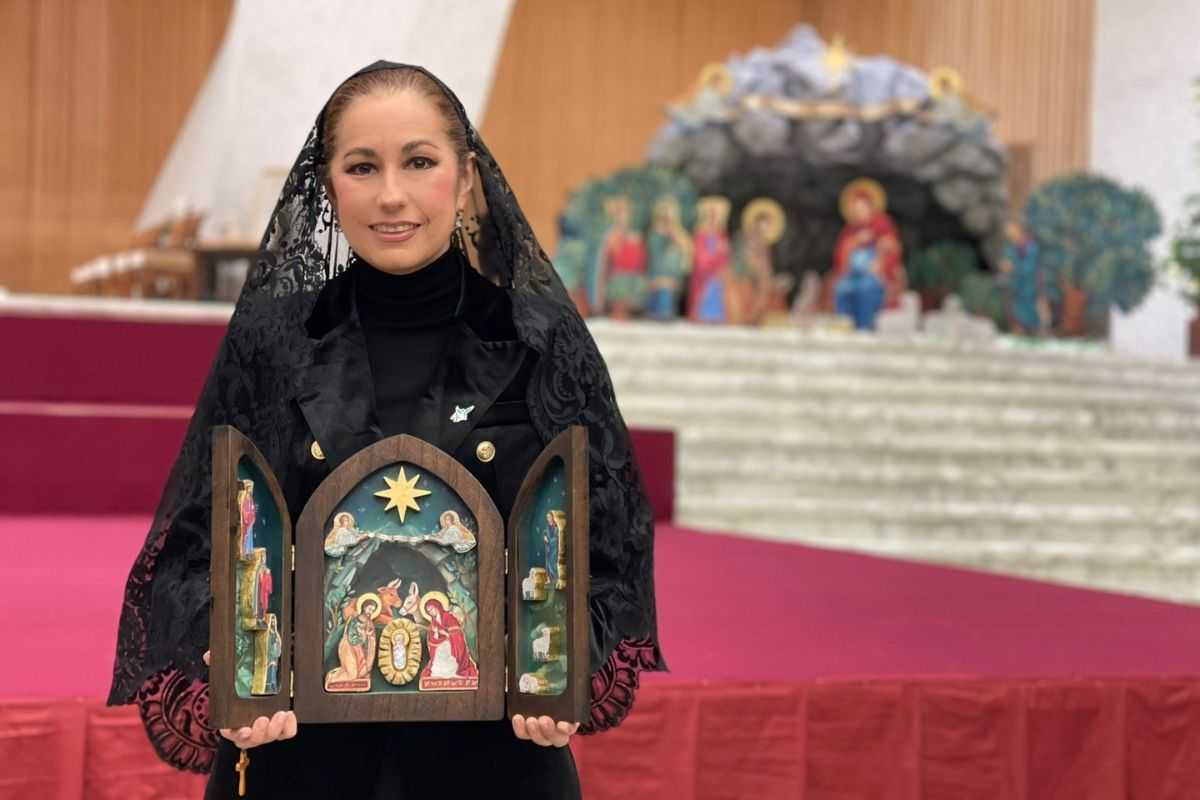
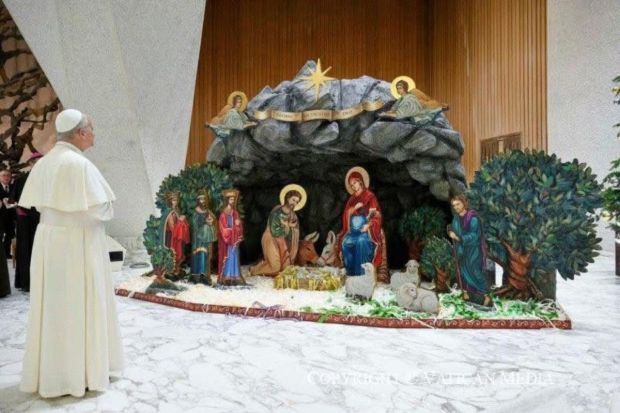
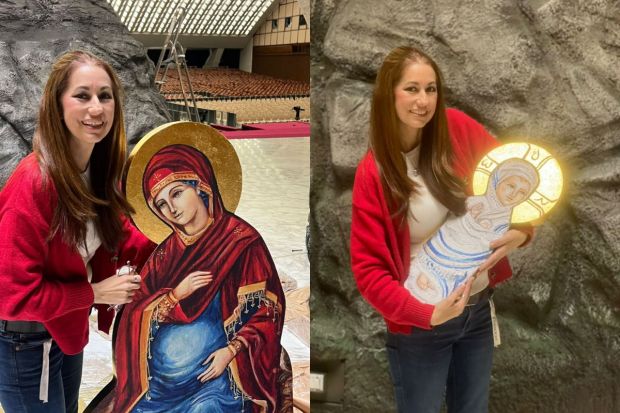
A unique Nativity scene graced Paul VI Hall this year: In it, up until Christmas Eve, the Virgin Mary was depicted pregnant. During the Jubilee of Hope, Paul VI Hall’s Nativity scene will not only be part of history, but also deeply touches the hearts of those who know the story behind its creation, including Pope Leo.
Paula en el Bosque is a sacred artist and creator of this work, titled Gaudium (joy in English). She told Aleteia about the creative journey that led her to the Vatican to share a message of hope at a time when many people have lost their sense of purpose in life.
“This Nativity scene is the first pro-life one in the history of the Vatican, the first blessed during this pontificate, and the one that closes the Jubilee of Hope.�
Courtesy of Paula en el Bosque
Aleteia: Where did the idea to create this Nativity scene come from?
Paula en el Bosque: It all started with Our Lady. In 2021 or 2022, I saw on television that Guatemala was setting up a Nativity scene in the Paul VI Hall. I thought it was beautiful. I looked into it and learned that it was the first Central American country to do so, something that’s normally done by Italy or other nearby countries.
I spoke with the ambassador, with whom we already had a close relationship, and the question arose as to whether Costa Rica could one day have a Nativity scene in the Vatican.
I already had something very clear in my mind and heart: I wanted a pregnant Virgin Mary.
Telling the story more completely
How did the idea of a pro-life Nativity scene come about?
Paula en el Bosque: This brings us to a fundamental issue: childhood. Today more than ever, we need to take care of children, pay attention to what they experience, what they see, and what they are taught.
From a very young age, I saw Nativity scenes at home and in church. I’m the eldest of four siblings, and I always asked my parents, “Why isn’t the Baby Jesus in the Nativity scene, and why isn’t the Virgin Mary pregnant?â€�
I saw my mother pregnant, with a baby bump, and it seemed strange to me that this was not reflected in the Nativity scene. They told me it was Advent, that we had to wait for the birth of the Baby Jesus. But I felt that the story wasn’t complete.

Courtesy of Paula en el Bosque
I felt that, from an iconographic point of view, the story needed to be told more completely, especially in a time marked by abortion and dehumanization.
The Incarnation isn’t an abstract idea: Jesus was conceived in Mary’s womb, had an umbilical cord, was nourished with her blood, and grew inside her. Mary felt his movements, her discomfort, her full motherhood. To deny that visually is, in a way, to deny her motherhood.
A “pro-life� Nativity scene
How were you able to present the Nativity scene at the Vatican?
Paula en el Bosque: I presented it thanks to the help of the ambassador, who spoke to the Vatican Governatorate. They told him it would probably be many years from now.
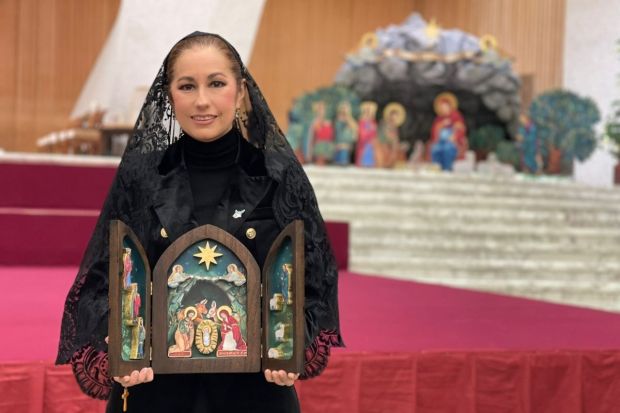
I replied, “It doesn’t matter, the important thing is to take the first step.â€� They asked me for a sketch, but I decided to make the complete Nativity scene, in miniature, and take it to Rome.
When I arrived and found myself in that room, I thought, “Here I am, an artist from Costa Rica, surrounded by engineers, architects, and authorities — this is much bigger than me.�
I explained to the cardinal and the others why this was a “pro-lifeâ€� Nativity scene. For years I’ve had a website called Paula en el Bosque, Arte en Defensa de la Vida (Art in Defense of Life), because I felt that there were no beautiful and deeply Catholic pro-life visual representations. I told them that I wanted to show Mary pregnant, that the Baby Jesus would be separate, and that on the 24th the image would be changed to a Virgin in adoration. The essential thing was to make visible Mary’s motherhood as the mother of us all.
Courtesy of Paula en el Bosque
I also explained that, historically, iconography avoided showing the Virgin explicitly pregnant. In Byzantine icons, the mystery was represented symbolically, not with a “baby bump.� But today, in this historical context, I felt it was necessary to clearly show the reality of the Incarnation.
When I explained all this, the cardinal was deeply moved. He told me that, of all the Nativity scenes he had received, he would keep this one for the rest of his life.
The road to the Vatican
What stages did the Nativity scene go through before arriving at the Vatican?
Paula en el Bosque: Initially, we were told that it could be placed there in 2027, and I entrusted it to St. Joseph. We didn’t have any money, so it depended solely on the generosity of the faithful. We launched a campaign with the support of the Autonomous University of Central America. And then something unexpected happened: They moved it up two years. The Nativity scene would be for the Jubilee of Hope.
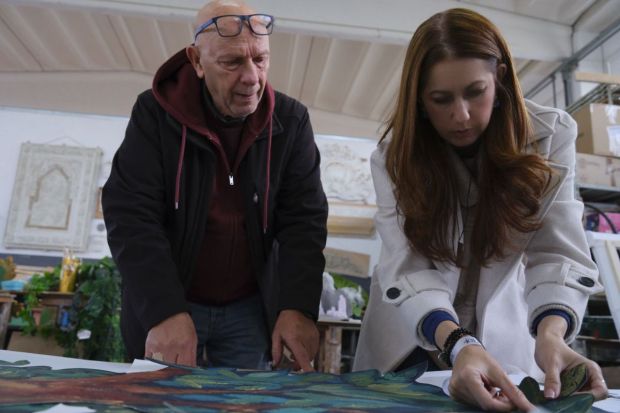
Two months before the trip, we didn’t have a single euro, but God opened the way again. In Italy, we found a set designer named Giacomo, a devotee of Padre Pio, who agreed to give us a discount as an offering to the Holy Father. Everything was providential.
Courtesy of Paula en el Bosque
We worked remotely, fine-tuning every detail. I arrived 10 days early to finish the work: gold leaf, ribbons, assembly. The hand of God was present in everything.
This Nativity scene is the first pro-life one in the history of the Vatican, the first one blessed during this pontificate, and the one that closes the Jubilee of Hope.
The symbolism of the ribbons
How was the Nativity scene created?
Paula en el Bosque: Instead of straw, the Nativity scene has straw-colored satin ribbons, and each ribbon represents a life saved from abortion.
I had spoken earlier with the 40 Days for Life movement, which keeps an official count of lives saved through prayer and fasting. More than 26,000.
Added to that were two institutions in Costa Rica that accompany pregnant women in vulnerable situations. In total, 28,000 lives are represented in ribbons.
And also, [I added a personal touch because] in Costa Rica, in front of the National Children’s Hospital, every Christmas they light up a big tree. When I was a child, I didn’t see the tree: I saw the sick children in the windows, with tubes, in gowns, smiling.
Courtesy of Paula en el Bosque
Today, in the manger of the Baby Jesus, there are 420 ribbons with requests written by sick children. They don’t ask for toys. They pray for their doctors, their mothers, their siblings. In suffering there is redemption, and that suffering is what warms this manger.
This Nativity scene is not decorative. It’s telling us something. It tells us that suffering offered up is fruitful, that hope is not lost.
What do you want people to feel when they see this Nativity scene?
Paula en el Bosque: I want those who see it to regain hope, to remember that God cares, that Mary is a mother, that life is always worth living. May they never, ever lose hope.
Support Aleteia’s mission with your donation