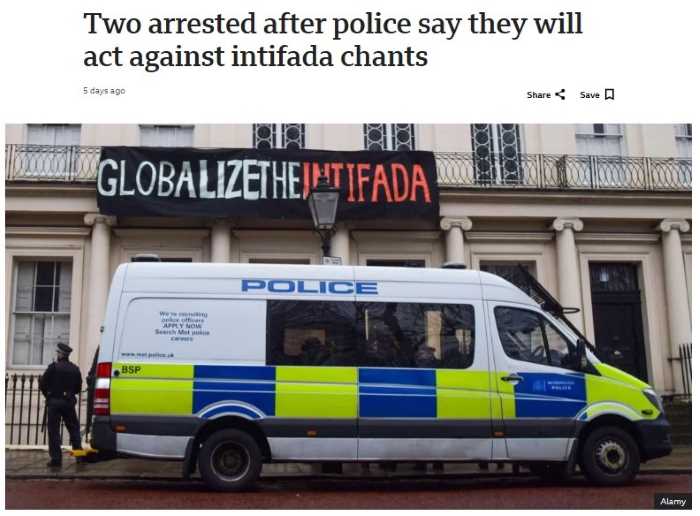
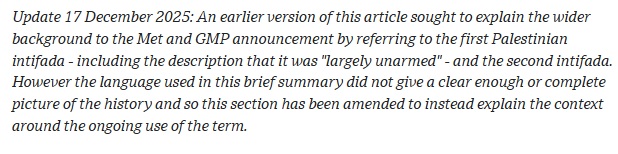
Late on December 17th the BBC News website published an uncredited report headlined “Two arrested after police say they will act against intifada chants”, the current version of which includes the following footnote:
The relevant part of the original version of the report read as follows:
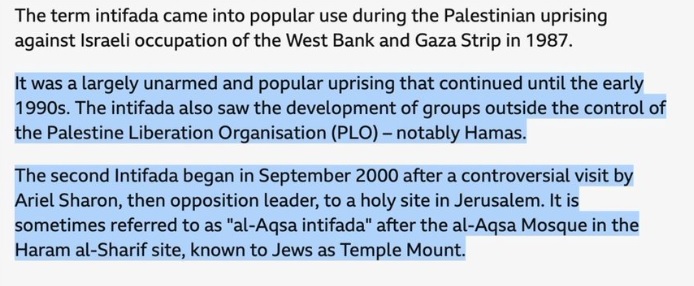
That portrayal of the first Intifada as “a largely unarmed and popular uprising” is particularly notable given that in 2017 a BBC television report marking thirty years since it began told audiences that: [emphasis added]
“In 1987, Palestinians began an “intifada”, or uprising, against Israeli rule. It lasted until 1993. Violent clashes led to the deaths of around 1,400 Palestinians and 271 Israelis.”
As was noted here at the time, then too the BBC ignored the internal Palestinian violence during the same period.
The Jewish Virtual Library provides the following documentation:
“During the first four years of the uprising, more than 3,600 Molotov cocktail attacks, 100 hand grenade attacks and 600 assaults with guns or explosives were reported by the Israel Defense Forces. […]
Jews were not the only victims of the violence. In fact, as the intifada waned around the time of the Gulf War in 1991, the number of Arabs killed for political and other reasons by Palestinian death squads in what amount to an “intrafada” exceeded the number killed in clashes with Israeli troops. […]
Palestinians were stabbed, hacked with axes, shot, clubbed and burned with acid. The justifications offered for the killings varied. In some instances, being employed by Israel’s Civil Administration in the West Bank and Gaza was reason enough; in others, contact with Jews warranted a death sentence. Accusations of “collaboration” with Israel were sometimes used as a pretext for acts of personal vengeance. Women deemed to have behaved “immorally” were also among the victims.
Eventually, the reign of terror became so serious that some Palestinians expressed public concern about the disorder. The PLO began to call for an end to the violence, but murders by its members and rivals continued. From 1989-1992, this intrafada claimed the lives of nearly 1,000 Palestinians.”
As we see, the first version of the report reverted to the long-standing BBC practice of inaccurate and romanticised portrayal of the first Intifada as “largely unarmed”. That version’s misleading portrayal of the second Intifada as having begun because of a “controversial visit” by Ariel Sharon to Temple Mount uses long-standing BBC framing.
21 YEARS OF BBC DISINFORMATION ON THE CAUSE OF THE SECOND INTIFADA
Yet again we see that one of the issues arising from the BBC’s failure to correct its own “permanent public record” online archive is the recycling of inaccurate and misleading claims years and even decades later by BBC journalists.
As the above footnote indicates, someone at the BBC News website apparently recognised the problematic nature of the report’s original portrayals of the first and second Intifadas and the wording was then changed to read as follows:
“The term intifada came into popular use during the Palestinian uprising against Israeli occupation of the West Bank and Gaza Strip in 1987.
Some have described the term as a call for violence against Jewish people.
Others have said it is a call for peaceful resistance to Israel’s occupation of the West Bank and actions in Gaza.”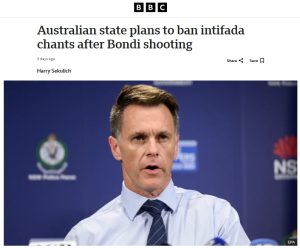
The same wording appeared in a BBC News website report published on December 20th under the headline “Australian state plans to ban intifada chants after Bondi shooting”.
Neither of those BBC reports bothers to inform readers of the identity of those “others” seeking to portray the term used by Palestinian terrorist organisations to describe periods of extreme violence against Israelis as “a call for peaceful resistance”. Listeners to a BBC Radio 4 report were however told that “pro-Palestine campaigners say it doesn’t necessarily imply violence”.
As noted by David Collier, the BBC’s promotion of that framing is particularly interesting given its past use of the term. During upticks in Palestinian violence in 2014 and 2015, the corporation’s journalists repeatedly used the term “third Intifada”.
“And certainly if you talk to Palestinians, many of them speak about a third Intifada – a third uprising – and I have spoken to Palestinians who believe only in non-violent resistance who’ve said to me it’s only a matter of time before it happens and if it happens, it’ll come because it’ll be sparked by something.” [Jeremy Bowen, July 3, 2014]
“Palestinians have carried out several deadly attacks against Israelis. Killings of Palestinians by Israeli forces have also fuelled anger. Jewish settlement activity in occupied East Jerusalem heightened tensions. Some believe this could be the start of a third intifada or Palestinian uprising.” [BBC News website, November 18, 2014]
“President Obama’s former special envoy for Middle East peace, George Mitchell, has warned that the prospect of a third Palestinian intifada is “dangerously close”.
He was speaking to BBC News a day after a deadly attack on a synagogue in Jerusalem which left four rabbis and a police officer dead.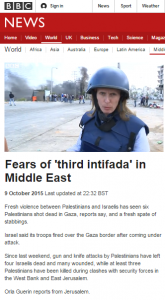
Mr Mitchell said an intifada or uprising would be harmful to the prospect of peace.” [November 19, 2014]
“Well the confrontation here is escalating. There are Palestinian stone-throwers on this side, Israeli security forces on the other. Rubber bullets have been used and there have been injuries [sic] taken away. The fear is that clashes like this could spread. Some here already calling this the third Intifada – or uprising.” [Orla Guerin, October 9, 2015]
“Well, they’re using the word Intifada again on the West Bank and in Israel. Attacks by Palestinians on Israeli Jews have increased in recent days – from the sporadic to the frequent. The first Intifada ran from 1987 to 1993 and mainly consisted of young people throwing stones and Molotov cocktails…ah…at Israeli troops. The second Intifada ran from 2000 to 2003 and involved suicide bombings and gun battles. Is the current wave of violence a third Intifada?” [Evan Davis, October 13, 2015]
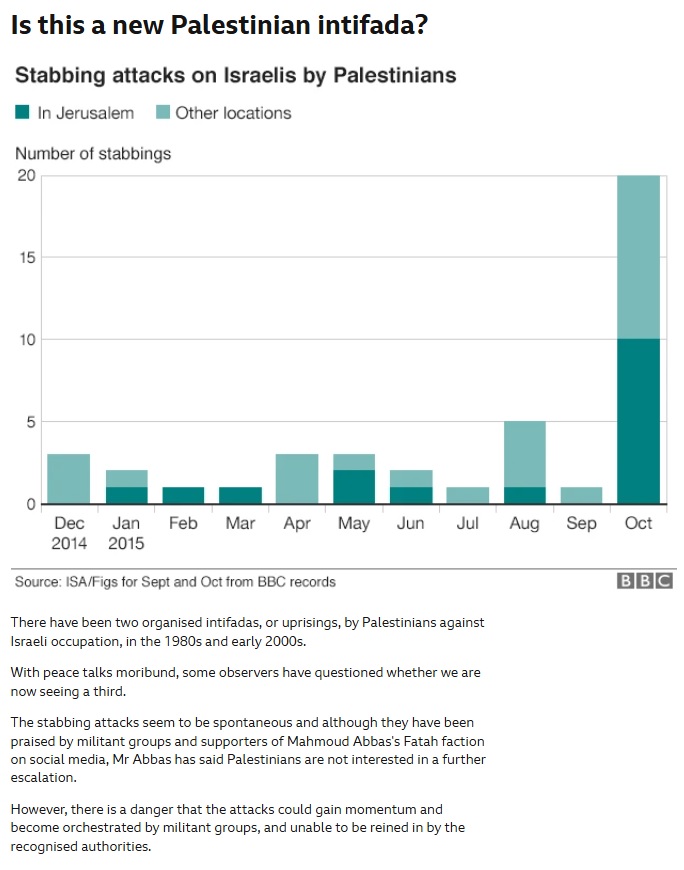
[BBC News website, October 13, 2015]
In 2011, the BBC News website was able to tell its audiences that the term intifada has the “connotation of violent revolt”:
“Facebook has removed a page calling for a new Palestinian uprising against Israel after more than 350,000 people signed up to it.
The page which appeared on the social networking site was called Third Palestinian Intifada after two previous uprisings against Israeli occupation.
It was removed for featuring calls for violence, a company spokesman said. […]
The Third Palestinian Intifada page had called for an uprising after Muslim prayers on Friday 15 May.
“Judgment Day will be brought upon us only once the Muslims have killed all of the Jews,” a quote from the page read. […]
Facebook said the page had begun as a call for peaceful protest, even though it used the term “intifada” with its connotation of violent revolt.”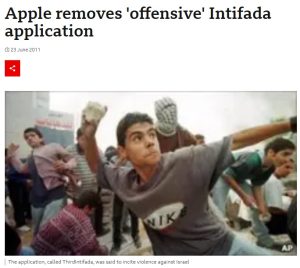
Also in 2011, the BBC News website reported that:
“Intifada refers to two violent uprisings against Israel over the past three decades, and a third intifada refers to a future uprising.”
As we see, over a decade ago the BBC was able to inform its audiences what the word intifada means and even used the term itself to refer to the possibility of Palestinian violence. In late 2025, however, the corporation has suddenly found fit to promote the narrative of unidentified “others” who patronisingly seek to rebrand that term for their own political interests.
That editorial decision of course hinders audience understanding of the reason why authorities in the UK and Australia have decided to adopt a different approach to chants and placards that, even after the murders of Jews in the UK, the US and Australia, continue to encourage violence and terrorism.