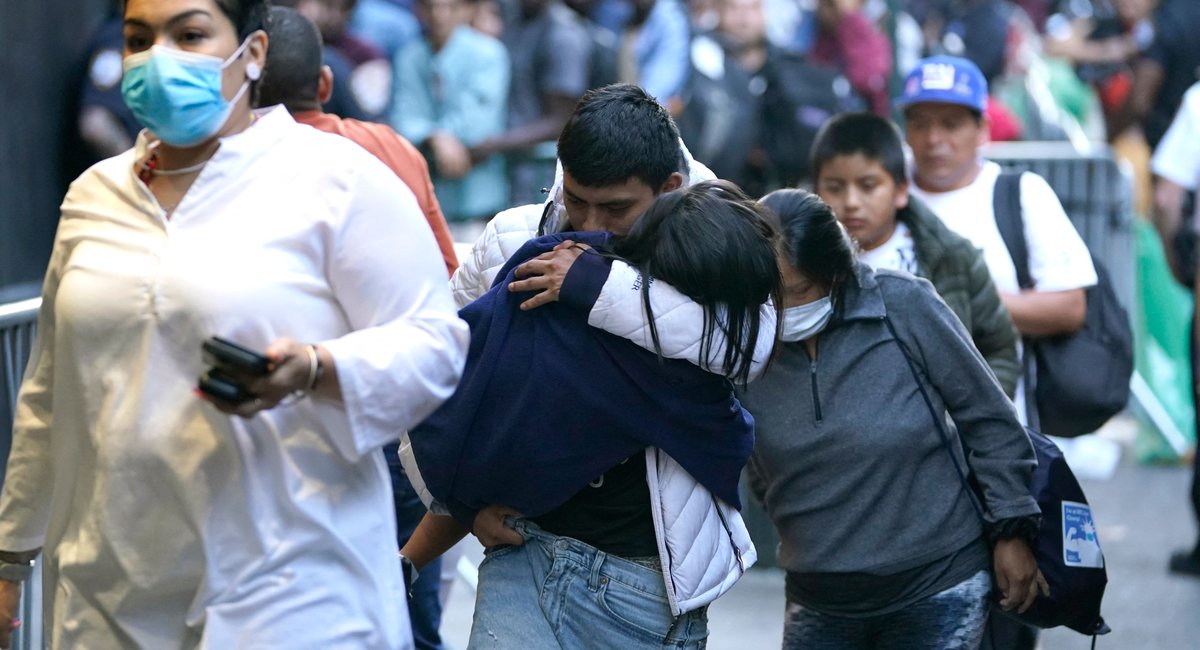
Just eight months into Eric Adams’ tenure as mayor of New York City, Texas Gov. Greg Abbott began sending buses of migrants to Manhattan, setting off what would become known as the “migrant crisis,” which many call a defining issue of the mayor’s term.
The influx of newcomers, many of them dropped off in Midtown Manhattan, strained the city’s shelter system, tested the city’s identity as a sanctuary for migrants and set off an intraparty Democrat squabble between Adams and then-President Joe Biden that some pundits say helped set the stage for President Donald Trump’s return to the White House.
“Immigration defined his mayorality,” said Muzaffar Chishti, senior fellow at the nonpartisan Migration Policy Institute at NYU School of Law. “In some ways, he dealt with it well, especially given the enormity of the challenges. In other cases, he was either tone deaf or had policies that backfired.”
More than 240,000 migrants have funneled through the city’s shelter system since the spring of 2022, costing the city over $8.7 billion, according to City Hall. In that time, city officials erected a system of more than 260 emergency shelters — including in sprawling tent cities and hotels across the five boroughs and in upstate communities — at times drawing the ire of shelter neighbors.
“Our ability to immediately jump in and start designing a system to handle this crisis, once we understood what was happening, was incredible,” said Deputy Mayor and Chief of Staff Camille Joseph Varlack, who worked closely on migrant-related issues at City Hall. “We created an entirely new shelter system to support this population, who had very different needs from our traditional system.”
“We largely did it on our own,” said Zach Iscol, the city’s emergency management commissioner, referring to the mobilization. The city’s shelter population more than doubled in size by January 2024, when City Hall says as many as 4,000 migrants a week were streaming into the city and applying for shelter.
Iscol added, “We got some help from the state. We got zero help from the federal government. And yet we still managed to do it at the scale we did.”
But the crisis rapidly became a thorny issue for the Adams administration, as city officials contended with critics on all sides, including those who thought the city wasn’t doing enough to help migrants and others who thought the city was doing too much.
Critics zeroed in on the administration’s providing prepaid debit cards to migrants to pay for food and baby supplies. Immigration advocates criticized the mayor for using divisive rhetoric, relying on costly no-bid contracts, implementing controversial shelter-stay limits for migrants, housing some migrants in facilities without showers, air conditioning or fully weather-proof exteriors, and for not doing enough to support nonprofits at the helm of providing aid to new migrants.
“His legacy’s probably going to be defined by chaos and missed opportunities,” said Murad Awawdeh, president and CEO of the statewide nonprofit New York Immigration Coalition, who added that Adams failed to see the influx of migrants as a “golden opportunity for the city.”
Here’s a look at some of the defining moments of the migrant crisis under Adams, according to immigration advocates, experts, and current and former city officials who spoke to Gothamist.
The first buses of migrants from Texas arrive in NYC
In early August of 2022, the first of what would become many buses of migrants from Texas arrived at the Port Authority Bus Terminal in Midtown Manhattan.
Ilze Thielmann, director of the nonprofit Team TLC NYC, said she learned of the arrival from a Texas-based nonprofit and, along with Adama Bah of the aid group Afrikana, quickly assembled volunteers to provide food, clothing, toiletries and transportation to shelters and other destinations. Thielmann said requests for city support, such as MetroCards and food vouchers, were denied, leaving volunteers to cover the costs or rely on donations.
In the weeks that followed, the city helped broker a deal with the Port Authority to allow volunteers to set up a makeshift welcome center inside the bus terminal, where the city provided on-site medical assistance and informational fliers alongside several other nonprofits. Eventually, the city also provided buses to city shelters and bus tickets to other cities.
But, for months, Thielmann and Bah said, volunteers shouldered much of the cost for greeting new arrivals. Thielmann said she personally spent about $50,000 on those costs, some of which were later reimbursed through federal emergency grants.
The lack of resources set off a fraught relationship between the city and some nonprofits at the helm of providing aid to migrants. Varlack didn’t respond to Thielmann’s specific claims, but she said it was often difficult to help fund community groups providing aid for migrants, given the city’s procurement processes.
“One of the things that was so challenging about this crisis is our ability to put money in the hands of additional organizations that would help us,” Varlack said. “ There’s a process for all of this. There needed to be mechanisms in order for us to get funding to these groups, and it just wasn’t fast.”
Hundreds of migrants sleep outside the Roosevelt Hotel
In late July 2023, stark images were broadcast across the country and the globe: Hundreds of migrants, largely West African men, were sleeping on sidewalks — curled up on cardboard boxes and backpacks — outside the Roosevelt Hotel in Midtown. For many, it was the first obvious sign that the city was struggling to shelter the influx of migrants.
The Roosevelt Hotel was the city’s main intake center for new migrants, opened in May of that year, and the migrants lined up outside were waiting to be processed to get a bed in the city’s shelters. But the line formed when Adams declared that the migrant crisis had reached a new zenith: the city’s shelter system was out of room.
The sight of migrants huddled in one of Manhattan’s most trafficked areas represented a new extreme in the city’s migrant crisis. Deputy Mayor Varlack described the moment as “incredibly difficult,” adding, “That was a moment where New Yorkers finally understood and appreciated what we had been struggling with and what we’d been trying to manage up until that point.”
Onlookers gawked and described the scene as “chaos,” “heartbreaking and maddening,” and “a disgrace.” In that moment, Chisthi said, “ The optics issue of the border was now becoming an optics issue in the interior cities.”
New York City was among several Democrat-led cities — including Washington, D.C., Los Angeles, Chicago, Philadelphia and Denver — where Texas sent buses of migrants, transforming immigration into a major voter issue hundreds of miles from the U.S.-Mexico border.
The Legal Aid Society and the Coalition for the Homeless threatened to sue the city for failing to comply with New York City’s right-to-shelter rules. The chaotic scene lasted for a few days before the Adams administration found more space and bused those camped out in Midtown to an old church building in Queens.
Adams says the migrant crisis will destroy NYC
In his opening remarks at a town hall in the Upper West Side on Sep. 7, 2023, Adams uttered what some saw as harsh words regarding immigrants, in a city renowned over centuries for taking in immigrants.
“Let me tell you something, New Yorkers, never in my life have I had a problem that I did not see an ending to. I don’t see an ending to this,” Adams said, referring to what he dubbed the “migrant crisis.” He added, “This issue will destroy New York City.”
The comments marked a stark departure from Adams’ earliest public comments on the migrant influx, when he affirmed the city’s identity as a “city of immigrants that welcomes newcomers with open arms.” Immigration advocates decried the mayor’s characterization, saying that his new rhetoric was harmful, galvanizing xenophobia and hatred toward new migrants. Awawdeh, with the New York Immigration Coalition, said uttering those words “was one of the most dangerous things that he did as mayor.”
“Immigrants literally are New York. They power our economy, care for families, enrich every single neighborhood that they live in,” Awawdeh said. “What harms a city isn’t people seeking safety. It’s leaders who refuse to invest in real solutions like he did.”
Several officials within the Adams administration said they disagreed with Adams’ rhetoric. Varlack said Adams’ statement wasn’t “ideal” and that she would’ve framed the situation differently, especially given the polarizing nature of immigration.
Adams was frustrated and didn’t mean that asylum-seekers themselves would destroy the city, Varlack said, but he was “sounding the alarm” on the fiscal impacts of the influx of people into the city’s shelter system, after several trips to Washington, D.C., to ask for help from the Biden administration.
The mayor’s comment foreshadowed — and some argue, contributed to — some of the political fallout to come. In October 2023, nearly six in 10 New York state respondents to a Sienna College poll said they agreed with Adams’ harsh prediction.
“It’s a bad year for sanctuary cities,” pollster John Zogby of Zogby International told Gothamist the following January. “It’s an instance also where Democrats have stirred their own pot and allowed it to be stirred because now this is a debate, not so much between Democrats and Republicans, but between Democrats and themselves, not the least of which are the mayors of big cities vs. the federal government.”
The Roosevelt Hotel welcome center closes
It was in May 2023 that the Adams administration reopened the shuttered Roosevelt Hotel and made it the Asylum Seeker Arrival Center, a central intake center for new migrants arriving in New York City and looking for shelter. It became an important waystation for newcomers to the city, informally dubbed “The New Ellis Island” by some city officials.
Most of the migrants who came to the city during the migrant crisis were processed at the Roosevelt Hotel, 155,000 people in all, according to the city’s hospital system, which ran the center. The center provided other services, like vaccines and bus and plane tickets to other cities.
For some migrants, it was where they first ever received professional medical care, city officials and advocates said. Notwithstanding later images showing migrants camped on the sidewalk outside the hotel, many see the intake center as a crowning achievement of the administration’s response, especially in the absence of major federal support.
“If we ran the Roosevelt Hotel kind of operation at the border, we might bring the asylum crisis under control,” Chishti said.
The center closed this summer, as the number of migrants seeking shelters sharply declined over the past year and the buses from Texas long since stopped. In the center’s final week of operation, fewer than 100 people were applying for shelter there, according to City Hall.
Just last week, Varlack placed an ID card from the Roosevelt Hotel in a time capsule memorializing the work of the Adams administration. It was buried near City Hall and is set to be opened in 10 years.