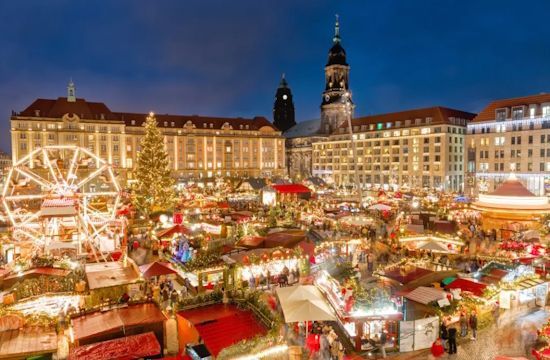
More than 17.3 million visitors are expected to be attracted this year by Central Europe’s Christmas markets, while their economic impact is estimated to reach €986.8 million. According to a recent analysis by The Data Appeal Company and Mabrian (Almawave Group), the seven most popular Christmas markets in Central Europe are no longer merely a festive addition to the urban landscape, but are evolving into a core pillar of winter tourism for many European cities.
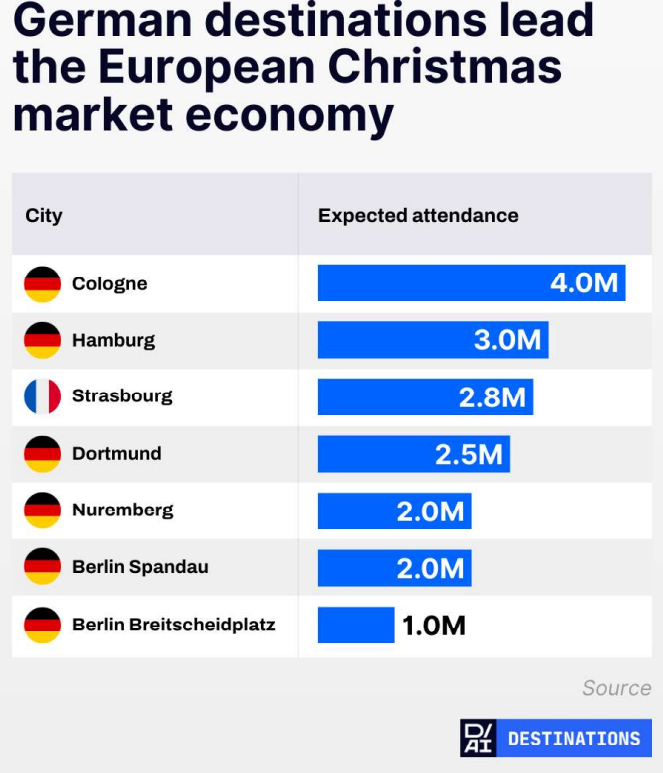
What stands out is the geographical concentration of success: six of the seven markets are located in Germany, with the sole exception being Strasbourg in France. These are markets with extremely high visitor numbers, which manage to activate the local economy during a period traditionally considered a low tourist season.
Germany dominates Europe’s “Christmas economy.”
Germany’s leading position is no coincidence. The country hosts thousands of Christmas markets every year, while historical examples such as the Nuremberg market have shaped the global standard of the modern Weihnachtsmarkt. Combined with an extensive railway network, easy cross-border access, and a strong gastronomic identity, German cities have all the competitive advantages needed to attract both domestic and international visitors.
Characteristic examples are Cologne and Hamburg. The two cities are expected to account for 44% of total visitor spending, with Cologne reaching €229.4 million and Hamburg €207 million in economic impact.
Cologne: the “flagship” of Christmas markets
At the top of the ranking is Cologne’s Christmas market, set in front of the city’s iconic cathedral. With an estimated 4 million visitors and nearly €230 million in economic footprint, Cologne ranks first both in visitor numbers and in spending.
Its success is directly linked to the city’s international recognition, excellent accessibility, and its stable position as one of Germany’s most popular winter urban destinations. The market acts as a powerful attraction not only for tourists, but also for millions of day visitors from neighboring regions.
Food and drink are at the center of spending
Of particular interest is the breakdown of tourist spending. According to the analysis, 58% of visitor expenses are directed toward food and drink, confirming the decisive role of gastronomy in the Christmas market experience. Transport follows with 28%, while only 14% αφορά accommodation.
This picture reflects the nature of the markets as spaces of experience and sociability, where local flavors, mulled wine (Glühwein), and a sense of collective festive participation dominate.
Berlin: One city, dozens of markets
Berlin is a special case in the study, as it is the only city with two markets in the top seven: Spandau and Breitscheidplatz. Together, they are estimated to generate an economic impact of €191.4 million, while also showing some of the highest average spending per visitor.
This finding becomes even more significant when considering that, according to the city’s official tourism website, Berlin hosts a total of 95 Christmas markets. These markets form a dense winter tourism ecosystem that operates in complementarity with the city’s cultural and urban identity.
Day visitors and the search for experience
The limited share of accommodation in total spending indicates that Christmas markets primarily target locals and regional day-trip visitors. This audience spends mainly on experiences, transforming the markets into open-air spaces for dining, meeting, and entertainment.
What the findings mean for tourism stakeholders
For destination management organizations (DMOs), municipalities, and local authorities, these data highlight the strategic importance of Christmas markets as tools for strengthening winter tourism, boosting local entrepreneurship, promoting and reinforcing city branding, and extending visitor stays through complementary experiences.
Christmas markets can function as a “gateway” to a broader tourism narrative, encouraging travelers to stay longer and to return outside the festive period.
The study confirms that, in a period of growing demand for experiences and authenticity, Christmas markets remain one of the most effective tools for activating demand in the low season, combining tradition, cultural significance, and a strong economic footprint.