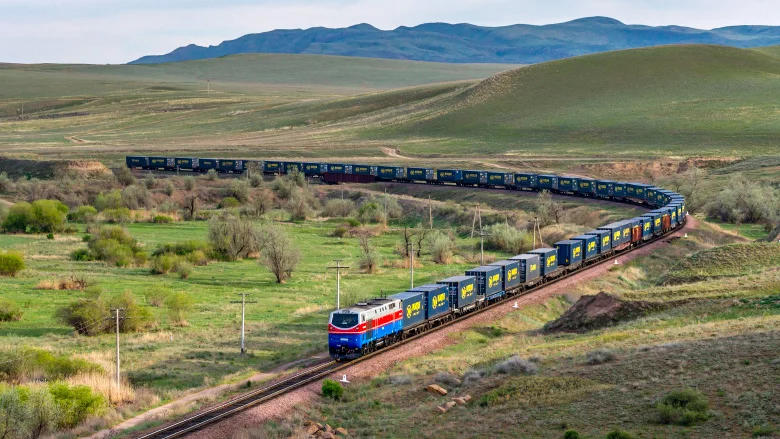
BAKU, Azerbaijan, December 26. Uzbekistan has
the potential to be a key partner in Central Asia for Europe,
Ambassador of the European Union to Uzbekistan Toivo Klaar told
Trend.
“On transport Uzbekistan has the potential to be a key partner
in Central Asia for Europe through the construction of new road and
rail infrastructure, which we are supporting,” the ambassador
noted.
He recalled that, within initiatives aimed at developing
transport infrastructure in Central Asia, the EU and Uzbekistan
agreed to attract financing from the European Investment Bank of up
to 100 million euros, backed by an EU guarantee of six million
euros, for the implementation of the Nukus highway development
project.
“The upgrade of the A380 highway, one of the country’s main
transport arteries, is expected to strengthen regional trade and
streamline transport flows with neighboring states within a
modernized, expanded, and strengthened TCTC transport network that
will link Central Asia with the South Caucasus, Türkiye and
Europe,” Klaar emphasized.
In addition, he said that the EU, together with the European
Bank for Reconstruction and Development, will finance a
pre-feasibility study on the construction of a motor road and a
railroad linking Uchkuduk in central Uzbekistan with Kyzylorda in
the south of central Kazakhstan.
“Once implemented, these infrastructure projects will
significantly increase transport, logistics, and economic and trade
options of the Central Asian region and Uzbekistan first of all. We
hope that Uzbekistan will actively participate in and own these
development projects to benefit from the increased number of
geoeconomic options that will arise as a consequence,” he
added.
The Nukus highway development project is part of the larger
initiative to modernize the A380 “Guzar-Bukhara-Nukus-Beyneu”
highway, a key segment of the Central Asia Regional Economic
Cooperation (CAREC) Corridor 2 trade route in Uzbekistan. Supported
by the Asian Development Bank (ADB) and the Asian Infrastructure
Investment Bank (AIIB), the project aims to reconstruct and widen
highway sections using climate-resilient materials, enhance
connectivity to European markets, improve transportation safety and
efficiency with Intelligent Transport Systems (ITS) and
weigh-in-motion (WIM) systems, and promote economic growth by
reducing travel time and operational costs while increasing transit
freight volume and service facilities along the road.