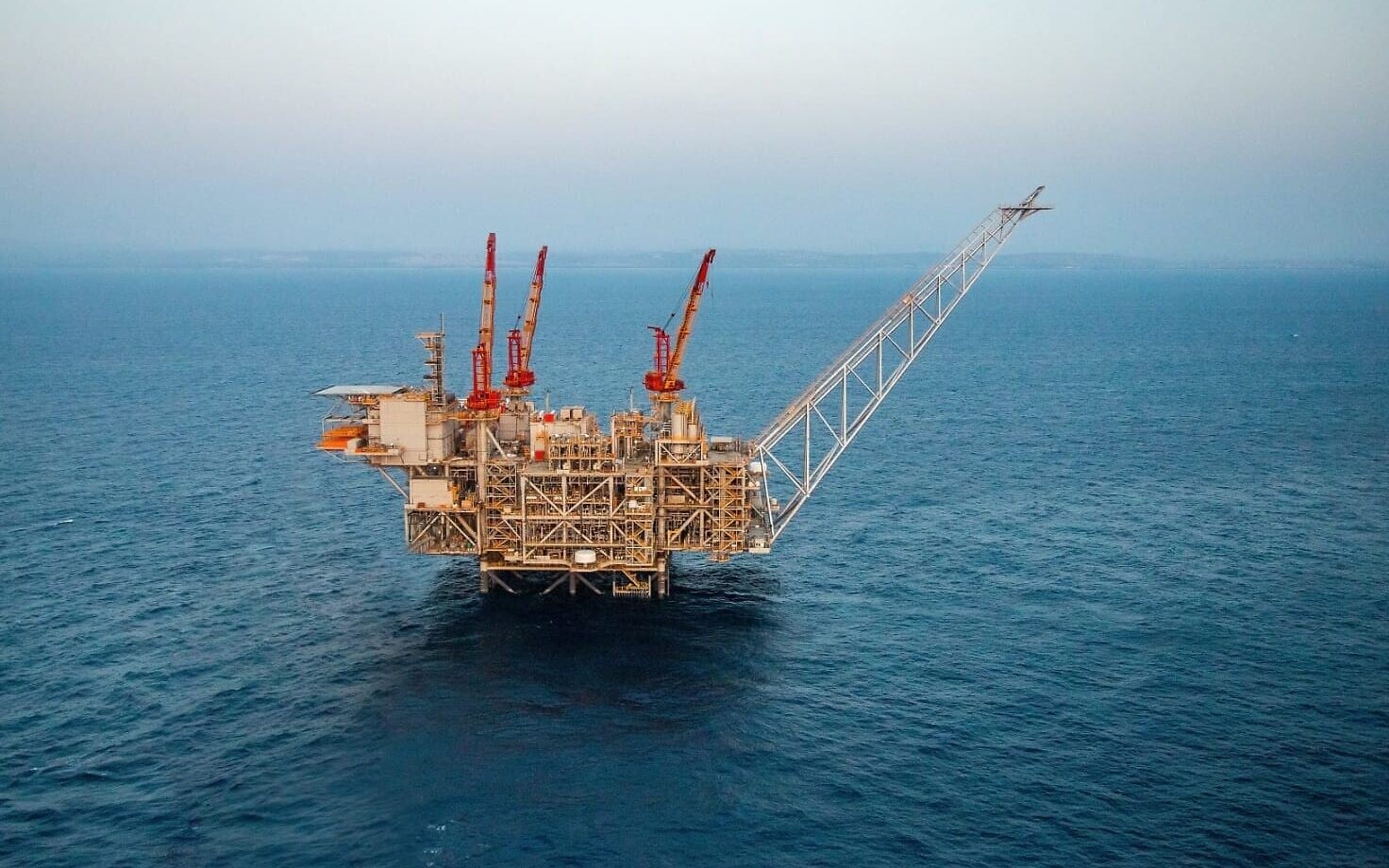
In a celebratory Hanukkah announcement earlier this month, Prime Minister Benjamin Netanyahu and Energy Minister Eli Cohen declared that they had sealed a $35 billion natural gas deal with Egypt, hailing it as a “historic moment.”
Netanyahu promised that not only would the deal pump NIS 58 billion ($18 billion) into state coffers to strengthen education, health, infrastructure and security, but he also vowed that the deal would not result in increased energy prices for the Israeli public.
In reality, though, the deal carries the risk of creating a shortage of natural gas in the domestic market within about a decade, leading to higher electricity prices for the public.
Under the largest export deal in the country’s history, a total of 130 billion cubic meters (bcm) of natural gas will be supplied to Egypt through 2040, with Israel receiving NIS 112 billion ($35 billion) in return. The amount totals some 15 percent of the country’s proven gas reserves, or about a decade’s worth of domestic consumption.
While Israel will receive around half of the proceeds from the sale, the rest will go to the partnership that owns the development rights to Israel’s offshore Leviathan reservoir, one of the world’s largest deep-water gas discoveries. The consortium includes NewMed Energy, formerly Delek Drilling (part of Yitzhak Tshuva’s Delek Group), which owns a 45.3% stake, US energy giant Chevron, which holds a 39.66% stake, and Ratio Oil Corp., with a 15% stake.
Boosters have touted the deal as a diplomatic and economic bonanza, trading the natural resource for buckets of cash and increased regional stability.
But critics argue that it amounts to a sell-off of the country’s energy reserves, benefitting a handful of tycoons while putting the country on the path to losing its energy independence sooner.
“Israel currently enjoys energy independence for its electricity market, meaning we are not dependent on any other country for our electricity consumption and supply,” Ariel Paz-Sawicki, head of research at Lobby 99, a grassroots advocacy group, told The Times of Israel.
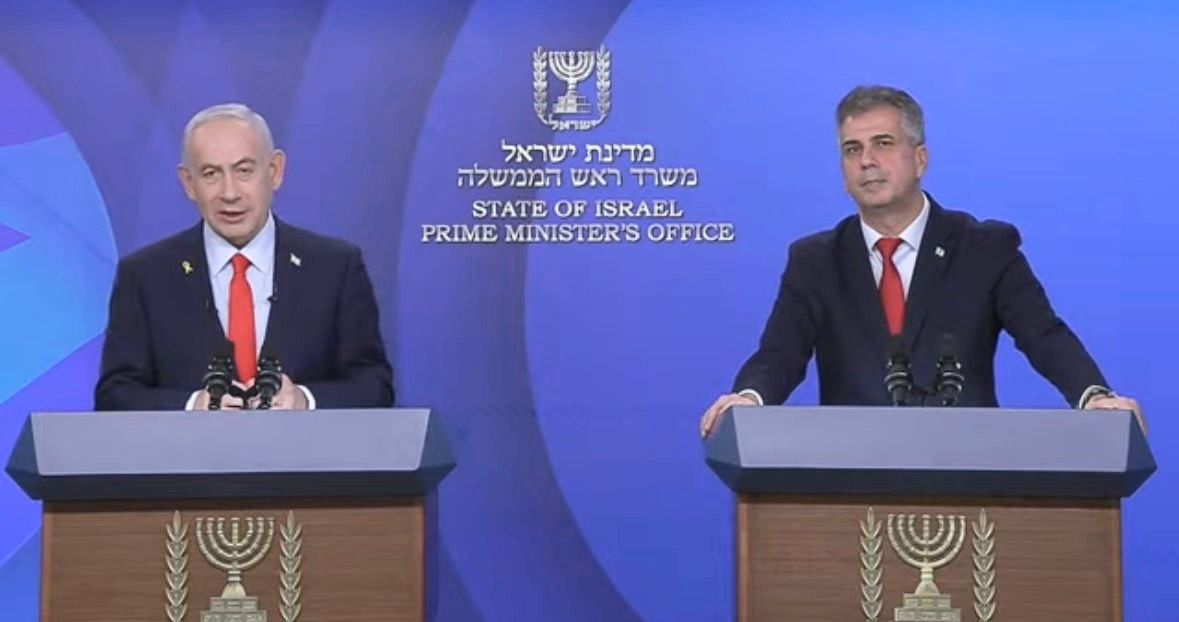
Prime Minister Benjamin Netanyahu, left, delivers a video statement alongside Energy Minister Eli Cohen, announcing a record gas deal with Egypt, December 17, 2025. (Energy Ministry)
He said the deal means the Leviathan reservoir will double its rate of production and be depleted more quickly. That, he said, will shorten the period of time when Israel is energy independent.
“What is likely going to happen to Israel is what happened to other countries who, in the past, were energy independent, and because of liberal exports, became dependent on expensive natural gas imports such as the Netherlands or the United Kingdom,” Paz-Sawicki said.
More than 70% of Israel’s electricity is currently generated from domestic natural gas production. Once the gas fields dry up and Israel has to start buying from elsewhere, prices can be expected to rise.
According to Paz-Sawicki, the depletion of the natural gas reserves means consumers can eventually expect a 25% increase in electricity bills, assuming the country does not follow through on plans to increase its use of renewable energy sources.
Gabriel Mitchell, a policy fellow at the Mitvim Institute think tank, said that with the Egypt deal in place, that day could be only a decade away.
“The trajectory and the projection of when ‘peak gas’ consumption will happen, will happen sooner than what was originally projected for around 2045… We are now looking at probably 2035,” he said.
With projections that local demand will exceed local supply earlier than expected, gas producers will essentially be incentivized to charge higher prices when negotiating their contracts, he said.
“This will have a very clear impact on the cost of living for the Israeli public because everyone consumes electricity,” said Mitchell.
Israel first discovered large natural gas fields off its Mediterranean coast in the first decade of the 2000s, transforming what had been a resource-poor energy importer into a natural gas powerhouse, with enough to supply its own needs and export elsewhere. The finds have helped shield the country from the worst of the energy crisis sparked by the Russian invasion of Ukraine, and have also been leveraged as a potential bargaining chip in geopolitical diplomacy.

Ariel Paz-Sawicki, head of research at grassroots civil society advocacy group Lobby 99. (Inbal Marmari)
Gas from the Tamar field, which holds some 280 bcm of natural gas, began to flow to Israel’s domestic market in 2013, followed in 2019 by Leviathan, which is thought to contain twice as much of the fossil fuel.
In 2020, the partners in the Leviathan reservoir began exporting natural gas to Egypt as part of a deal for 60 bcm, which is expected to be supplied by the early 2030s.
“Israel must accept that its gas supplies are shrinking while gas demand is increasing, which means that the country needs to start planning for the day after ‘peak gas’ and how to ensure that transition doesn’t adversely impact its economic growth and energy security,” said Mitchell, who is also a visiting fellow at the German Marshall Fund. “Egyptian demand is not going to decrease; it’s only going to increase in the next decade.”
“Israel is going to have to figure out what the right balance is, considering all of the factors at play, the geopolitical interests, but also its own domestic interests in order to ensure that Israelis are able to have affordable electricity,” Mitchell added.
Power to the pumpers
The giant Egypt deal was approved by the government despite the Finance Ministry earlier this year raising genuine concern that increased exports will undermine domestic energy security and drive up prices for Israeli consumers.
“Israel must accept that its gas supplies are shrinking while gas demand is increasing, which means that the country needs to start planning for the day after ‘peak gas’
Justifying the Egypt deal, Netanyahu is banking on the premise that the huge export deal will cement the country’s position as a regional energy superpower, and draw other companies to search for and discover new natural gas reservoirs in local waters, which will help to keep pace with future domestic consumption needs.
But Paz-Sawicki noted that it’s not as if prospectors haven’t been searching for profitable plays off Israel’s coast since the last major find.
“Fifteen years have passed since the last big discovery in Israel’s waters even though during this entire period exploration was encouraged and a host of concessions were given to entrepreneurs,” he said.
There is a logic to the government’s hope that the expanded agreement with Egypt will encourage future exploration, more investment, and, in turn, will deliver more money for taxpayers, Mitchell said.
“It’s a lot of ifs,” he added.

Gabriel Mitchell, visiting fellow at the German Marshall Fund and policy fellow at the Mitvim Institute. (Courtesy)
Veteran geologist Yossi Langotsky, who discovered the Tamar gas field in 2009 and who has long warned that Israel is making a mistake by putting exports ahead of securing Israel’s strategic gas reserves, recently estimated that there is little chance of finding more discoveries of the size of the Tamar or Leviathan fields.
“Given these fairly pessimistic projections for finding more gas, the right move at this point is to be more conservative, keep more gas for the Israeli market, but unfortunately, there was a lot of pressure from the gas companies and the US administration to authorize this deal,” said Paz-Sawicki. “The right step in terms of energy security is for the Leviathan expansion to be carried out in front of an anchor customer in Israel – for example, the Israel Electric Corporation, and sign a deal with them for 40 years to make sure local demand is satisfied.”
But he noted that the private companies pumping the gas out of the ground prefer the export market, which commands a higher profit margin for their investment.
Mitchell said, “Israel is caught in a bind where it’s married to the singular Egypt export option, and it’s married to commercial parties who are only interested in pursuing this single option, and so that makes it very difficult for Israel to negotiate effectively to export less, also in the years to come.”
Experts emphasized that Netanyahu’s promises of riches from taxes and gas royalties flowing into the state’s coffers should be taken with a pinch of salt.
“The past decade has taught us that promises of future taxation from gas sales cannot be trusted,” said Paz-Sawicki. “In 2015, the Finance Ministry estimated that over $5 billion from gas reserves would enter the sovereign wealth fund by 2024; in reality, the number is about $1.5 billion, less than a third of what was promised.”
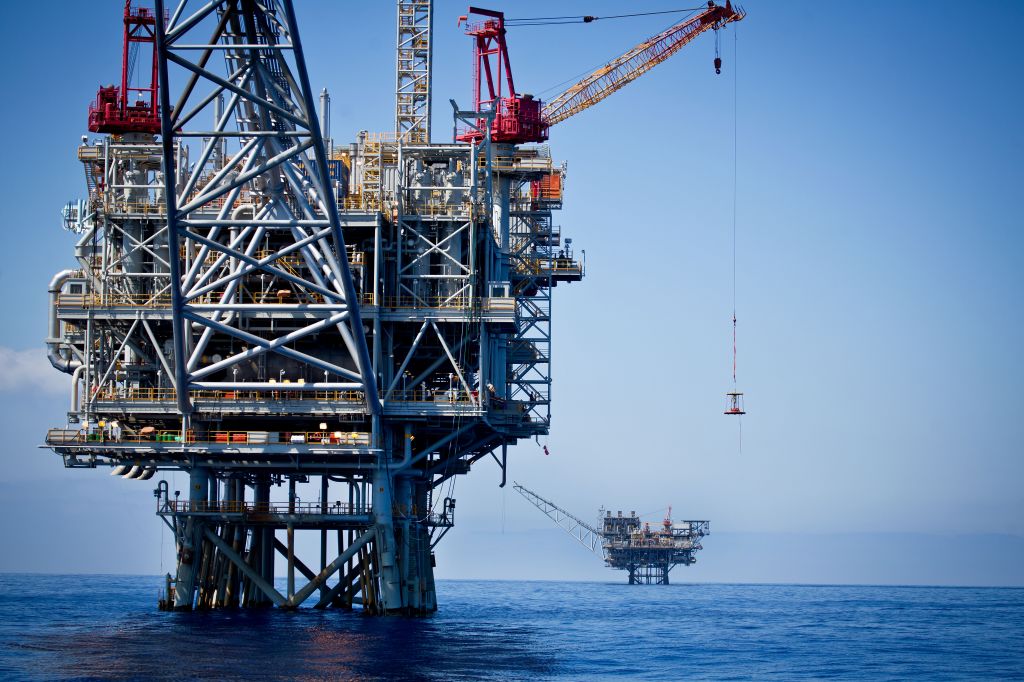
Gas rigs in the Tamar field, off the coast of Israel, June 2014. (Moshe Shai/Flash90)
The majority of the revenue from gas royalties is generated from export sales, mainly to Egypt and to a smaller extent to Jordan. Israel’s sovereign wealth fund, also known as the Israeli Citizens’ Fund, was created to invest expected windfall profits from the discovery of natural gas and other natural resources.
Mitchell said that without a long-term policy, Israel could find itself by the next decade in a situation where it is scrambling to explain how its natural resources were plundered, while forced to import expensive natural gas to meet its domestic energy needs.
A decade is a long time, and the government can already begin to start developing the infrastructure needed to move away from gas, a finite resource, and toward more renewables, he advised.
“The short-term gains from the deal are difficult to ignore, but only if Israel manages to develop a comprehensive long-term strategy that addresses the country’s future energy demands and its vulnerability to the demands of a small group of investors and one significant export route, Egypt,” said Mitchell. “Israel isn’t in a kind of danger zone, but it will become more costly the longer the government waits.”