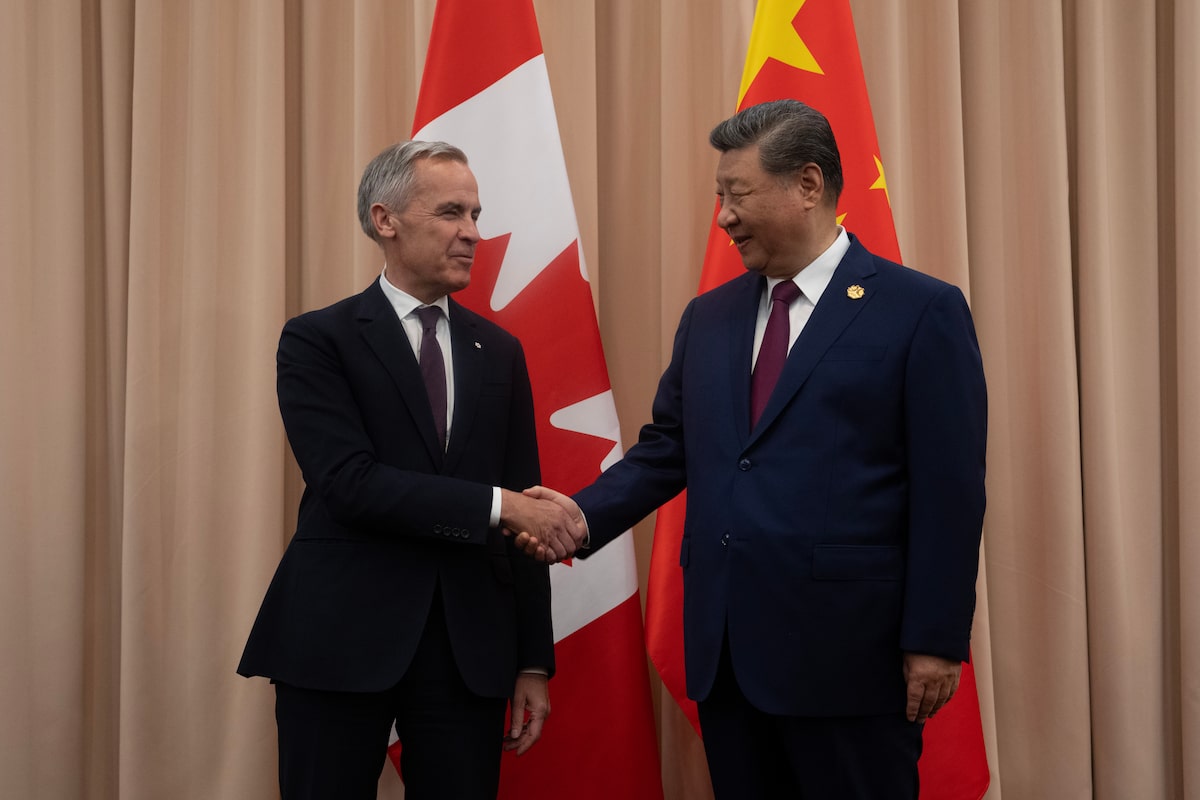
Prime Minister Mark Carney meets Chinese President Xi Jinping at the start of a meeting in Gyeongju, Oct. 31.Adrian Wyld/The Canadian Press
As members of Prime Minister Mark Carney’s team lay the groundwork for an expected trip to China next year, one many hope could end a smouldering trade war between Beijing and Ottawa, they are taking some inspiration from a province that never broke off engagement: Alberta.
Ottawa has been talking a lot to Invest Alberta (IAC), a provincial Crown corporation.
“We’ve had more conversations with the federal government in the last six months than at any time in my tenure,” Rick Christiaanse, chief executive of IAC since October, 2021, told The Globe and Mail in an exclusive interview during a visit to Hong Kong this month.
China and Hong Kong accounted for more than $60-billion worth of foreign direct investment in Canada last year, the third-biggest source of overseas money, about half of which flowed to Alberta.
On his seventh visit to the region in the last four years, with another trip to China planned in January, Mr. Christiaanse said that while recent political strife meant relations often “weren’t easy,” a renewed push for trade with Beijing by the federal government means it’s “harvest time” for those who persevered.
“Our view has always been: We need more investment, Canada needs more investment,” Mr. Christiaanse said. “I think the fact we’ve shown up every year consistently, regardless of what’s going on, and we’ve had these discussions, has been incredibly helpful.”
Resetting relationship with China will be difficult, experts say
While Mr. Carney’s approach to China has been driven in part by a need to find new export markets owing to the protectionist policies of U.S. President Donald Trump, Ottawa’s rapprochement began during the waning months of the Justin Trudeau administration.
Then-foreign-minister Mélanie Joly visited Beijing in July, 2024, in an attempt to restart ties after they entered a deep freeze during the Meng Wanzhou-Two Michaels saga. But Canada’s decision to copy U.S. tariffs on Chinese electric vehicles soon derailed this push — and prompted tough Chinese levies on Canadian canola. It took a change of administration before talks could properly resume.
Ms. Joly also faced far more criticism domestically for engaging with China than her successor, Anita Anand, did following her own visit to Beijing in October, after Mr. Trump’s trade war justified for many Canadians a pivot to foreign-policy realism.
While Mr. Christiaanse said the case for disengaging from China “simply does not exist,” he acknowledged there was “absolutely” more pushback previously, which the federal government felt far more keenly than IAC.
“In the past, we’ve not necessarily been loud about our work” as regards China, he said. “Now with the changing environment in Canada and the push from the federal government to get back, it’s okay for us to have this conversation.”
While most Chinese investment in Alberta is in traditional oil and gas, with China a major customer of the expanding Trans-Mountain pipeline, there has also been interest in carbon capture and green energy projects, as well as investing in the province’s push to expand tourism, Mr. Christiaanse said.
He was hopeful a visit to China by Mr. Carney could unlock further investment, sending the message that Canada is open for business.
“In the past, Canada has been the place that says ‘no,’ whereas now Canada is the place that says ‘yes’ – Alberta was always the province that said ‘yes,’” Mr. Christiaanse said.
Mixed messaging from Ottawa has often left Chinese businesspeople and officials confused on exactly what the rules are when it comes to investing in Canada, what sectors are open to them and which are seen as too sensitive, said a senior executive representing Canadian business in Asia.
The Globe is not identifying the executive as they were not authorized to speak publicly.
Opinion: Carney wants a China ‘reset.’ May he avoid the mistakes of the previous four
While there is likely to be little Chinese resistance to investing more in Canada, other aspects of the trade relationship are a lot trickier. In particular, the pressure will be on Mr. Carney during or ahead of any China trip to get relief for the agricultural sector, which has been stung by the tariffs Beijing imposed in retaliation for Mr. Trudeau’s EV levies.
Asked for comment, Mr. Carney’s office pointed The Globe to a statement noting the “long history of co-operation between Canada and China,” as well as comments by the Prime Minister saying there would be “guardrails” around relations with China, and areas “where clearly the security threats are such that we would not have a deep relationship.”
Jacob Cooke, the Beijing-based chief executive officer of Canadian consultancy WPIC Marketing + Technologies, said while strained relations haven’t hurt Canadian brands, “the larger negative trade impact has been in commodities.”
“In terms of tangible results, Carney should press for the removal of Chinese tariffs on Canadian canola, seafood and pork,” he said.
“One positive impact of the thaw in bilateral relations is that more Canadian brands are expressing interest in exporting to China, and we continue to see China as a lucrative growth opportunity for Canadian brands.”
In the past, Canadian engagement with China was often seen in unequal terms, but the Asia-based executive noted Chinese officials are equally keen to rebuild ties with Ottawa and other middle powers as a hedge against the pressure they, too, are facing from the U.S.
Writing this month, Nick Bisley, a professor of international relations at Melbourne’s La Trobe University, said that just as during the worst years of the COVID-19 pandemic, governments and businesses sought “China plus one,” a strategy of diversifying from overreliance on one country for manufacturing or market access, now many are seeking the same when it comes to the U.S.
Canada has a strong case to make on this front, Mr. Christiaanse said. “We’ve always wanted to diversify, but what’s changed in our discussions in the last year is that people are now aggressively looking at ‘How do I diversify out of the U.S.’”
He pointed to sudden U.S. restrictions on talent visas, unpredictable tariffs and immigration crackdowns such as that targeting a South Korean factory in Georgia, as reasons investors are looking for a more stable North American partner.
“You know that if you’re going to come to Canada, that’s not going to happen.”
That’s a message Mr. Carney may deliver – quietly, with an eye on Mr. Trump – when he meets Chinese and other Asian officials in 2026, on a visit to Beijing or when China hosts the next APEC summit in Shenzhen in November.