Japan’s cabinet has approved a record defence budget of 9.04 trillion yen ($58 billion), a move criticized by Beijing as a sinister plot to remilitarize the country.
Approved on December 26, the draft defence budget for the upcoming fiscal year is 9.4% larger than the previous budget that ended in April. The rise is part of Japan’s five-year plan to boost its yearly armaments spending to 2% of GDP, which is currently in its fourth year.
According to reports, the budget proposal emphasizes the use of unmanned systems and surface-to-ship missiles to strengthen coastal defences and strike-back capability.
Japan has steadily increased its defence spending and is rapidly boosting its military might, including the acquisition of standoff strike capabilities and other advanced systems, to address the severe and complex security challenges posed by China’s military expansion, North Korea’s advancing nuclear and missile programs, and Russia’s assertive military activities in the region.
The latest budget approval carries added significance amid escalating tensions between Tokyo and Beijing, triggered by Prime Minister Sanae Takaichi’s remarks in parliament on November 7, 2025.
Responding to an opposition lawmaker’s question about “survival-threatening situations” under Japan’s 2015 security legislation, Takaichi stated that a hypothetical Chinese attack or blockade of Taiwan “could constitute a survival-threatening situation for Japan no matter how you think about it,” potentially justifying the deployment of Self-Defense Forces in collective self-defense.
Beijing reacted with immediate outrage, lodging strong protests, summoning Japan’s ambassador, and demanding a retraction, while Chinese state media and diplomats accused Takaichi of crossing red lines and reviving militarist rhetoric.
Tensions have remained elevated ever since, with the dispute spilling into diplomatic channels, social media threats from Chinese officials, and ongoing criticism at international forums, further highlighting the fragility of Sino-Japanese relations.
Earlier this month, the Chinese Navy’s J-15 fighter jet locked its radar onto Japanese combat jets southeast of Okinawa’s main island, in a dangerous provocation. “This radar-locking constitutes a dangerous act exceeding the scope necessary for safe aircraft operations,” the Japanese Defence Minister Shinjiro Koizumi said at the time.
The Japanese Cabinet adopted a draft initial state budget of 122.3 trillion yen on December 26, 2025, which reportedly includes defence and other spending, for the year beginning in April next year. The construction of the “SHIELD” layered coastal defence system has been allocated 100.1 billion yen, or about $640.8 million.
Formally known as Synchronized, Hybrid, Integrated and Enhanced Littoral Defence, the SHIELD program is a key initiative under Japan’s Defence Buildup Program to create a multi-layered coastal defence network using unmanned systems across air, surface, subsurface, and land domains.
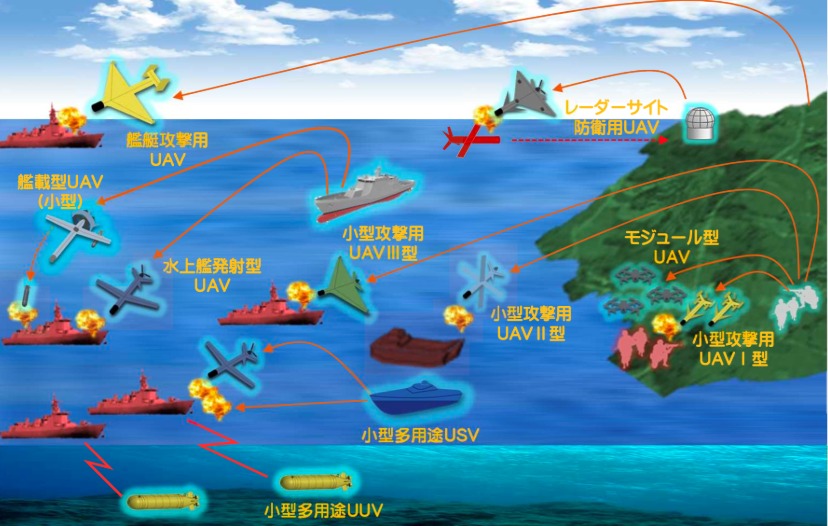 Japan’s SHIELD Program (Via Japan MoD)

The primary goal of SHIELD is to counter invading surface ships, amphibious forces, landing craft, armoured vehicles, and other threats at ranges of 20-30 km or more, providing a “drone wall” for littoral defence.
The SHIELD system could be operationalized by 2028.
The system aims to integrate various unmanned assets into a synchronized network for intelligence gathering, surveillance, and targeted strikes, creating a comprehensive shield for Japan’s southwestern periphery. This aligns with Japan’s fortification of the southwestern territories, mainly to counter threats posed by China’s military expansion, North Korea’s missile tests, and tensions over Taiwan and the Senkaku/Diaoyu Islands.
Announced in 2025 as part of Japan’s broader defence buildup, it integrates unmanned systems across air, sea, land, and underwater domains to create a unified, asymmetric defence network by combining resources from the Air Self-Defence Force (ASDF), Maritime Self-Defence Force (MSDF), and Ground Self-Defence Force (GSDF).
The GSDF could deploy three types of drones: short-range strike drones for attacking equipment and targets, extended-range drones for attacking enemy fortifications and landing ships, and long-range strike drones with a range of up to 100 kilometres to strike ground and surface targets.
Meanwhile, the MSDF ships-launched unmanned aerial vehicles (UAVs) for striking surface targets, small ship-based UAVs for intelligence and attacks, and small multi-role unmanned surface vehicles (USVs) for surveillance and combat, whereas the ASDF long-range anti-ship UAVs and interceptor drones near radar stations to protect air defence assets and counter enemy drones.
According to reports, 1.1 billion yen ($7.04 million USD) has been allocated to evaluate the use of long-endurance drones as a deterrent to airspace infractions with China in mind.
The SHIELD program is in line with Japan’s 2025 defence White Paper, which called for the acquisition of unmanned systems to enhance intelligence, surveillance, and reconnaissance (ISR) and strike capabilities, particularly for maritime and territorial defence against China. Japan believes swiftly acquiring and deploying such drones is essential to gaining the upper hand during combat while ensuring a reduction in human casualties.
These recommendations and plans come as modern combat is pivoting to unmanned systems and robotics, prioritizing autonomy and network integration.
The Ukraine war, for instance, has changed the rules of warfare and galvanized countries into exploring asymmetric combat platforms, primarily drones. In fact, China has emerged as one of the world’s leaders in drone technology, with unique designs unveiled in recent years.
Japan’s SHIELD program reportedly emphasizes importing off-the-shelf systems initially for rapid deployment, with plans to acquire several thousand drones. For instance, the Japanese Ministry of Defence (MoD) sought cash to purchase six coastal surveillance UAVs to support amphibious operations and detect beach obstructions, five long-range maritime UAVs to detect surface ships, and four MQ-9 Sea Guardian UAVs.
Earlier reports suggested that Japan was evaluating the Israeli Heron-2 and the Turkish Bayraktar TB2 drones to determine which is best suited to the needs of the Japanese Self-Defence Forces (JSDF).
Responding to the record hike in defence budget, Chinese Foreign Ministry spokesperson Lin Jian said Japan’s new defence budget plan reveals the sinister intentions of Japan’s right-wing forces to push for the country’s remilitarisation and resurrect militarism.
“Despite the international community’s continuous criticism over Japan’s military and security moves, Japan plans to substantially increase its defence budget once again instead of reflecting on its actions and exercising restraint,” he lamented.
In addition, the Japanese Foreign Ministry criticized what it called Japan’s “space militarisation.”
 File Image
Japan Is Militarising Space, Says China

Japan intends to rename the Air Self-Defence Force as the Air and Space Self-Defence Forces with an eye on strengthening its space capabilities.
It has reportedly allocated an additional 1.1 billion yen ($7.04 million) to purchase equipment to track satellite interference.
It is building a satellite constellation for target detection/tracking, which will support standoff missile guidance in combat. Additionally, the country is prioritizing next-generation defence communications satellites.
To ensure that its forces can function efficiently even in the face of electronic or cyberattacks, the budget places a strong emphasis on developing capabilities across several domains and on making large investments in satellite communications, space surveillance, and cyber defence.
Moreover, it has allocated about 30.1 billion yen ($192.5 million) to purchase hypersonic guided missiles, which are difficult to intercept and can travel at more than five times the speed of sound.
Japan adheres to its long-standing policy of peaceful use of space and, in 2022, explicitly committed not to conduct destructive direct-ascent ASAT missile testing, aligning with U.S. initiatives to reduce space debris risks. However, its defence policy has evolved to include capabilities to disrupt adversaries’ command, control, communications, and intelligence (C4I) systems in space, primarily through non-kinetic means.
Two crucial documents curated by the Japan MoD, the 2022 National Defence Strategy and the 2025 Space Domain Defence Guidelines, emphasize “disrupting opponent’s C4I” while prioritizing defensive resilience, satellite constellations for Intelligence, Surveillance, and Reconnaissance (ISR) missions.
Like everything else, China criticized Japan’s investment in space-based capabilities. The Chinese Ministry of National Defence warned that Tokyo’s recent steps toward space militarisation pose serious concerns to regional and international security, as reported by CGTN.
Citing media reports, the Chinese Defence Ministry said that Japan claims to have made substantive progress in technologies that could disrupt other nations’ satellites. It also highlighted Tokyo’s willingness to build a spacecraft carrier and the reorganization of the Air Self-Defence Force into the Air and Space Self-Defence Force as potential dangers.
According to certain media analysis, there is a need for caution because Japan might be preparing a space-based Pearl Harbour incident, the CGTN report stated, citing the Defence Ministry.
Meanwhile, senior Colonel Zhang Xiaogang, a spokesman for the Defence Ministry, condemned Tokyo’s course as provocative and disruptive.
“Maintaining lasting peace and security in space is vital to the security, development, and prosperity of all nations. Japan’s unrestrained development of satellite-jamming technology is accelerating the weaponization and militarization of space, and fueling a space arms race. It is extremely dangerous and unpopular,” he was quoted as saying.
He also used past concerns about Japan’s militarism and surprise attacks during World War II to support his claim that Tokyo’s new stance exacerbates tensions throughout the world.
“Given that Japan’s vicious militarists once launched sneak attacks and that the country is now taking an offensive space policy, it is hardly surprising that there are growing concerns of another Pearl Harbour scenario,” Zhang stated.