
Japan’s record defense budget plan has shown that its government has deviated from its exclusively defense-oriented policy and turned to dramatically accelerate military buildup, thus posing a threat to the country’s economy and regional security.
Japan’s draft defense budget was set at a record 9.04 trillion yen (about 58 billion U.S. dollars) for fiscal 2026, local media reported Friday.
The figure exceeds the then record initial budget of 8.7 trillion yen for the current fiscal 2025 starting in April and is in line with Japan’s defense buildup plan to allot about 43 trillion yen to defense outlays from fiscal 2023 through 2027.
Meanwhile, an 18.3 trillion yen supplementary budget enacted on Dec 16 for the current fiscal year included 1.7 trillion yen for security and diplomacy, allowing Japan to bring defense-related spending to its target of 2 percent of gross domestic product within fiscal 2025.
These moves indicate that Japan’s defense spending has reached the military expenditure standards of NATO countries, and its Self-Defense Forces are accelerating their transformation into an army with extensive combat capabilities.
In an interview with China Central Television (CCTV), Professor Liu Jiangyong at the Department of International Relations, Tsinghua University analyzed the specific uses of Japan’s defense spending.
“First, Japan aims to acquire medium-to-long-range missiles capable of striking so-called enemy missile bases and command centers. Specifically, this involves extending and changing the range of existing missile models, such as increasing their reach to over 1,000 kilometers. Japan has already allocated budgets for at least over 1,000 such missiles. Additionally, Japan is jointly developing with the United States hypersonic gliding missiles capable of speeds five times the speed of sound. These projects are already underway, with some of those almost ready for combat. Furthermore, Japan plans to produce deep-sea submarines and space weapons — an all-around military equipment and unmanned combat capabilities. These are actually the key part of its military buildup, requiring significant investment in research, development, production, and exports,” he said.
The expert expressed concern over the resurgence of Japanese militarism, highlighting the potential risks it poses to its Asian neighbors.
“Therefore, from an overall perspective, Japan has in effect abandoned the so-called exclusively defense-oriented policy, adopting instead an offensive strategic posture aimed at exerting military pressure on China. Consequently, I believe this poses a potential threat to China’s national security and the peace of the entire East Asian region,” said Liu.
Since the new Japanese government came to power, it has significantly accelerated the pace of strengthening the military and expanding its armed forces. Prime Minister Sanae Takaichi has attempted to revise the Three Principles on Transfer of Defense Equipment and Technology, further relax restrictions on weapons exports, advance the revision of three national security documents, and hint at the revision of three non-nuclear principles. An official from the Prime Minister’s Office have made shocking remarks that “Japan should possess nuclear weapons.”
All these moves indicate that Japan is advancing its rearmament at an unprecedented speed, according to Liu.
“Japan is rampantly pursuing military expansion, strengthening its combat-ready military deployments targeting China and disrupting cross-Taiwan Strait reunification. It has, in fact, positioned itself as the ‘pacesetter’ and ‘frontline.’ Such an extreme government has already drawn criticism from the Japanese public and some opposition parties. The further it advances down this path, the greater the negative impact it will have on Japan’s economy and the livelihoods of its citizens, while also sounding an alarm for the world,” said Liu.

Japan’s record defense budget plan harms economy, threatens regional security: expert
More than a month after China’s Ministry of Culture and Tourism advised its citizens to avoid traveling to Japan, Japanese businesses that relied on Chinese tourists are struggling during what should be their peak travel season.
In a statement published on its official website in November, the ministry cited the travel advisory issued by the Chinese foreign ministry, which referred to a deteriorating security environment for Chinese citizens in Japan as well as provocative remarks made by the Japanese leader regarding China’s Taiwan.
As a result, about 30 percent of the 1.44 million trips scheduled from China to Japan through the end of December have been canceled.
In Asakusa, one of Tokyo’s most popular tourist destinations, this time of year would typically see streets packed with Chinese visitors, who rank among the city’s biggest spenders. Their presence has long supported a wide range of local businesses, from rickshaw drivers to kimono rental shops.
This year, however, store owners are feeling a sharp drop in Chinese tourists, and the year-end slump is cutting deeply into their revenues.
Tomomi Ogawa, store manager at kimono rental shop Cocomo Tokyo, is one of many businesses caught in the fallout. She said that Chinese customers used to make up 20 to 30 percent of her clientele, but now the situation has changed dramatically.
“The town has somehow become quieter. We’ve seen a big drop in the number of customers. If people stop to come, the overall energy just isn’t there,” said Ogawa.
Up to September this year, Chinese tourists still constituted the largest share of inbound travelers to Japan — a loss that is now proving difficult to replace.
With Chinese airlines maintaining reduced flight schedules through March next year, Ogawa expressed worry that the downturn could extend beyond the Chinese New Year, typically one of her busiest periods.
“I think the Chinese tourists won’t come until spring. They would wait until spring. Chinese tourists really like kimono rentals, so when they don’t come, it causes real damage to us,” she said.
The impact is also being felt across the broader tourism economy. Kansai International Airport in western Japan reported that flights between the airport and the Chinese mainland in December have decreased 34 percent, with a further 28 percent drop expected from January to March next year.
In Osaka, 21 hotels reported that 50 to 70 percent of bookings made by Chinese nationals have been canceled.
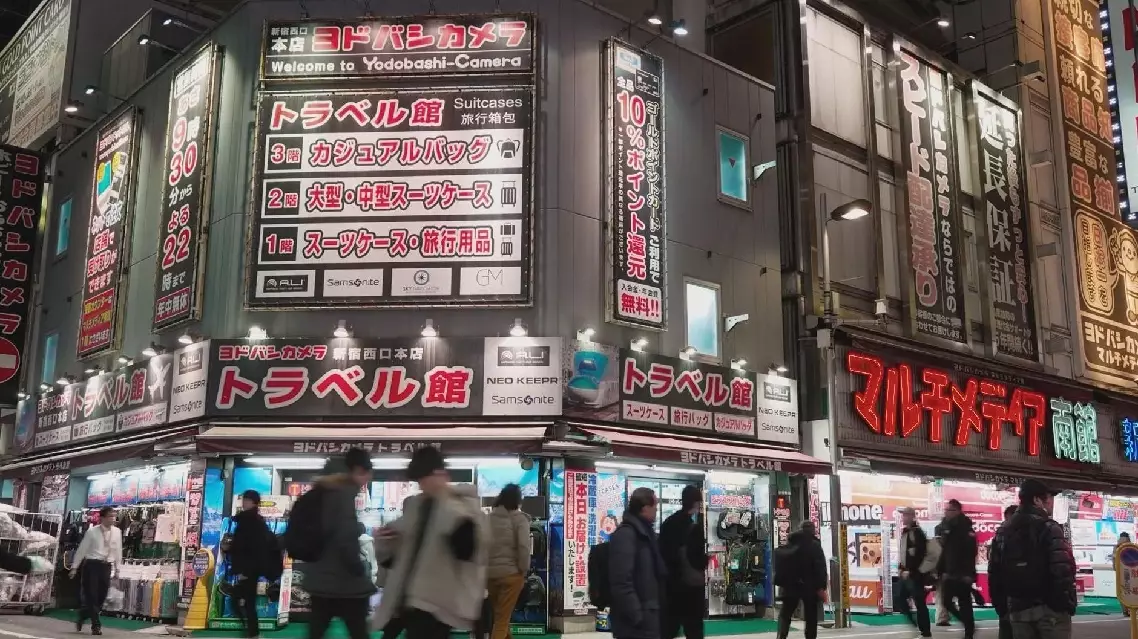
Japan’s tourism industry hit hard after PM’s erroneous remarks on China’s Taiwan