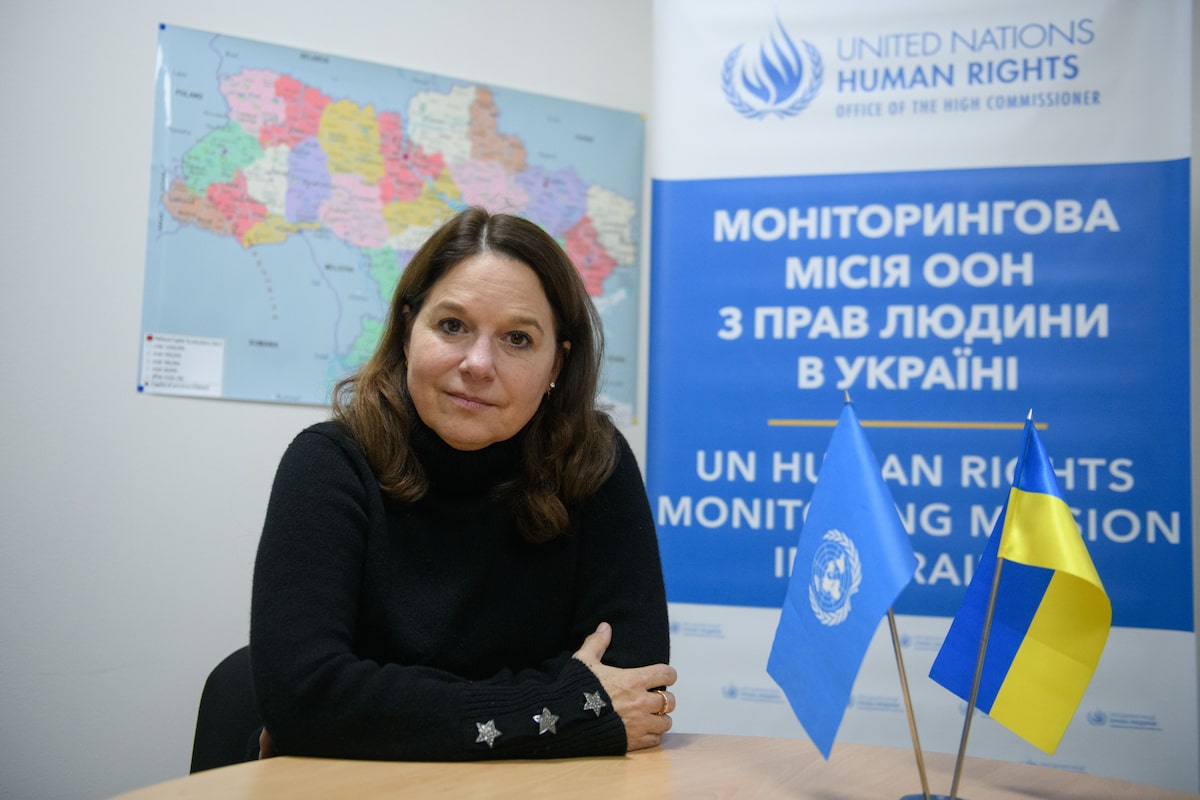
Danielle Bell has worked to protect human rights in dangerous regions around the world for more than two decades, most recently in Ukraine.Olga Ivashchenko/The Globe and Mail
Danielle Bell has stood at mass graves in East Timor, walked through burned-out villages in Darfur, listened to the haunting testimonies of ISIS survivors in Iraq and now visits towns in Ukraine scarred by missile strikes and shelling.
The air-raid sirens, explosions and drones she hears daily in Ukraine are the same as the improvised explosive devices she faced in Afghanistan, she says, or the constant risk of violence in the Darfur region of Sudan.
“Behind it is dreadful human suffering,” said Ms. Bell, who now heads the United Nations Human Rights Monitoring Mission in Ukraine after stints in some of the world’s other war zones.
Over the last 25 years, Ms. Bell has worked to protect human rights in some of the world’s most dangerous regions. Her work has been consistent: gathering facts, analyzing law, publishing findings and using those findings to advocate for specific, trackable protection measures for civilians.
Russia is building an army out of Ukrainian children under occupation, human rights lawyer says
Ms. Bell has held her post in Ukraine since August, 2023. She oversees a team of 85 human-rights professionals documenting civilian casualties, the treatment of prisoners of war and civilian detainees, conflict-related sexual violence, and the impact of attacks on towns, villages and critical infrastructure.
As the war has intensified over the past year, the mission’s reporting has recorded a sharp rise in civilian deaths and injuries, including in areas far from the front lines, as long-range missile and drone strikes increasingly affect daily life across the country.
“Civilians across Ukraine are facing levels of suffering we have not seen since the early days of the full-scale invasion,” Ms. Bell said, referring to Russia’s invasion of Ukraine in February, 2022.
“Behind every number is a family shattered, a community changed. Every report we issue represents someone’s story, someone’s suffering.”
Ms. Bell has been working in Ukraine since 2023.Supplied
Ms. Bell grew up on Vancouver Island, where Canada’s safety and stability shaped her early years. “I could ride my bike alone at the age of six and trust the police without question,” she recalled.
It was a world far removed from the places where she would later work. She left the quiet streets of Gordon Head in Victoria, B.C., for regions where extrajudicial killings, enforced disappearances, torture, arbitrary detention and discrimination based on ethnicity, gender or sexual orientation were everyday parts of her job. In these conflict zones, Ms. Bell not only bore witness to unimaginable human suffering but also navigated strict security protocols to protect herself from ballistic missiles, rockets, drones and the constant threat of violence and instability.
“The hardest part isn’t the danger,” Ms. Bell said. “It’s sitting across from someone who has endured unimaginable suffering and trying to process what one human being can do to another.”
After finishing high school, Ms. Bell struggled to find direction. She worked as a waitress, had a couple of dead-end jobs and thought university was out of reach. “I had no plan; a little lost. I was 21 years old with no future ahead,” she said.
A friend told her she was wasting her life and urged her to leave Canada to travel and see the world. Taking that advice, she embarked on a nine-month backpacking trip through Southeast Asia, a journey that would change the course of her life.
“I was on a crowded bus in Bangkok, surrounded by the city’s vitality, when it hit me: I needed to go to university and try to create a meaningful life. I finished the trip, travelling through Thailand, Indonesia and Malaysia. The day after I returned home, I enrolled and completed my degree with distinction in just over three years.”
In Ukraine, children who have lost fathers face a growing mental-health crisis
After majoring in Indonesian language at the University of Victoria, she studied primatology and conducted field research on wild orangutans in Kalimantan, Borneo. Her academic focus soon expanded to the human-rights implications of deforestation. During her first master’s degree, also at the University of Victoria, she worked with women’s rights organizations in Java, Indonesia.
She put herself through university working on women’s labour rights for the B.C. government, both before and after completing an internship with the United Nations Development Fund for Women in New Delhi from 1999 to 2000.
These experiences revealed the links between environmental justice, gender equality, labour rights and poverty – connections that would shape her UN career.
Ms. Bell’s first UN posting was in East Timor in 2001, shortly after the country’s vote for independence from Indonesia. “There was no government in place; the UN served as the transitional administration, as the de facto government,” Ms. Bell said. “You were helping to build systems from the ground up, alongside people who were determined to create a different future.”
Ms. Bell also recalls moments of respite that helped sustain her. “On rare weekends, we would snorkel near Tutuala Beach – extraordinary coral, and sometimes dolphins nearby. Those moments of beauty helped you recover the energy to keep doing very difficult work.”
Ms. Bell shows a photo from her mission in Iraq, where she organized an event with children to deliver anti-hate-speech messages to community leaders.Olga Ivashchenko/The Globe and Mail
The human-rights situation was acute, including widespread gender-based violence and killings, sometimes after false accusations of witchcraft, with little accountability. As a human-rights officer, she monitored police and prisons, supported early justice institutions and co-ordinated with the UN Serious Crimes Unit investigating international crimes from the 1999 violence in the country.
“And this is where I met my beloved husband, Jim,” she says. He was an investigator with the Serious Crimes Unit. “He was conducting an investigation that involved exhuming bodies from a well.”
In 2004, Ms. Bell and her husband moved to Jalalabad, Afghanistan, where she served as the UN’s human-rights officer for eastern Afghanistan. He was the UN’s head of security for the same region.
Together, they navigated daily insecurity while working to rebuild communities shattered by decades of war. Their home was burned down at one point, and the UN compound where they lived came under attack during widespread riots, a reminder of how quickly instability could erupt.
Working with UN Women, a specialized agency for gender equality, Ms. Bell helped establish the first women’s referral centre in eastern Afghanistan – in effect, the first women’s shelter in the region.
“We were documenting and trying to stop practices like so-called ‘honour killings,’ the exchange of girls to settle disputes, forced and underage marriage. In some cases, police were detaining women and girls – not because they had committed crimes, but because authorities believed jail was the only way to protect them from being killed, or because women had ‘run away’ from abuse,” she said.
“We worked case-by-case, but also with tribal leaders, religious figures, police and local officials to find ways to prevent violence before it happened. Over time, in some communities, we did see a real reduction in killings and other abuses.”
The shelter remained open until the Taliban’s return in 2021.
As funds dry up, so do South Sudan’s hopes of feeding itself
In early 2009, while she was working in Darfur, her husband was diagnosed with cholangiocarcinoma, an aggressive cancer. They sought specialized treatment at the Mayo Clinic in Phoenix while obtaining positions with the UN in New York to allow for travel and care, and prepare for a new chapter in life.
On June 14, 2009, he died – a loss Ms. Bell describes as the most excruciating period of her life, “a grief so deep it felt like my bones were breaking,” she said quietly.
Several months later, she chose to return to her human-rights work in the field.
Ms. Bell now lives in Kyiv, where – compared with previous postings – there is a different kind of daily risk, she says. When she is in Kyiv or other cities, aerial alert systems warn of incoming long-range missiles and drones, allowing people to seek shelter, while air-defence systems intercept many of the attacks.
“But those systems are never complete,” she said. “They don’t stop everything, and civilians continue to be killed and injured in increasing numbers.”
When conditions allow, Ms. Bell cycles along the Dnipro river and teaches two voluntary yoga classes a week to staff and partners. “Work comes first,” she said, “but making space for people’s well-being helps them keep doing the work.”
Ms. Bell says that human-rights work is not for everyone. “There are some cases that I’ve dealt with that weigh so heavily. You have flashbacks your entire life of things you’ve witnessed because they’re so dreadful,” she said.
“I’m interviewing people who have been victims of the worst torture you could possibly imagine; it would keep me awake, not just for nights, but for years.”
What sustains her is the strength of the people she serves. “Time and again, I’ve been inspired by the courage of those who, despite unimaginable loss, continue to fight for justice.”