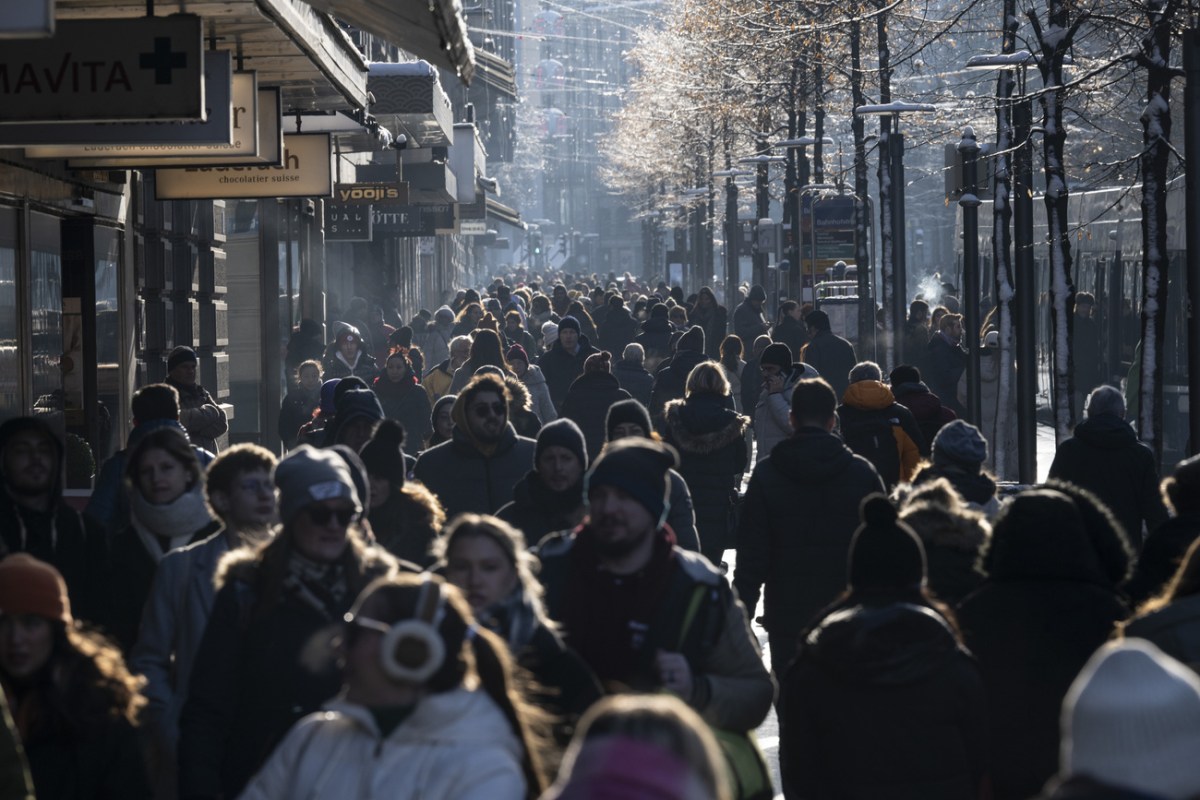
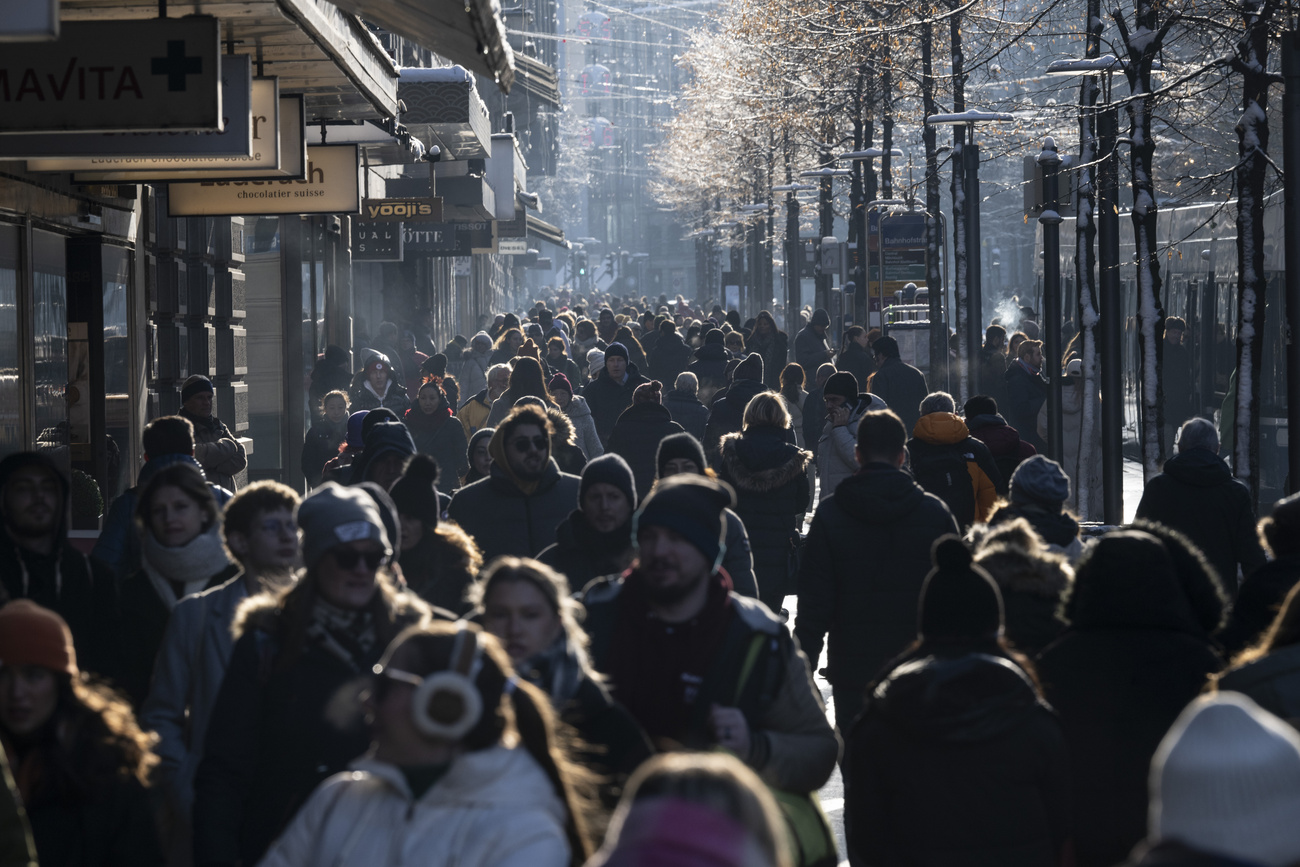
The Swiss are having fewer children, feel less religious and increasingly have a migration background.
Keystone / Ennio Leanza
Migration, climate change and artificial intelligence (AI): these global phenomena have a major impact in Switzerland too. Swissinfo presents a selection of statistics from 2025 to help explain how these issues affect Swiss residents.
Decline in births
Fertility is constantly declining in Switzerland. And the fertility rate just reached the lowest point ever recorded: 1.29 children per woman in 2024.
This means smaller families. According to figures published in November by the Federal Statistical OfficeExternal link, births of third children have fallen most steeply (-14% over the past five years). The number of first children is down by 8.5% and second children by 9%.
More people are choosing not to have children at all. The proportion of 30-year-olds adopting this attitude increased from 9 to 16% over a ten-year period. Yet the most widespread aspiration across the population is still to have two children.
The decline in births is partly explained by the fact that people are having children later. The average age of women giving birth is now 32.4, one of the highest in Europe – and a record for Switzerland.
>>The decline in fertility in Switzerland is part of a global trend, as this article explains:
More

More
Demographics
Fertility rates plummet in Switzerland – and beyond
This content was published on
Feb 29, 2024
Faced with a historic dip in birth rates, some countries are turning to family-friendly policies and campaigns. Can such action have anything more than a marginal impact?
Read more: Fertility rates plummet in Switzerland – and beyond
Immigration boosts population
Despite the decline in fertility, the population of Switzerland is still increasing. The milestone of nine million inhabitants wasExternal link reached in 2024 and the permanent resident population rose to 9.05 million at the start of 2025.
That means an increase of 1%, and nearly 89,000 more people in a year. Of these, 83,000 (over 93%) came from immigration. Natural growth amounted to no more than 6,000 people.
The proportion of the Swiss population with a migrant background thus continued to increase, and stood at 41% at the start of 2025External link.
>>Is there an appropriate level of immigration? Switzerland is certainly not the only developed country dealing with this demographic challenge, as the following article explains:
More
More
Demographics
How countries are managing immigration between economic needs and social tensions
This content was published on
Jan 21, 2025
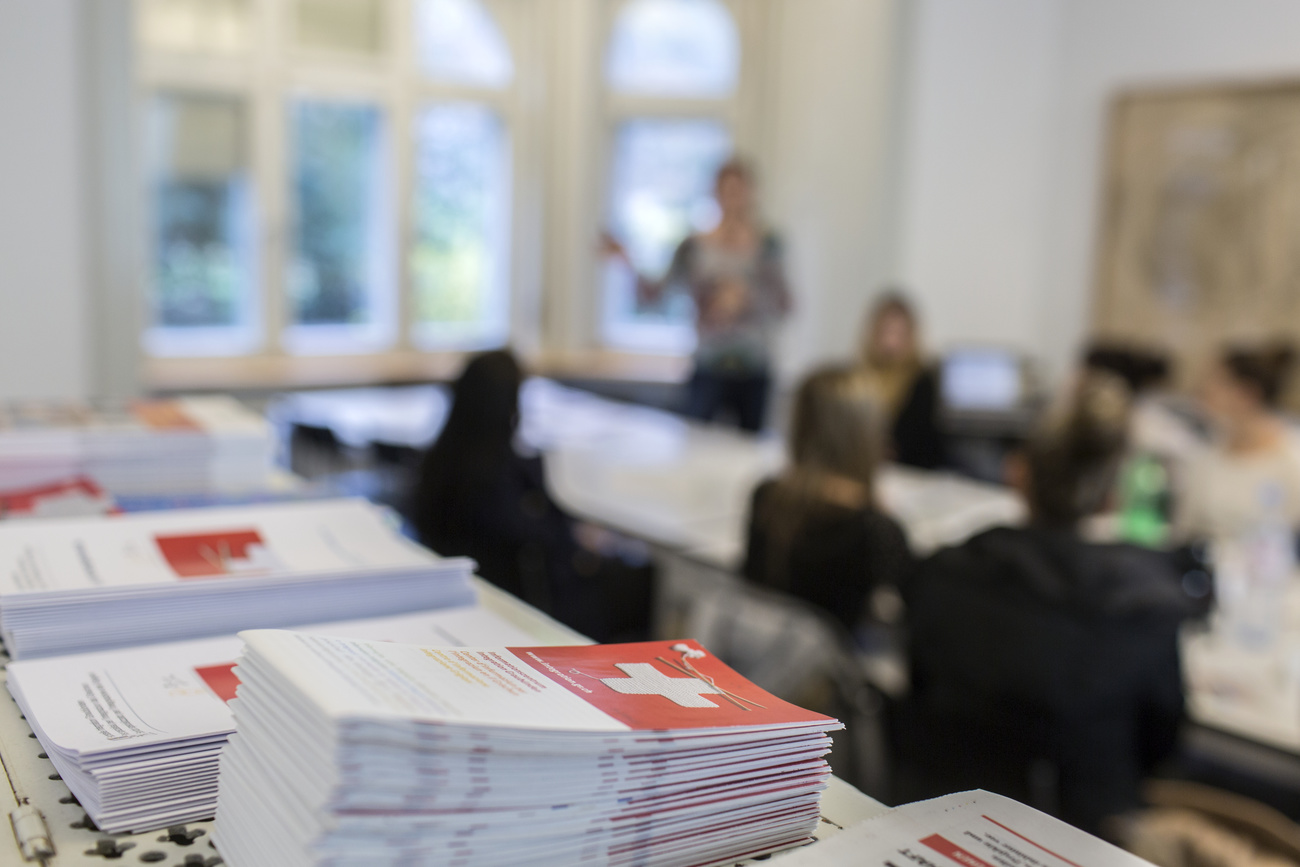
In many developed countries population growth is now essentially fuelled by immigration. Here are some facts, figures and insights from demographers.
Read more: How countries are managing immigration between economic needs and social tensions
>> Read this article to learn more about Swiss residents with a migrant background:
More

More
Foreign Affairs
In Switzerland four out of ten people have a migrant background – who are they?
This content was published on
Jul 7, 2025
Migration is increasingly shaping Swiss society. Almost 2.5 million people do not have Swiss nationality, and even more have foreign origins. Where do they come from, and what are their profiles?
Read more: In Switzerland four out of ten people have a migrant background – who are they?
All our coverage on demographic issues can be found here.
More Swiss citizens live abroad
More Swiss nationals have been leaving the country than there are coming (back) here to live. In 2024, about 30,000 Swiss nationals emigrated, and about 22,000 immigrated.
This emigration trend means the Swiss Abroad have reached recordExternal link numbers. Since 2025, more than 826,700 registered with a Swiss diplomatic mission outside the country, about two-thirds in Europe.
Birth of Swiss children abroad and naturalisations explain part of this increase.
>> For an overview of all statistics about Swiss Abroad, see this article:
More

More
Swiss Abroad
The Swiss Abroad in nine charts
This content was published on
Mar 28, 2025
The number of Swiss people living abroad continues to increase. Five charts explain their characteristics and geographic distribution.
Read more: The Swiss Abroad in nine charts
All our coverage on Swiss Abroad issues can be found here.
The impact of climate change in Switzerland
June 2025 was the second hottest month in Switzerland since records began in 1864. And the country continues to heat up faster than the global average.
The average temperature recorded in Switzerland in 2024 (the last year for which there are now complete records) was 2.3°C higher compared to the reference period 1951-1980. In comparison, global warming rose by 1.3°C.
>> Switzerland is one of the ten countries that have warmed the most in the last decade, as explained in this article:
More

More
Climate adaptation
Why Switzerland is among the ten fastest-warming countries in the world
This content was published on
Jul 10, 2025
Switzerland is particularly affected by climate change, with temperatures rising faster than in most other countries.
Read more: Why Switzerland is among the ten fastest-warming countries in the world
To mark the tenth anniversary of the adoption of the Paris Agreement, Swissinfo carried out an exclusive survey last autumn with 80 climate specialists in Switzerland.
The overwhelming majority of them no longer believe it is possible to limit global warming to 1.5°C. Most now expect a global rise in temperatures of 2.5° C by 2100, which, if present trends continue, would mean a rise of 4° C or more in Switzerland.
The experts contacted expect climate change to have significant consequences for living conditions in Switzerland by 2050.
>>Our articles based on the survey and the whole series dealing with the tenth anniversary of the Paris agreement can be found here:
More

More
Emissions reduction
Climate experts in Switzerland: 1.5°C target is out of reach
This content was published on
Oct 24, 2025
Ten years after the Paris Agreement, a survey of Swiss climate scientists shows they no longer expect the world to limit warming to 1.5°C.
Read more: Climate experts in Switzerland: 1.5°C target is out of reach
>>All our climate coverage can be found here.
Swiss internet users now confronted with AI, fake news and hate speech
The last survey on internet useExternal link shows that generative AI use is spreading quickly in Switzerland. In spring 2025, over 40% of the population over 15 said they had used an application like ChatGPT. This proportion rises to 80% in the 15-24 age group.
Use of AI is already a frequent activity. The majority of people using AI do this daily or at least once a week. The statistical office characterises the figures as “very high”, considering that AI has been available to the public for no more than three years.
>>Our article on a Swiss alternative to ChatGPT can be read below, and all our articles on AI are to be found here.
More

More
Swiss AI
Switzerland launches transparent ChatGPT alternative
This content was published on
Sep 2, 2025
Swiss Apertus LLM aims to compete in a crowded field with openness and accessibility.
Read more: Switzerland launches transparent ChatGPT alternative
The survey shows that the public is increasingly exposed to disinformation and on-line scams, but also hate speech.
Over four people out of ten say they were exposed to hostile content about individuals or groups. The kinds of hate speech that have increased the most are about political opinions, ethnic origin and religion.
>>All our coverage of information wars and digital democracy can be found here.
Religion continues to decline in popularity
Religion continues toExternal link decline in Switzerland. People with no religious affiliation are the fastest-growing segment of the population in recent decades. At 36% of the population, their numbers are now greater than those who are Catholics.
People giving up their religion do so initally because of losing their faith, but also because they disagree with the views of their religious institutions.
>>But the main reason for decline of religion in the West, and the main long-term threat to religions, is modernisation of society. This was explained by sociologist of religions Jörg Stolz in this 2023 article:
More
More
Demographics
Deserted churches and fewer believers: Swiss abandon God
This content was published on
Oct 16, 2023
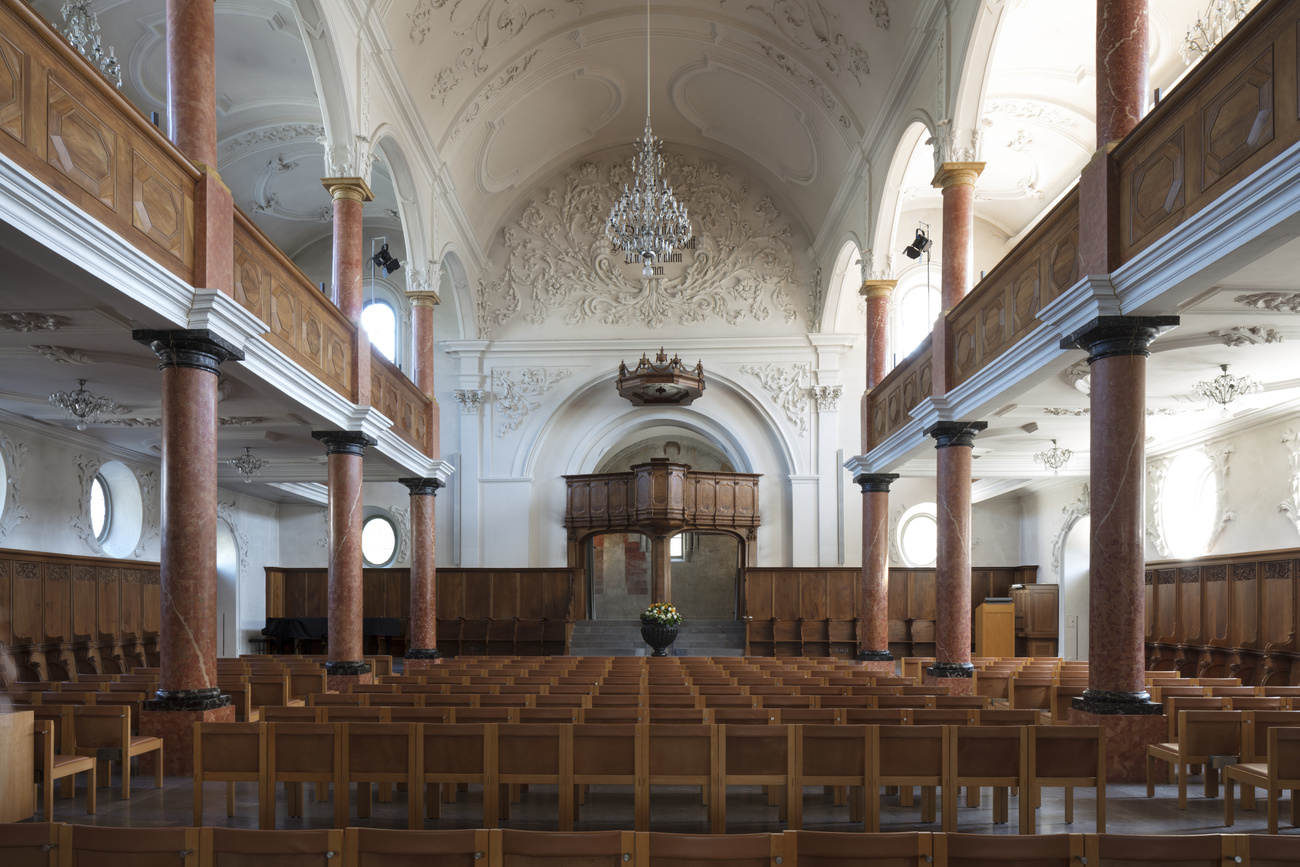
Churches are becoming increasingly obsolete in Switzerland. What do church leaders say about that?
Read more: Deserted churches and fewer believers: Swiss abandon God
Edited by Samuel Jaberg; adapted from French by Terence MacNamee/sb
Articles in this story