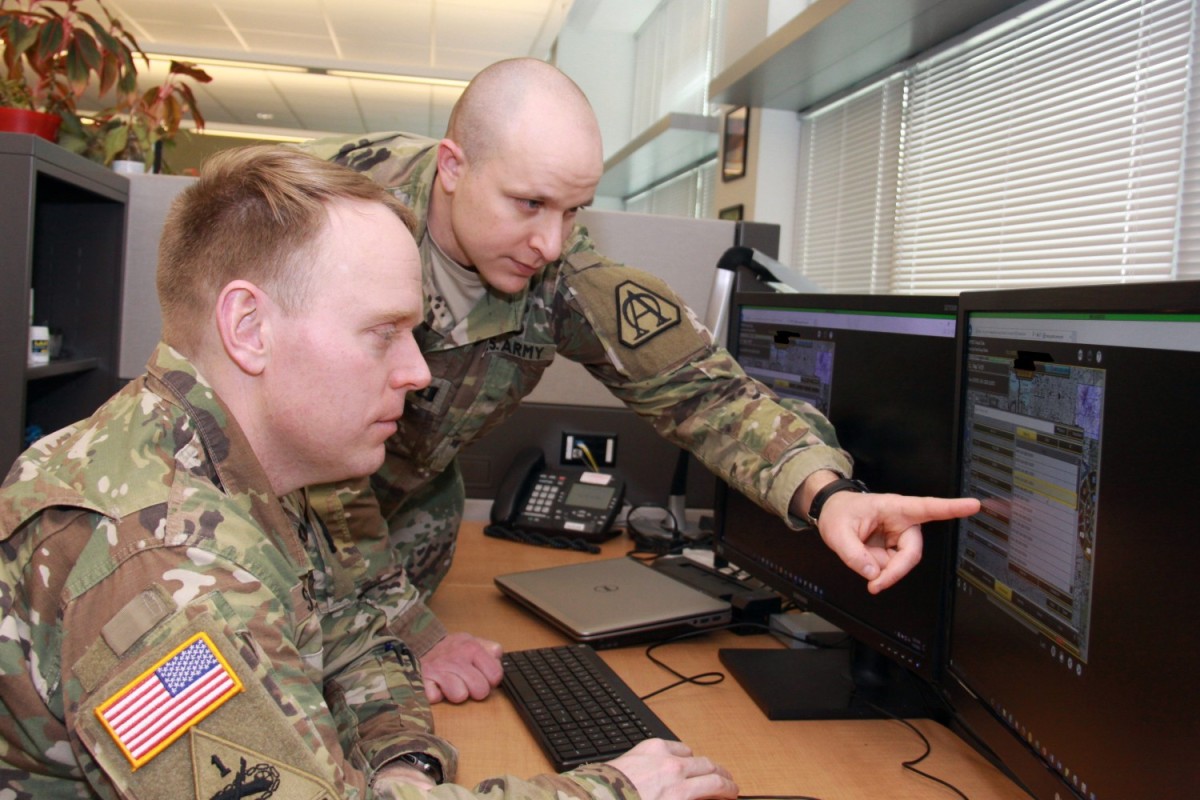
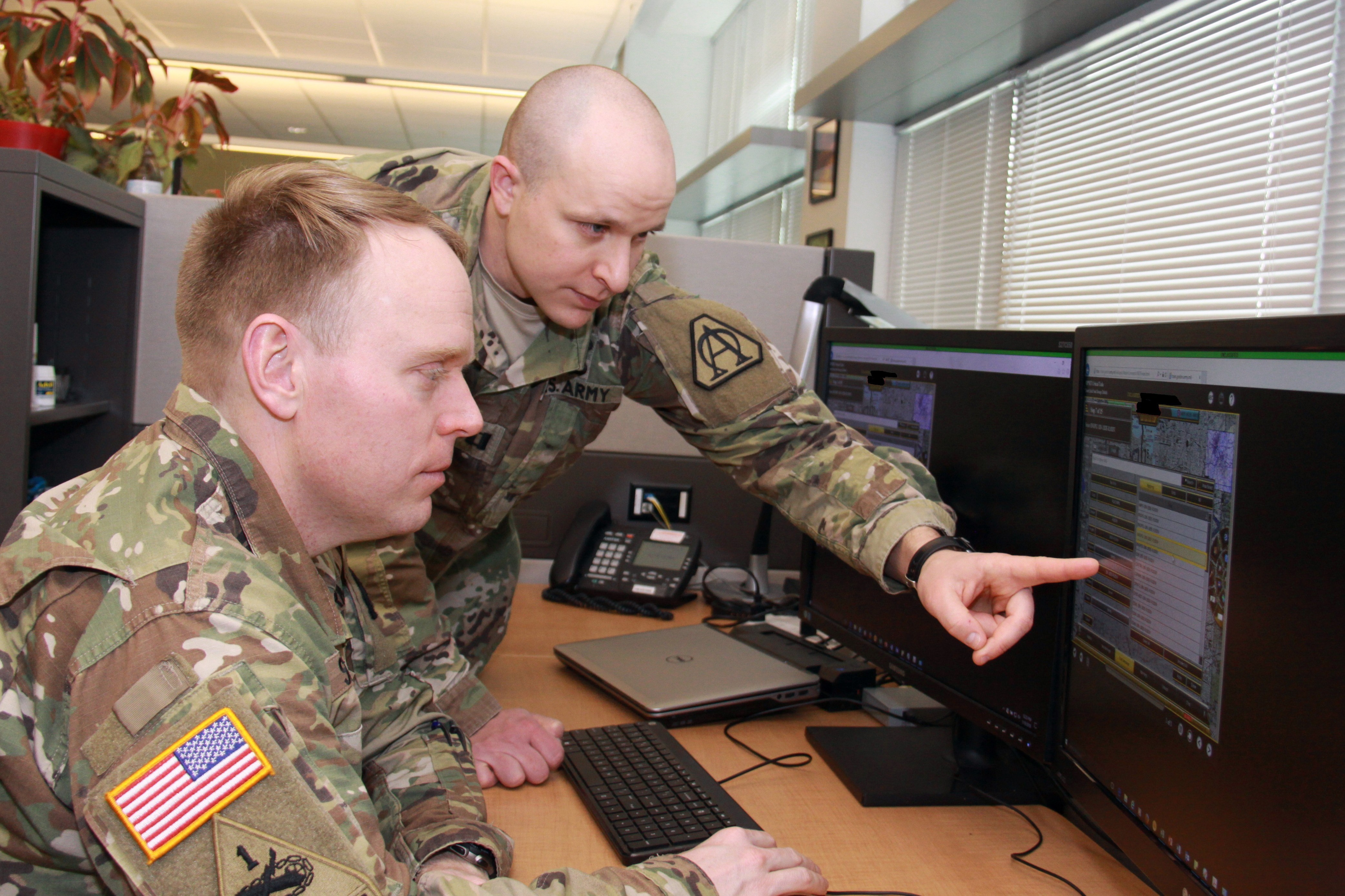
Capt. Doug Williams, right, and Capt. Jake Singleton review the Joint Battle Command – Platform’s new interactive multimedia instruction software in January at Aberdeen Proving Ground, Maryland. The software will allow Soldiers to train on the system from a CD, the Army’s online training tool LandWarNet or embedded on-vehicle hardware. Developing, testing and fielding the Joint Battle Command – Platform system was one of Thurston’s many responsibilities as the PM for Mission Command. (U.S. Army photo by Dan Lafontaine, PEO C3T)
(Photo Credit: U.S. Army)
WASHINGTON – The U.S. Army is advancing its personnel readiness capabilities with data-driven tools that provide leaders with real-time insight into the health and status of every military occupational specialty (MOS) required by the force. As part of this effort, the Army recently launched the MOS Health Dashboard. It’s a comprehensive platform that provides a real-time view of personnel status and readiness across all military specialties, enabling more informed, optimized manning decisions.
“Effective personnel management depends on reliable personnel data,” said Col. Frank Pena, chief of the Total Army Readiness Division, U.S. Army G-1. “Tools like the MOS Health Dashboard give us the clarity and agility to see ourselves, to act faster, and to ensure every Soldier is trained, ready, and in the right place at the right time.”
The dashboard tracks and visualizes key indicators that shape personnel readiness across several areas affecting the Army’s manning and operational capability. These indicators include:
Accessions, Retention, and Promotions: Monitors Soldiers from Initial Entry Training (IET) through career progression, providing insights into qualifications, promotion rates, and cohort trends.
Strength and Utilization: Compares on-hand strength to authorized strength and identifies Soldiers serving in key positions within the modified table of organization and equipment (MTOE).
Stability and Deployability: Analyzes time-on-station, deployment tempo, and medical or administrative readiness factors.
Attrition: Evaluates separation trends across ranks and service phases to identify retention risks and inform policy decisions.

By consolidating these elements into a single, secure platform, leaders and staff can continuously monitor the health of their formations and anticipate personnel challenges before they affect readiness. The new data tool leverages consolidated data to deliver automated, accurate, and timely insights that enhance senior leaders’ clarity and decision-making speed across the Army’s accessions, retention, and attrition missions.
Ultimately, the dashboard is enabled by interoperability between the Integrated Personnel and Pay System-Army (IPPS-A) and the Army Vantage systems. IPPS-A provides the validated personnel data that underpin the system. Army Vantage analyzes data from IPPS-A and other systems that track accessions, retention, and promotion timelines to reveal trends and readiness indicators.
“Together, the MOS Health Dashboard and Army Vantage allow the Army to shift from reactive personnel management to proactive readiness shaping, said Pena. “They support data-informed decisions about personnel across all levels of leadership to ensure those formations have what they need to accomplish their missions.”