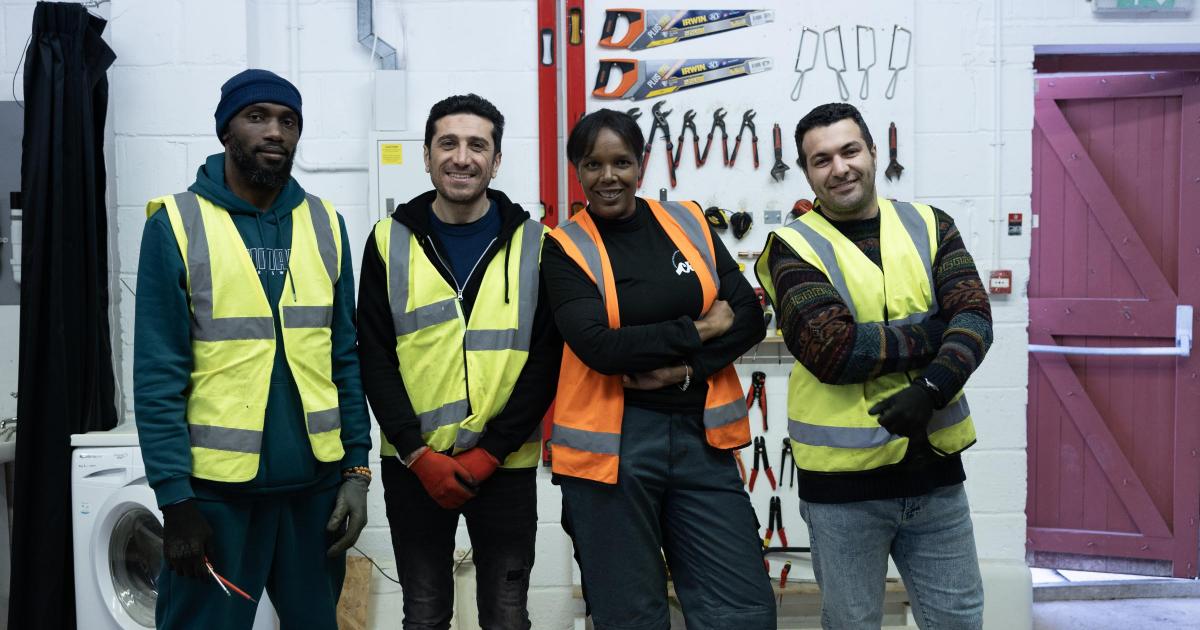
Mansour, an Iranian national, has been living in hotel accommodation in Croydon for just over a month. “Being in the hotel is just depressing,” he said. “Being here is so much better.”
Inside a custom-built workshop, he is learning to fix leaks, use tools safely and work towards a construction qualification that could help him move from temporary accommodation into employment.
He is among a growing number of asylum seekers and refugees attending training sessions at CEO, Construction and Engineering Opportunities.
The community interest company was founded by plumbing and heating engineer Viviene Bish Bedeau, who has spent forty years in the industry. Its aim is to create employment opportunities for young people and marginalised members of society through construction and engineering training.
The Local Democracy Reporting Service (LDRS) visited CEO during a RAISE session, a Croydon Council supported programme focused on Refugees and Asylum Seekers Integration and Empowerment.
“The idea is to give them skills that make them more employable and get them involved,” Viviene told the LDRS. During the visit, three RAISE participants – Mansour, Saiied and David – were hard at work on construction tasks set by Viviene, each step bringing them closer to earning their CSCS cards.
A CSCS card shows that a worker has the required training to work on a construction site. It is often a minimum requirement for employment in an industry that can be one of the few options available to new arrivals.
Pointing to one of the learners, Viviene said: “Hopefully, Mansour will have his certificate in a couple of weeks.” She added that while progress is often quick, difficulties arise when participants are relocated at short notice because of housing availability.
Despite this, around nine people attend sessions regularly, many first hearing about the programme through word of mouth. “People come along, go back to the hotels and bring new people with them,” Viviene said.
After a couple of hours of work, where Viviene watches closely to instruct and occasionally intervene if someone is using a ladder incorrectly, the group then breaks for lunch.
Over pastries and tea, participants have time to chat and bond. “It’s more than just a workshop,” Viviene said. “It’s a hub, it takes you out of your four walls.”
Saiied, a fellow Iranian who speaks fluent English, said isolation can be one of the hardest parts of life in hotels. “It’s hard to make friends there, but here we have the same target,” he said.
Farsi and French are commonly spoken among the group, but Viviene said language is not a barrier. “They don’t need to speak English to come along, but I tell them they need to learn English to get a qualification,” she said.
Learners are also given opportunities to carry out paid work under supervision, helping them build confidence and experience. “Mansour did a job for a neighbour the other day,” Viviene said. “They were very pleased.”
“They came back and said it was some of the best customer service they’d had,” she added.
Viviene spent most of her career self employed before deciding to give something back and change the face of the industry. “Nowadays kids are all pushed towards university, but there are some children where that is not right for them and construction or engineering could be an option.”
She said her own experience shapes the organisation’s ethos. “If you want to say anything about how hard it can be, look at me,” she said. “I am female, black and in construction.”
She believes representation matters and said CEO’s female leadership team, which includes her colleague Jo, has helped open the organisation up to people who might not otherwise consider construction.
This has been especially important for CEO’s youth programmes, including Constructioneers for teenagers and Mini Constructioneers for children aged six and seven.
Jo told the LDRS: “We are preparing them because in the real world there will be women in charge as well, and they need to get used to that.”
“I think as a woman it is easier because we are mothers and we know how to deal with certain situations,” she added.
Youth groups are kept small, as many children have special educational needs. Sessions focus on basic electrical and construction skills for children seeking extra curricular support, as well as those not currently attending school.
Around the workshop, the walls are lined with with sturdy shelving units and electrical circuit boards; the handiwork of CEO’s Constructioneers. Viviene believes learning should be hands on and centres sessions around problem solving.
“On lunch break I’ll create a leak and ask them to find and fix it,” she said, giving and example of her methods. She believes practical learning suits many children and that the workshop has been adapted to meet a wide range of needs.
She stressed that children, like the asylum seekers, should gain something meaningful from the experience. “They all deserve that opportunity,” she said.
“We had an autistic girl come here and at first we gave her ear defenders because the noise can be intense,” Viviene said. “Later her mum told us she never asked for them again because she trusted us.”
Trust, she added, is central to learning. Feeling safe allows children to engage and build confidence.
Jo, who joined CEO in October, helps manage the business side and brings experience from working in schools. She said the approach at CEO is very different.
“Flexibility is key,” she said. “It’s not like a classroom, but we want the children to respect us and learn skills. We will put lunch on for them, but after that we will say you need to wash up.”
“I’ve got a saying,” she said. “Each one teach one.”
Viviene’s motivation behind CEO also stems from her faith. She first became interested in supporting asylum seekers through her involvement with West Croydon Baptist Church.
“Everyone is always talking about what asylum seekers get,” she said. “But a woman came to speak to us one day and brought a box.”
“She said this is what they get for a week and it was barely anything,” Viviene added. She said it changed her perspective.
“It is very easy to believe what you hear,” she said. “This world doesn’t belong to any of us.”
“I just love that they want to learn,” she added. “That’s what motivates me.”
Although CEO is not a charity, it depends on external funding to provide programs that serve the most marginalized communities. Viviene initially paid out for schemes like RAISE through her own money and from crowdfunding, but has since gained the support of Children in Need funding.
CEO also hopes to strengthen its relationship with Croydon Council by becoming an approved provider of alternative education. According to Viviene, Croydon already refers some young people who have left school, and Viviene said the placements can be life-changing.
However, approval would mean Croydon could send more children to CEO in the future. One way they hope to achieve this is through their upcoming move from a workshop at Mitcham’s Eagle Trading Estate to Croydon’s Whitgift Centre.
The relocation, expected to be completed in March, will place CEO at the heart of the community, something Viviene believes will bring them closer to the people they most need to support.
The new space will be larger and will include a designated hot-work zone with strict safety measures. Viviene also hopes that the increased footfall from being based in the town centre will boost sign-ups for its DIY courses, which she acknowledges are the self-sustaining arm of the social enterprise.
Viviene, recently named Inspirational Woman of the Industry by the Hustle Awards for startups, is excited about bringing her work to the wider community. “They’ve never had training like ours there,” she said. “It’s completely unprecedented.”