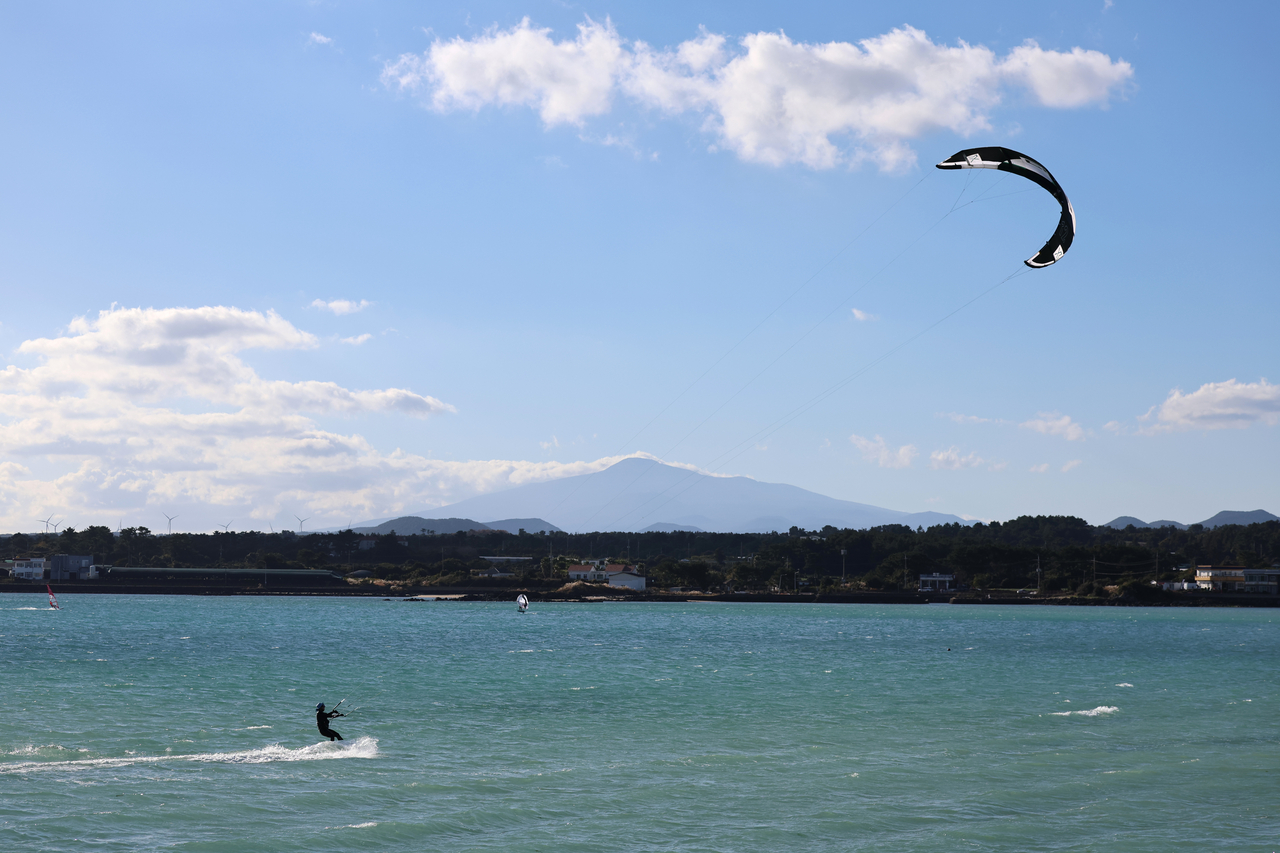
 A kite surfer rides the waves at a beach on Jeju Island on Nov. 30. (Yonhap)
 An analysis showed Sunday that South Korea’s sea surface levels rose by 11.5 centimeters from 1989 to 2024, possibly affected by global warming.
Twenty-one observation points across the nations coastal lines showed that sea levels rose by an average of 3.2 millimeters per year, according to the report by the state-run Korea Hydrographic and Oceanographic Agency. The annual rises in the East Sea and the West Sea were more profound, at between 3 and 3.6 millimeters, while seas rose relatively slowly on the south coast, at between 2.6 and 3.4 millimeters.
The data indicated a particularly steep rise in sea levels in all coastal areas from 1995-2004 (5-8 millimeters per year), continuing at a similar rate on the eastern coast from 2005-2014, with western shores and Jeju Island resuming that pace from 2015-2024.
“We’ve confirmed that the rise in sea level is a phenomenon that occurs differently depending on the region. … These distinct characteristics must be factored in when making policies on management of the coastal areas and climate change,” officials at the agency was quoted as saying.
Global factors such as the shift in temperature and salinity of the ocean water — effects of global warming and the melting of glaciers — are thought to have contributed to the change in sea levels. Other factors such as the shifts in atmospheric and ocean circulation are also believed to have played a part.
The latest findings will be used by the government in assessing the flooding risks of each area, as well as designing and maintaining of facilities in the coastal regions.
minsikyoon@heraldcorp.com