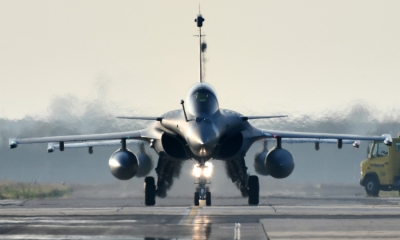
From 1 January 2026, the Croatian Air Force (HRZ) will officially assume full responsibility for protecting Croatian airspace, marking a major milestone in the country’s defence capabilities.
A squadron of twelve multi-role Rafale fighter jets will take over air-policing duties after Croatian pilots have successfully completed full training on what is considered one of the most advanced combat aircraft currently in service worldwide. From the start of the new year, the Croatian Air Force will formally carry out this task as part of NATO’s integrated air and missile defence system.
Speaking to Croatian public broadcaster HRT, Krešimir Ražov, Commander of the Croatian Air Force, confirmed that Croatia is now fully prepared to independently monitor and protect its skies.
“Croatia will now supervise and protect its airspace within NATO’s integrated air and missile defence, through what is commonly referred to as ‘air policing’. With multi-role combat aircraft, we will be an active participant 365 days a year, 24 hours a day, day and night, with a 15-minute readiness posture,” Ražov said.
Until now, air-policing duties for Croatia had been carried out by Italian Eurofighters and Hungarian Gripen jets, a temporary arrangement that has been in place since early December last year. Although Croatia was never without fighter aircraft, the transition to the advanced Rafale platform required an extensive training programme for pilots, technicians, engineers and weapons specialists.
“Our pilots, technicians, engineers and armourers are fully ready for this mission and prepared to operate in rotating duty teams. In peacetime, if an aircraft loses communication or cannot be identified, a so-called Alpha or Active Scramble is launched within 15 minutes, followed by identification, warning and escort of any potential threat out of Croatian airspace,” Ražov explained.
Rafales at the Core, but Not the Only Line of Defence
While the Rafale jets form the backbone of Croatia’s air defence, they are part of a broader, layered system that also includes advanced radar networks and the Bayraktar TB2 unmanned aerial system.
In addition, a €125 million contract was recently signed with domestic companies to develop anti-drone defence systems, further strengthening Croatia’s ability to protect critical infrastructure.
Croatian Deputy Prime Minister and Defence Minister Ivan Anušić said the project includes both fixed and mobile systems.
“The project includes two stationary systems for the protection of critical military infrastructure, as well as two mobile systems. Our goal is to protect key infrastructure, specifically Zagreb and Zadar airports,” Anušić said.
Domestic Industry at the Heart of New Defence Systems
The development of the anti-drone system has been entrusted to Croatian industry, with Končar playing a central role.
“We will develop the entire system based on the concept presented to the Ministry of Defence. Integrating all components into a single operational system will be Končar’s greatest added value,” said Gordan Kolak, President of Končar’s Management Board.
The system will include an operational command centre, drone interceptors and automated 30-millimetre cannon systems, aligning the Croatian Armed Forces with modern defence trends.
Chief of the General Staff of the Croatian Armed Forces, Tihomir Kundid, emphasised the strategic importance of innovation.
“Innovations in the defence industry have a direct impact on the technical, operational and tactical capabilities of the Armed Forces. An army that has access to top-level innovation and technology is, by definition, highly effective,” Kundid said.
The increasing frequency of Russian drone incursions into NATO member states’ airspace has underscored the importance of robust air defence systems and the protection of national sovereignty — not only on the ground, but also in the skies.
@nethawinpichaiyan Dassault Rafale????????????????????#เครื่องบินรบ #กองทัพอากาศ #dassaultrafale #f35 #???????? ♬ original sound – DAVIDmusicvibes – MVmusicvibesz