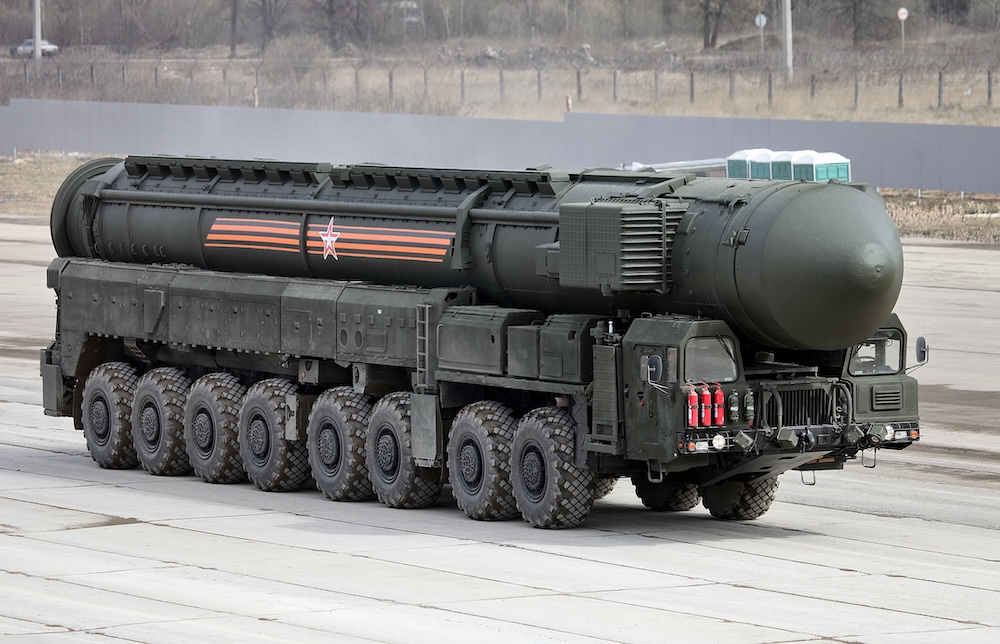
Jeffrey Lewis, of the Middlebury Institute of International Studies, and Decker Eveleth, of the CNA research and analysis organisation, said images from Planet Labs showed features consistent with the establishment of a Russian strategic missile base at a former airfield near the town of Krichev. They assessed they were “90 per cent certain” that mobile Oreshnik launchers would be stationed there.
Krichev lies about 190 miles (307 km) east of Minsk and roughly 300 miles (478 km) south-west of Moscow, close to the Belarus-Russia border. The researchers said the site’s size appeared sufficient for three launchers, suggesting that if Belarus hosts the larger number discussed publicly, other launchers could be placed elsewhere.
A person familiar with the matter told Reuters that the researchers’ assessment broadly aligned with US intelligence findings. Neither the White House nor the CIA commented. The Russian Embassy in Washington did not respond to a request for comment. Belarus’s embassy declined to comment.
Viktor Khrenin, Belarus’s defence minister, was quoted by the state news agency Belta as saying the deployment would not change the balance of power in Europe and described it as a response to Western actions.
The Oreshnik, named after the hazel tree, is an intermediate-range system that President Vladimir Putin has said Russia intends to deploy in Belarus. Reuters reported that the precise location had not previously been disclosed. The missile’s estimated range has been put at up to 3,400 miles (5,500 km), a distance that would place a broad swathe of Europe within reach from Belarus.
Russia tested a conventionally armed Oreshnik against a target in Ukraine in November 2024. Putin has claimed the weapon is difficult to intercept, citing reported speeds exceeding Mach 10.
Lewis and Eveleth said their conclusion was based on indicators in the imagery that resembled known characteristics of Russian strategic missile sites, including secure logistics handling and launch infrastructure. They described what they believed to be rapid construction beginning in early August 2025, with changes visible between August 4 and August 12.
Eveleth pointed to a feature in a November 19 image that he described as a “military-grade rail transfer point” enclosed by a security fence. He said it would allow missiles, launch vehicles and associated equipment to arrive by train. Lewis cited a concrete pad poured at the end of the runway and later covered with earth, which he said was consistent with a camouflaged launch point.
Putin has previously framed the planned deployment as part of a revised posture that would place Russian nuclear weapons outside Russian territory for the first time since the Cold War. After a meeting with Belarusian leader Alexander Lukashenko in December 2024, Putin said the system could be stationed in Belarus in the second half of 2025. Lukashenko said last week that the first missiles had been deployed, without giving a location. He has said up to 10 Oreshnik missiles could be based in the country.
The reported move comes as the 2010 New START treaty — the last remaining US-Russia accord limiting deployments of strategic nuclear weapons — is close to expiry. Only weeks remain before the treaty ends.
Some analysts cited by Reuters interpreted the Belarus basing plan in the context of NATO’s evolving missile posture. John Foreman of Chatham House, a former British defence attaché in Moscow and Kyiv, said stationing Oreshnik in Belarus would extend coverage further into Europe. He also linked it to the US plan to station conventional missiles in Germany next year, including the intermediate-range hypersonic Dark Eagle.
The Reuters report situated the development against the wider diplomatic backdrop of US efforts to end the war in Ukraine. President Donald Trump has pursued talks with Moscow and has, for now, rejected Kyiv’s request for Tomahawk cruise missiles, which would be capable of reaching Moscow. Britain and France have supplied cruise missiles to Ukraine, and Germany announced in May that it would co-produce long-range missiles with Ukraine without limits on their range or targeting.
Not all specialists see the basing decision as materially changing Russia’s capabilities. Pavel Podvig, a Geneva-based expert on Russia’s nuclear forces, told Reuters he was sceptical that deploying Oreshnik in Belarus would offer Russia additional military or political advantages beyond reassurance to Belarus.
Lewis argued that the basing choice carried a political signal. He said there was no military necessity to place the system in Belarus and suggested the purpose was to underline Russia’s increased reliance on nuclear messaging.
First published on defencematters.eu.
Post Views: 1,814