
Overview of the Germany Smart Cities Market:
The Germany smart cities market stands as one of Europe’s most advanced models of urban innovation, driven by sustainability, digitalization, and citizen-focused design. Germany’s smart city vision emphasizes balancing efficiency with inclusivity, integrating technology seamlessly into everyday urban life. Its approach combines environmental responsibility with technological progress, creating a foundation for resilient, future-ready cities.
Germany’s smart city infrastructure initiatives focus on optimizing mobility, energy, and governance systems through advanced data analytics and automation. Municipalities leverage IoT networks to reduce emissions, enhance public transport, and improve transparency in city operations. Recently, Bechtle introduced its “Smart City@Bechtle” initiative to help German municipalities implement digital platforms and IoT-driven infrastructure for more efficient urban management. The collaboration between citizens, policymakers, and businesses fosters a data-driven ecosystem where innovation directly benefits urban living and environmental sustainability.
Over time, smart city development in Germany has matured from isolated experiments into comprehensive governance frameworks. Cities now embed IoT adoption and AI in city management as core elements of urban planning, driving adaptive energy grids, digital public services, and smart transport systems. This strategic evolution highlights Germany’s commitment to sustainable urban development, positioning the country as a global benchmark for integrating advanced technology with social inclusion and ecological balance.
Market Size and Development Outlook:
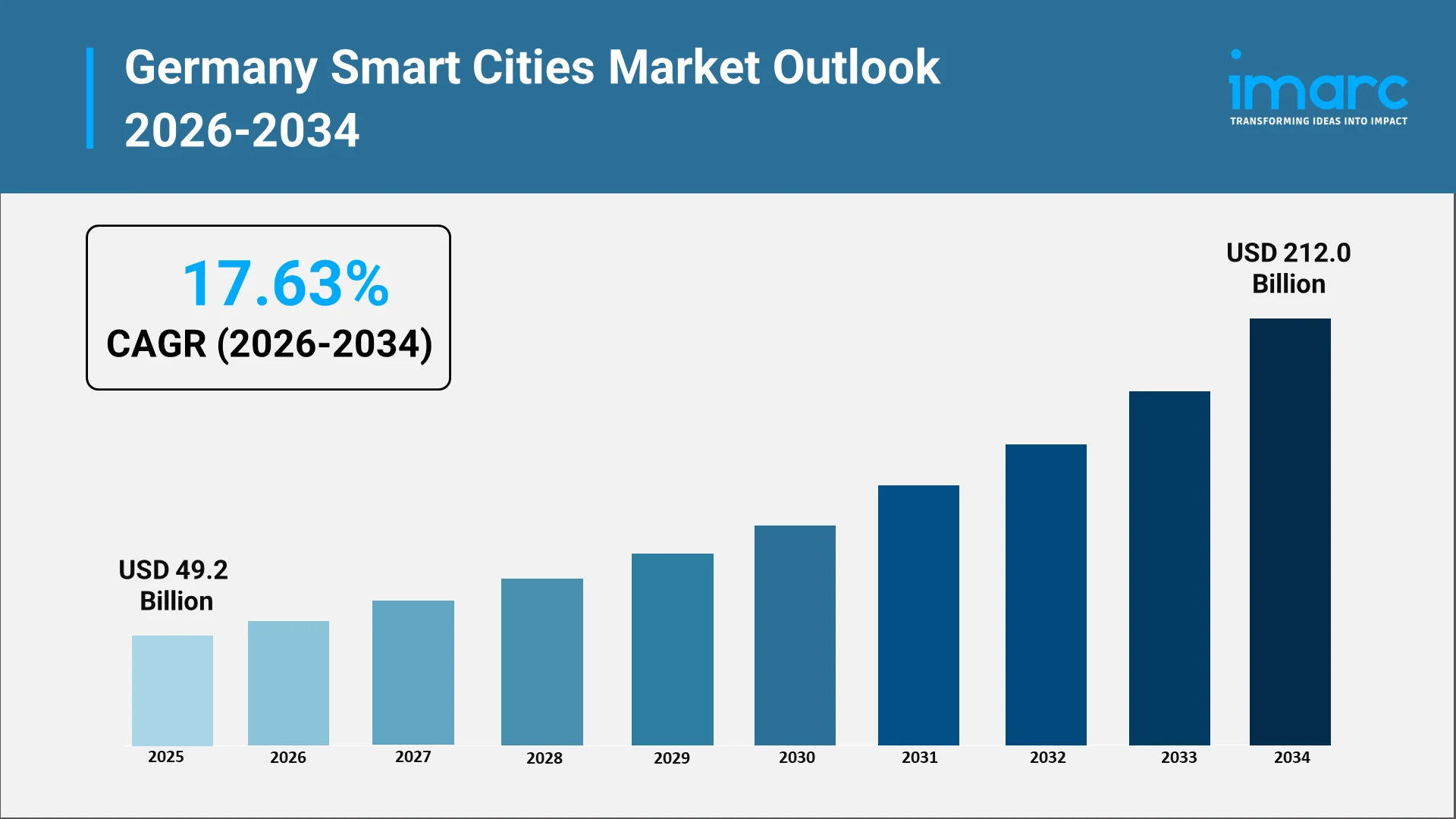
The Germany smart cities market is progressing with steady and sustainable growth, reflecting the country’s pragmatic approach to digital transformation. Rather than pursuing rapid but uneven modernization, German cities emphasize long-term viability through scalable technologies and data-driven planning. Each investment in smart city infrastructure Germany aims to deliver measurable social, economic, and environmental benefits, ensuring inclusivity and resilience. The Germany smart cities market size reached USD 49.2 Billion in 2025, and looking forward, IMARC Group expects it to reach USD 212.0 Billion by 2034, exhibiting a CAGR of 17.63% during 2026-2034. For example, in the recent “Smart City Index 2025”, Germany’s major cities improved their digitalisation scores, signalling broad-based progress rather than just isolated flagship projects.
Aligned with Germany’s broader digital and environmental agendas, smart city initiatives span energy management, mobility, waste reduction, and governance efficiency. These projects are built with flexibility, enabling cities to integrate emerging technologies such as IoT and AI seamlessly over time. This adaptability ensures urban systems remain responsive and future-proof, supporting sustainable urban development across regions.
Collaboration remains central to Germany’s smart city model. Federal and municipal authorities partner with academic institutions, startups, and technology leaders to foster innovation and ethical data practices. Strong emphasis on privacy and transparency builds citizen trust—an essential driver of smart city adoption. As cities confront growing challenges from population expansion and climate change, Germany’s commitment to innovation, policy foresight, and public engagement positions it as a leading force in shaping intelligent, sustainable, and people-centric urban ecosystems.
Explore in-depth findings for this market, Request Sample
Key Factors Driving Smart City Adoption:
Several interlinked drivers are propelling the growth of the Germany smart cities market, each reinforcing the other to create a cohesive framework for transformation. These factors are not limited to technology but include social, environmental, and policy dimensions that shape the country’s urban future.
Sustainable Urban Development Goals: Germany’s commitment to sustainable urban development is a major catalyst. Cities are rethinking infrastructure and mobility systems to achieve carbon neutrality and energy efficiency. Smart grids, renewable energy integration, and intelligent transportation systems align with the broader national and EU sustainability mandates.
Digital Transformation and IoT Integration: The rise of IoT adoption has transformed how cities monitor and manage resources. From traffic flow optimization to waste management and water conservation, IoT devices enable real-time decision-making. This digital layer helps cities become more responsive and predictive rather than reactive.
Urban Mobility and Smart Transportation: Germany’s focus on smart mobility, electric vehicles, shared transportation models, and connected logistics is redefining urban travel. Intelligent mobility solutions aim to reduce congestion, improve air quality, and promote accessibility for all citizens.
AI in City Management: Artificial intelligence is increasingly central to urban governance. Through AI in city management, municipalities can analyze large datasets to optimize energy distribution, predict maintenance needs, and streamline administrative processes. This results in more efficient city services and proactive infrastructure management.
Public-Private Partnerships: Collaborative models between the public sector and technology innovators drive significant progress. Partnerships foster shared investments in infrastructure, knowledge exchange, and the creation of scalable pilot projects that can be replicated nationwide.
Citizen Engagement: Citizen participation is the cornerstone of Germany’s smart city success. Transparent communication, digital feedback platforms, and participatory budgeting tools empower citizens to shape local initiatives, ensuring technology serves real community needs.
Role of IoT, AI, and Sustainable Infrastructure:
The growth trajectory of the Germany smart cities market is inseparable from the transformative impact of IoT, AI, and sustainable infrastructure. These pillars form the technological and philosophical foundation of Germany’s urban evolution.
IoT Adoption: The Nerve System of Smart Cities
IoT adoption has become synonymous with smart city operations in Germany. IoT networks act as the sensory system of modern cities, connecting buildings, transport systems, and public utilities through data-driven insights. Sensors embedded in roads, lighting systems, and waste bins provide real-time information that enhances service efficiency. Recently, Kassel led a national initiative under the “Modellprojekte Smart Cities” program, where 20 German cities collaborated to deploy sensor-based IoT systems for traffic, energy, and waste management optimization.
By analyzing these data streams, cities can predict maintenance needs, improve energy management, and respond swiftly to urban challenges. Intelligent traffic management systems dynamically adjust signals to reduce congestion and emissions, while smart waste systems optimize collection routes to save fuel and resources.
AI in City Management: Intelligence Beyond Automation
AI in city management enhances how data from IoT devices is processed, turning raw information into actionable intelligence. In Germany, AI algorithms support decision-making for energy efficiency, water distribution, and emergency response. For example, a new system developed by researchers at Karlsruhe Institute of Technology and University of Freiburg allows urban planners to model heat stress down to the square-metre level in German cities, enabling proactive interventions for vulnerable zones. Predictive analytics allows urban managers to foresee potential system failures and take corrective action before disruptions occur.
Furthermore, AI-driven platforms are streamlining administrative services, reducing paperwork, enhancing communication channels, and making public service delivery more agile. By automating repetitive tasks, city employees can focus on strategic urban planning and citizen engagement.
Sustainable Urban Development: The Core Ethos
Germany’s approach to sustainable urban development blends green design with digital innovation to build efficient, resilient cities. Smart energy grids balance renewable inputs with demand, while data-driven green buildings optimize lighting, ventilation, and water use to align architecture with ecological objectives.
Sustainable transport systems—including electric buses, cycling lanes, and shared mobility—foster cleaner, healthier environments. By integrating IoT, AI, and sustainability, the Germany Smart Cities Market creates an adaptive ecosystem that supports carbon-neutral growth, transforming urban spaces into intelligent, environmentally responsible, and future-ready communities.
Government Policies and Urban Innovation:
Policy leadership is one of the defining strengths of the Germany smart cities market. The government plays a central role in aligning innovation with regulation, ensuring that digital transformation supports both social welfare and environmental stewardship.
Strategic Policy Frameworks: Germany’s smart city policies are designed to promote innovation without compromising security or inclusivity. Federal and municipal authorities have established frameworks encouraging digital infrastructure investments, data governance, and sustainable mobility systems. For example, the Model Projects Smart Cities programme supports 73 municipalities with €820 million in federal funding and mandates use of open-source solutions to ensure interoperability and avoid vendor lock-in. These frameworks prioritize open standards to foster interoperability between various technologies and service providers.
Funding and Pilot Programs: Public funding and research grants stimulate experimentation at the city level. Pilot programs across transportation, energy, and housing sectors test new technologies before scaling them nationwide. This risk-managed approach ensures that only proven solutions are integrated into the broader urban ecosystem.
Data Governance and Citizen Privacy: Germany’s strict data protection standards, rooted in its strong privacy culture, form a critical backbone for smart city implementation. Transparent data policies ensure that while cities become more connected, citizens’ personal information remains safeguarded. This emphasis on digital ethics builds public trust and encourages participation in smart city programs.
Innovation Hubs and Digital Partnerships: Government initiatives support the creation of innovation labs and partnerships with academia and private enterprises. These hubs serve as incubators for emerging solutions such as AI-powered public safety systems and energy-efficient housing models. Such collaboration nurtures a culture of innovation that extends beyond technology to social and environmental problem-solving.
Urban Resilience and Climate Strategy: Sustainability remains central to every policy decision. Smart city projects are closely aligned with Germany’s climate strategies, ensuring that digitalization contributes to carbon reduction and resource conservation. The integration of renewable energy systems, intelligent mobility, and green architecture embodies the government’s long-term vision of climate-neutral cities.
.webp.webp)
Competitive Landscape and Future Opportunities:
The Germany smart cities market thrives on innovation, collaboration, and competition, driven by a blend of global tech firms, startups, and research institutions. Germany’s collaborative innovation model fosters alliances that enhance data interoperability, mobility integration, and digital inclusion. This ecosystem accelerates the rollout of cutting-edge technologies while promoting knowledge-sharing and sustainable urban growth.
Startups and SMEs play a vital role by developing niche solutions in smart mobility, waste management, and building automation, adding agility and creativity to the market. Supported by public funding, these ventures complement large industry players, ensuring balanced progress. With expanding smart city infrastructure Germany, investments in 5G, edge computing, and intelligent energy systems present strong opportunities. The convergence of ICT, energy, and mobility continues to shape a dynamic, future-ready smart city landscape.
Conclusion:
The Germany smart cities market embodies the future of urban living where digital technology, environmental sustainability, and social inclusivity converge to shape resilient, connected cities. With a firm emphasis on IoT adoption, AI in city management, and sustainable urban development, Germany continues to pioneer new standards for intelligent urban ecosystems.
Through robust governance, innovative public-private partnerships, and a strong ethical foundation, Germany’s cities are redefining how technology can coexist with humanity and nature. As digital transformation deepens, the focus will remain on creating smart cities that are not just efficient but equitable, green, and profoundly human.
Choose IMARC Group as We Offer Unmatched Expertise and Core Services:
Empowering Urban Innovators with Data, Insight, and Strategy
At IMARC Group, we specialize in delivering actionable intelligence to help stakeholders navigate the evolving Germany smart cities market. Our research and consulting services are designed to support policymakers, technology providers, and investors in shaping sustainable, connected, and efficient urban environments.
Data-Driven Market Research: Deepen your understanding of Germany’s smart city ecosystem—covering IoT integration, digital infrastructure, energy management, mobility solutions, and AI-driven governance. Our in-depth reports provide comprehensive insights into adoption trends, funding mechanisms, and technological innovation.
Strategic Growth Forecasting: Anticipate market trends in smart mobility, data analytics, renewable integration, and urban digitization. Our forecasting models help you identify investment opportunities and prepare for policy shifts that influence urban transformation.
Competitive Benchmarking: Evaluate leading players, assess emerging startups, and track innovations in smart energy, connected transportation, and digital public services. Benchmark your strategies against market leaders to drive innovation and resilience.
Policy and Infrastructure Advisory: Stay ahead of evolving regulations and government programs, including Germany’s Model Projects Smart Cities and EU-level digital initiatives. We provide guidance on sustainable infrastructure development, funding access, and compliance with data governance standards.
Custom Reports and Consulting: Get tailored insights aligned with your organizational goals—whether developing urban technology solutions, investing in IoT-driven systems, or designing climate-resilient city frameworks.
At IMARC Group, our mission is to empower business leaders, municipalities, and innovators with the clarity and intelligence required to build smart, sustainable, and inclusive cities. Together, we can shape the digital future of Germany’s urban landscape.