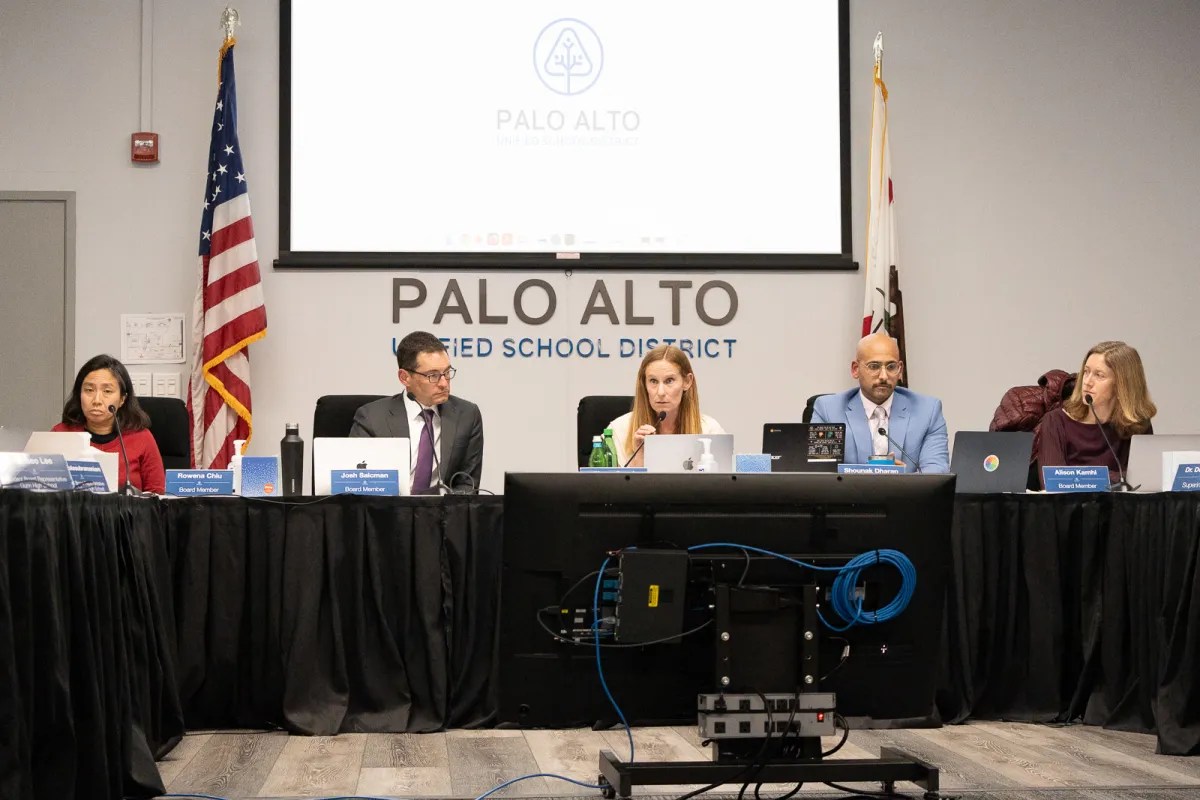
 The Palo Alto Unified School District board of directors meets in February 2025. Photo by Anna Hoch-Kenney
Just a month after three new board members were elected to the Palo Alto Unified School District Board of Education, the group got straight to business as it tackled two major and contentious decisions – adopting a state-mandated ethnic studies course and axing an honors biology course.
The January decisions were a product of years of research and were teed up months in advance, but board members couldn’t have anticipated the controversy that ensued in the next months. From controversial social media posts, to multiple recall efforts, to a Brown Act lawsuit, the Palo Alto Board of education faced an academic tug-of-war in 2025, as some parents and school board members bristled at the new initiatives.
Veteran school board members Shounak Dharap and Shana Segal did what they could to prepare for the impending storm. After welcoming three new board members Josh Salcman, Alison Kamhi and Rowena Chiu in November 2024, then-board president Segal hosted a “governance workshop,” in early January. While the meeting was meant to prepare newer board members for their leadership roles, meeting discussion heavily revolved around how the board could change its “Promise” or mission statement.
The discussion foreshadowed the new board’s interest in shaking things up and pushing to address parental concerns over “academic excellence.”
Just days after the workshop, Superintendent Don Austin made a shocking announcement on January 16: The Palo Alto Unified School District would pause its upcoming implementation of a new ethnic studies course requirement that Governer Gavin Newsom mandated through Assembly Bill 101 in 2021.
The bill, which offered little implementation guidance, required state school districts to release the graduation requirement beginning with the 2025-26 school year. But the mandate was contingent on appropriations, said Superintendent Don Austin, or specific funding from the state legislature to create the course, which never happened.
While the course never officially became a mandate due to its lack of funding, that didn’t change the fact that Palo Alto teachers had been working on creating the class for the past three years. In honor of that work, the board agenda-setting committee decided to reagendize the course for adoption.
Meanwhile, the board had to tackle another contentious decision – whether or not to get rid of an honors biology course. The effort to combine the honors class with biology came into consideration in 2018, when a new state-mandated K-12 science framework changed the way the course would be framed. That consideration was briefly paused due to the COVID-19 pandemic but teachers began efforts to revise the courses in 2022.
Teachers argued at a January 21 board meeting that after implementing the new framework, differences between the two courses would no longer be meaningful.
“What we heard from our teachers, our experts, is that this is designed to be rigorous,” Dharap said at the meeting. “People have concerns, but they don’t work with our kids every day.”
Dharap, Segal and Kamhi voted to get rid of the honors course on the recommendation of Palo Alto teachers, while Salcman and Chiu voted against it. The decision would later draw fire from U.S. Rep. Ro Khanna, who called the district “absurd” in a May X post.
“They call it de-laning. I call it an assault on excellence,” Khanna wrote.
Just a week after that decision, the board of education voted 3-2, with Chiu and Kamhi dissenting, to adopt the ethnic studies graduation requirement following hours of debate at a January 23 board meeting.
Students described overwhelmingly positive experiences in a pilot ethnic studies course and teachers asked for trust when handling the subject. Board members Kamhi and Chiu were wary, requesting to further postpone its adoption.
Hours after the course was adopted, Chiu took to social media, sharing a post by an account named “Asians Against Wokeness,” which claimed a district staff member bullied her. The post attached a photo of the staff member and garnered hundreds of comments, many of which were racist and physically threatening to the staff member, who is Black.
The Palo Alto Management Association, composed of school principals and leaders, alongside former board members, called for Chiu’s immediate resignation.
“Ms. Chiu’s conduct has contributed to a hostile and antagonistic environment, directly undermining the work of educators who dedicate themselves to fostering inclusive, academically enriching experiences for all students,” the management association wrote in a letter to the district.
While Chiu apologized for the post, the board of education voted to reassign Chiu to less active liaison roles in February, a decision that was reversed in June following community support for the board member.
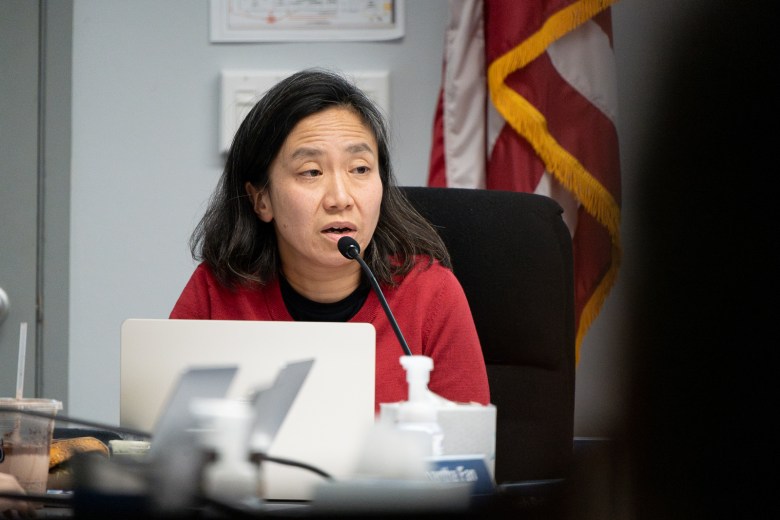 PAUSD board member Rowena Chiu speaks during a Feb. 11, 2025, school board meeting. Photo by Anna Hoch-Kenney.
As some educators expressed distrust of Chiu, many parents voiced opposition toward board member Dharap. In a February recall petition, they claimed that Dharap had failed to prioritize academics. The Santa Clara County Registrar of Voters denied the petition – and another toward Dharap in April – after it could not verify minimum signatures.
Locals continued to push back against the board’s decision to adopt ethnic studies. In late February, a parent filed a Brown Act complaint against the board, claiming the district intentionally “misled” the public after it made an error in the course description.
The parent elevated the claim in July, filing a lawsuit against the district and hoping to nullify the ethnic studies adoption. District officials called the claims “meritless” and continued to implement the class, bringing to a close the spring 2025 semester.
Early in the year, teachers also began a yearlong process to adopt an on-campus advanced math course that would give honors students an opportunity to take a senior-year math class. In December, the board of education green-lit the multivariable calculus/linear algebra honors and introduction to proofs honors courses. Principals of Palo Alto high schools will now get to decide if they want to pick up the courses, which community members have demanded for years.
The board of education made a smaller splash in the second half of the year following summer recess, taking less votes on action items and hearing more informational presentations.
It also sided with student recommendations to allow cell-phone use on high school campuses as it created its new state-mandated technology policy in October. While some community members and board member Kamhi expressed concern over screen time and mental health, students made it clear that they would protest a device ban.
“We will hold anyone that tries to do this accountable and responsible for their actions and their consequences on the student body,” said student board representative Dylan Chen, who represents Palo Alto High School.
Meanwhile, district officials, board members and the community joined hands to tackle teen mental health in a different way, theorizing new techniques to address suicide prevention as Palo Alto entered its third suicide cluster in the past 15 years.
Palo Alto district officials denied a city-led proposal to collaborate in April with the Jed Foundation, a national nonprofit dedicated to emotional wellness and youth suicide prevention, in aims of evaluating its own mental health services first. But in September, the board of education expressed support for the collaboration, underscoring student calls for additional servicing.
Residents also reinstated community-led Track Watch, which enlists local volunteers to sit at various intersections in an attempt to make the areas “less private.”
“We’re really fortunate to live in a community who deeply cares about this issue and are working nonstop to prevent suicides,” Palo Alto City council member Greer Stone said at a September council meeting.
Most Popular