The village of Sainte-Croix sits high on the southern bank of the St. Lawrence River not far from Quebec City, on a fertile piece of land named for the Feast of the Holy Cross – the Christian symbol of salvation.
A 10-minute drive gets you there from the TransCanada Highway at Laurier-Station, through fields of corn and oilseed before the local church’s two bell towers flash into view. Almost as soon as the farmlands end, the rows of modest village homes begin.
On this misty morning, residents are cuddling their hot coffee mugs and walking their dogs. A burning smell lingers in the air from the Bibby-Ste-Croix foundry, which makes cast iron pipes. But it’s the village’s other main employer that’s top of mind. The Laflamme family’s South Shore Furniture and its sprawling factory have been a mainstay of the community since 1940, an anchor that has provided good jobs and social largesse. Now, that mooring is starting to come loose.
As global trade friction rises, the company is coming under pressure like never before. The United States has veered sharply toward protectionism, exacting a higher price for access to its market and imposing tariffs that are rattling its trading partners and disrupting supply chains. Asian manufacturers are unloading their goods in greater numbers in less restrictive markets such as Canada as a result.
The strain has already crushed other domestic furniture producers. Quebec’s Dorel Industries Inc. and B.C.’s Prepac Manufacturing both stopped making furniture in Canada this year, citing the need to reshape operations. Now it’s coming for South Shore, one of the last major players still standing.
The company today is cranking out half the production volume it did 18 months ago. It has laid off hundreds of workers as it shrinks to survive, shocking employees and local residents. The manufacturer has battled through hardship before and it’s fighting again now. But the future is clouded.
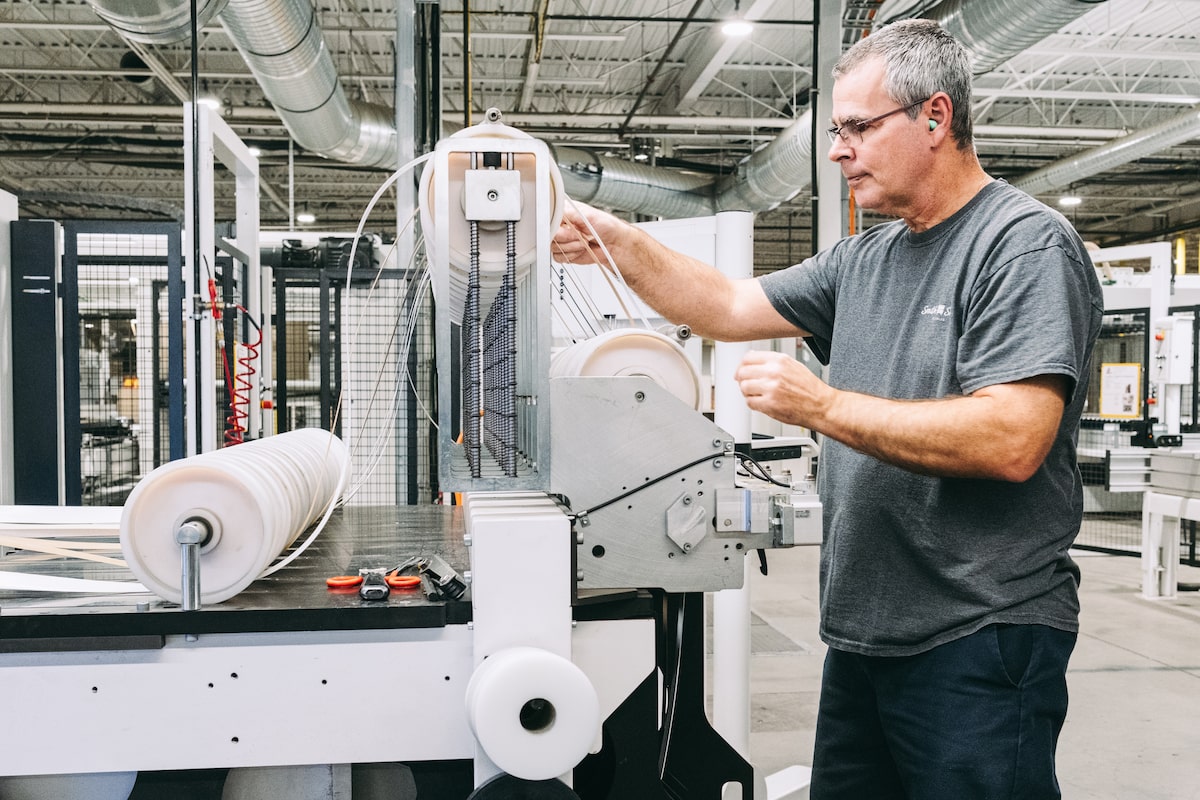
Packaging lines at the Sainte-Croix factory have been more idle than usual since South Shore Furniture cut back its output, and its staff, due to a continuing downturn in business.
“We’re being attacked,” says South Shore’s chairman and chief executive Jean Laflamme. Dumping by furniture makers from China and Vietnam continues unabated and the Canadian government has so far failed to grasp the severity of the situation, he says. “It’s not a game,” he says. “It’s people. It’s factories. It’s regions. It’s villages.”
The practical and psychological effects of the global trade war are shaking the public fabric across the country. The 2,700 people of Sainte-Croix are feeling it but they’re not the only ones. From Algoma Steel’s home base in Sault Ste. Marie, Ont., to Quebec forestry product centres such as La Doré and Saint-Félicien, communities are grappling with the prospect that the employers they’ve counted on for decades might not be there in the future.
In some places, it’s caused panic; in others, a more measured effort by local leaders to figure out what they can do about it. But everywhere, it seems, there’s a feeling that a piece of the Canadian dream – living comfortably with gainful employment in a small town – is slowly unravelling.
“I remember my dad training people to read and write and count to do the job,” Mr. Laflamme says, alluding to a period in the 1960s, 70s and 80s. “They learned it. And they managed. And they had a nice family with the house and car and Ski-Doo and four wheelers. You know, it’s sad to see that go.”
Jerseys in the cafeteria record the names of past employees, and how many years they served. Recent downsizing has cut many careers short, hence the empty desks in the administrative offices.
South Shore Furniture began as a small toy company on the outskirts of Quebec City in the early war years after founder Eugène Laflamme lost his job as a journalist.
The business did well, and he soon bought a sawmill in Sainte-Croix to expand with $2,000 borrowed from an uncle.
During the postwar years, demand for furniture exploded as living standards climbed. Buyers for Canada’s big department stores such as The Bay and Eaton’s scoured the country for product and Laflamme delivered. The company trucked its kitchen sets, chairs and tables 13 kilometres to the train stop in Laurier-Station to fill the orders.
Logic dictated that South Shore should have located in Laurier-Station for ease of transportation. But the company’s ties to Sainte-Croix were woven strong.
Twice the factory burned to the ground and twice the local citizenry pitched in with tools and muscle to help rebuild. The second time, dejected and lacking insurance, Eugène Laflamme was ready to give up and return to journalism. Villagers persuaded him to continue. “He believed in the people and the people believed in him,” Jean Laflamme, his grandson, says now.
As South Shore thrived, so too did Sainte-Croix’s population and confidence. The company expanded, buying two competitors then changing its business model to begin making ready-to-assemble furniture – a first in Canada. In 2004, it shipped its first internet order via direct delivery, and today, it sells its furniture on Wayfair, Walmart and other retail platforms in addition to its own.
Ginette Gagnon, now retired, worked for 42 years at South Shore.
You cannot walk a minute in Sainte-Croix today without meeting someone with a South Shore story.
Ginette Gagnon was fresh out of college when she interviewed for a job at the company on a morning in May, 1975. She was hired on the spot and started that same afternoon in customer service. Now retired, she spends part of her day as a school crosswalk guard.
“I was there 42 years but there are others who stayed there even longer,” Ms. Gagnon says, adding the business treated employees like family.
“When you arrived at South Shore, often you never left.”
The company is known now as South Shore after a marketing refresh that dropped the name Les Industries de la Rive Sud but in the early days, nobody called it that, Ms. Gagnon says. “It was Laflamme. We worked Chez Laflamme” or “La Shop Laflamme.”
Ms. Gagnon remembers when South Shore launched online sales and thinking no one would ever buy an entire bedroom set without seeing it first. She was wrong, and credits company leaders for anticipating industry trends and for innovating.
People in Sainte-Croix have a deep emotional bond with the factory, retiree Martin Desrochers says.
Martin Desrochers is another South Shore retiree. Over a 52-year career, he worked with four generations of Laflammes. Initially hired to run the corporation’s first computer, he took on increasing responsibilities in accounting and other areas until his departure in 2023.
Sainte-Croix, he says, is intimately tied to South Shore and Laflamme, in ways that aren’t always apparent. Sure, there’s Laflamme street and the company’s charitable foundation. But there’s also the substantial tax paid by the company and its employees, and actions that have shaped the municipality’s growth. The company gave up land for the village fire station and more land for its expansion, for example.
“It’s a business that’s really seeped into people here,” Mr. Desrochers says. “There’s a big emotional attachment.”
Councillor Francine Castonguay, a former South Shore employee, has seen their cutbacks affect other businesses.
Francine Castonguay, a former employee who now sits on the town council, says most of the residents of Sainte-Croix have a piece of South Shore furniture in their homes. She says people are proud that such a tiny place is home to a major manufacturer selling to retail giants.
There were periods where orders were flowing in so quickly that she staffed the client help line the entire day without breaks, she says. By choice. “Sometimes it was ‘My desk is wobbling,’ and the customer hadn’t put the back on it,” she explains. “We were doing lots of sales. It was stimulating work.”
The trajectory has changed, however.
South Shore cut its work force twice over the past 18 months as business conditions worsened, first in the fall of 2024 and then again this past February. Blue- and white-collar workers alike were let go, from vice-presidents to factory employees, some with decades of experience.
“People were shaken,” Ms. Castonguay says, but harboured no ill-feeling toward the owners. The slump hurts everyone, she says. “When there’s a problem in your midst, as a municipality it ends up affecting your collective morale.”
In the months that followed South Shore’s restructuring, the village’s lone grocer pulled up stakes. The local printer lost a chunk of revenue. And dozens of people were forced to find new work, with various measures of success.
And yet, life in Sainte-Croix goes on. This past year marked the busiest ever for home construction and sales in the municipality and Mayor Stéphane Dion expects an influx of 1,000 new citizens over the next five years as more units get built. The village is becoming a bedroom community to Quebec City and Lévis, where properties are more expensive.
“Sainte-Croix is affordable for families” and offers quality infrastructure such as schools, parks and an arena, Mr. Dion says. “That’s why a number of real estate promoters are currently developing projects.”
As the workers turn out furniture, general manager Charles Laflamme checks in on them. Mr. Laflamme, son of the CEO, believes the business has what it takes to innovate: ‘We’re not scared to test an idea and drop it if it doesn’t pan out.’
At South Shore’s peak several years ago, the Sainte-Croix factory was buzzing with workers and equipment. The plant and its sister facility in Coaticook were pumping out so much furniture that they didn’t have space for it all – spillover was kept in storage yards and cargo vans nearby.
These days, that spirited bullishness has given way to optimistic self-preservation. The company has cut inventory drastically to improve cash flow and free up working capital, leaving yawning spaces on the plant floor. In other areas of the building, scores of cubicles sit empty like white-collar nests waiting for their occupants to return.
The Sainte-Croix operation is making 3,000 pieces of furniture a week. It has the capacity to easily make more than twice that amount. Total company employment has gone from 500 in Canada a few years ago to less than 200.
South Shore spent millions modernizing its equipment from 2019 to 2023, adding new robots and systems. But it still has to pay off the loans for those investments and deal with the fixed costs of running the business, a much harder task when sales have diminished.
From his perch overlooking the packing line, supervisor Michel Laflamme shares his fears about the future. The 63-year-old, who’s not related to the founding family, says employees are in good hands with South Shore’s owners. Still, he wonders whether the external factors slamming the company are too strong.
“What’s frustrating is we don’t necessarily see the exit out of this situation,” Mr. Laflamme says. “Will the plant still be here in a year? Will it still be here in two? I’d like to finish my working days here and not start again somewhere else.”
Michel Laflamme – no relation to the founding family – is 63, and hopes to enjoy the rest of his working years here.
The source of the distress is fairly simple to understand.
The United States has imposed 25-per-cent tariffs on imports of kitchen cabinets, vanities and upholstered furniture that will be hiked in January. Industry representatives expect the levies will be expanded to other home product categories over time, including the ready-to-assemble dressers and beds that South Shore makes.
As the U.S. tightens access to imports, China, Vietnam and other Asian countries are increasing their shipments of low-cost furniture into Canada, selling them at prices even cheaper than in their domestic markets, according to Gilles Pelletier, chief executive of the Quebec Furniture Manufacturers Association. That amounts to a violation of World Trade Organization rules should it be proven.
“We’re really a very, very open market compared to the United States,” Mr. Pelletier says. “We’ve really become a place where big Asian producers can come unload their production surpluses.”
Jean Laflamme compares the situation to a game of chess. One country moves, then the others move. “Unfortunately Canadian governments are not well equipped to deal with these trade wars,” he says. ”They don’t have the reflex of acting quickly.”
Open this photo in gallery:Open this photo in gallery:
South Shore’s recent equipment upgrades give it more costs to manage as sales diminish.
Despite the adversity, South Shore’s owners express confidence the manufacturer can find its feet in the long term. It continues to sell into the U.S., and wants to sell more domestically. The retreat by other “Made in Canada” rivals has opened an unexpected opportunity for market share gains, at least in the short term.
The company is also analyzing whether its equipment can be used to make products other than furniture. And it’s pursuing other diversification avenues.
“We’re not scared to test an idea and drop it if it doesn’t pan out,” says Charles Laflamme, Jean Laflamme’s son, who runs much of the operations as general manager. “We can reinvent ourselves.”
Meanwhile, Jean Laflamme is urging the Canadian government to think about the bigger picture: That it needs to champion its natural resource industries and the companies that transform those products, including the lumber producers and fibreboard makers whose wood goes into furniture. Once they’re gone, he says, they’re gone.
Ms. Castonguay says Sainte-Croix would be forever changed if South Shore stopped operating. Losing the company, if that ever came to pass, she says, “would be like losing our church, it’s as big as that.” In a village named for salvation, that’s something no one wants to face.
At the station where Michel Laflamme oversees the work, a sign reads: ‘The solution moves us forward more than the problem holds us back.’
The toll of tariffs: More from The Globe and MailThe Decibel podcast
Economics editor Matt Lundy spoke with The Decibel about how three Canadian companies have fared in the North American war. Subscribe for more episodes.
The politics of trade
From Washington to Iqaluit, Carney’s travels in 2025 reveal a lot about his diplomatic dancing act
U.S. targeting dairy, Online Streaming Act in USMCA negotiations, top Trump trade official says
Bank of Canada’s Tiff Macklem on lessons from the trade war and what risks he sees ahead