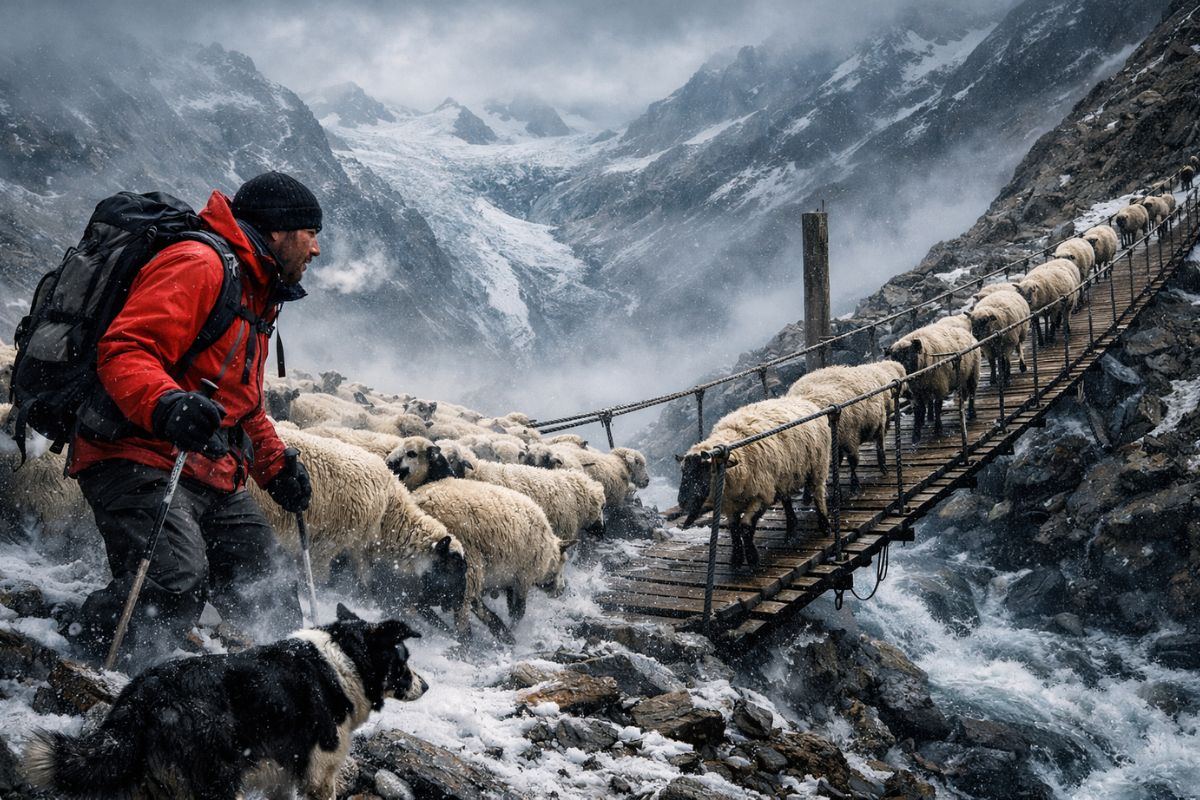
In an annual, extremely risky journey, shepherds from South Tyrol lead one hundred sheep across glaciers at over 2.800 meters between Italy and Austria, crossing borders on bridges and through unstable snow, maintaining a tradition recognized as a UNESCO World Heritage site under threat from wolves, avalanches, sudden storms, and falls.
In this year’s season, in June, Shepherds in South Tyrol once again led around 100 sheep down the slopes of the Alps.Starting from Italian valleys at an altitude of around 800 meters, where the animals have been grazing since April 25th, the route leads to the Alpine passes already inside Austria, exceeding 2.800 meters and crossing stretches of glacier.
Recognized by UNESCO as a World Heritage site, this ancient transhumance crosses ice, turbulent rivers, and a national border, while facing real risks: in the late 1970s, a blizzard knocked about 70 sheep off a cliff, and in 2023 alone, attacks by an estimated 80 wolves led to the death of the… state to pay Nearly 100 euros in compensation.
An alpine climb of over 3.000 meters and a UNESCO title.
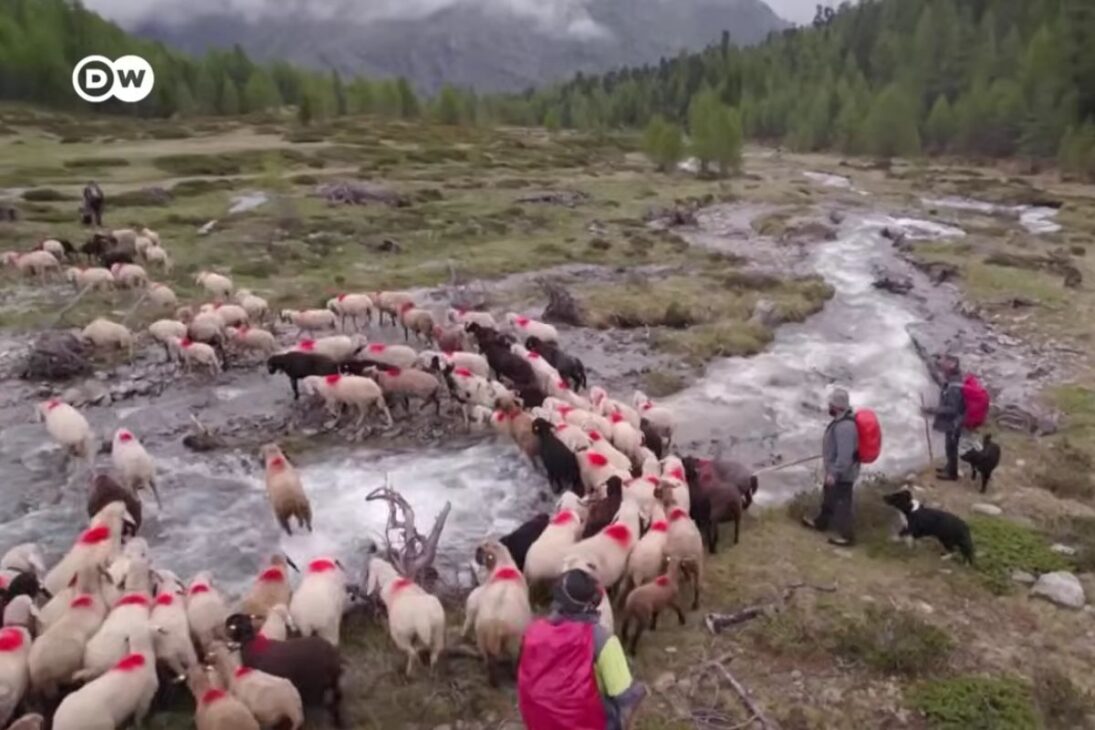
The journey these shepherds make every year adds up to over 3.000 meters of ascent on rough terrain, with snow, ice, loose rocks and crossing rivers of meltwater.
This is not a symbolic walk: each step requires planning, coordination, and experience accumulated over generations.
The practice, known as Alpine transhumance, is now recognized as a World Heritage Site by UNESCO, precisely because it combines Traditional sheep farming practices, sustainable landscape use, and cross-border cooperation between Italy and Austria..
For the shepherds of South Tyrol, it is official proof that what was always “just the family’s way of life” has become a global benchmark for mountain culture.
The crossing also has an ecological impact.
Without the herd, the alpine pastures would quickly be overtaken by dense vegetation, which would alter the balance of plants typical of high mountains.
Sheep maintain the mosaic of open pastures that sustains local biodiversity….while ensuring meat and a minimum economic return for the communities.
Shepherds of South Tyrol between Italy and Austria
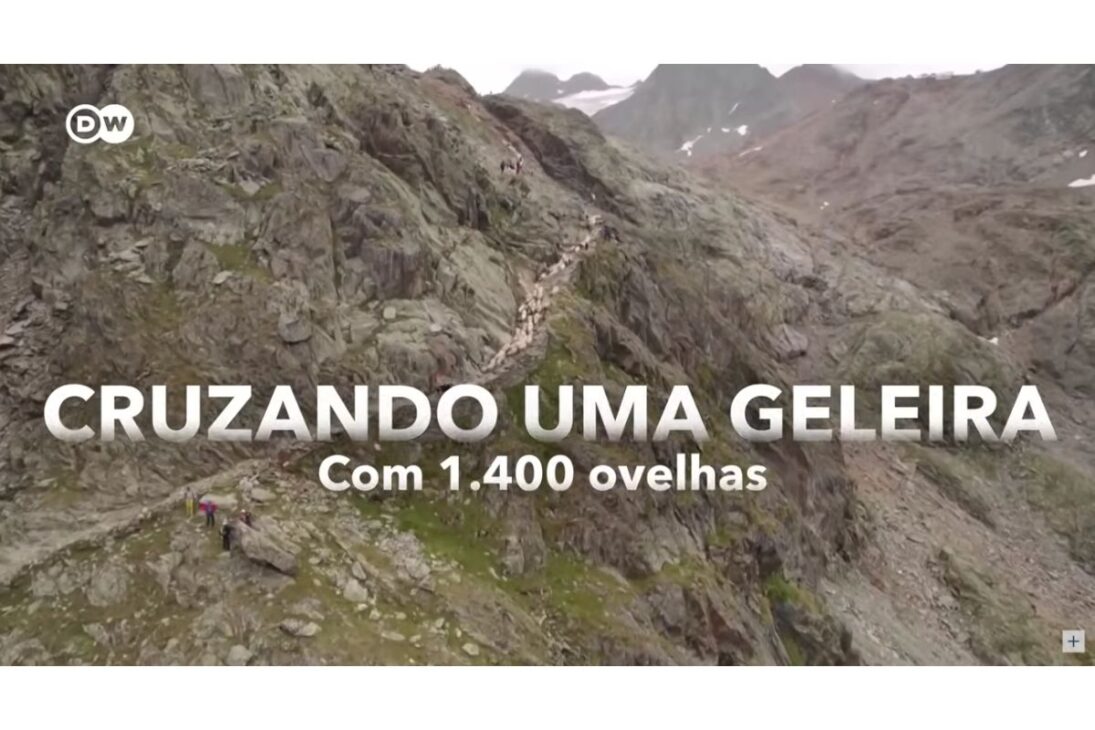
The starting point is in the valleys of South Tyrol, on the Italian side.
There, shepherds like Thomas gather the sheep over several days, pulling scattered animals together to form the flock of about 100 head that will complete the journey to the Eartstal valley in Austria.
Experienced shepherds divide the route into stages, alternating climbs, crossings, and overnight stays at ski resorts that are inactive out of season.
The first major goal is the summit cross at Tinurer, at approximately 2.800 meters. After about three hours of climbing, the break is short.
The descent that follows, on steep and unstable terrain, is described by the shepherds as almost more strenuous than the ascent itself.
Still, everyone knows that this routine repeats itself year after year and that A single slip can be enough to end human and animal lives in seconds..
Along the way, transhumance crosses a national border.
In one of the most sensitive sections, the herders must lead the flock across a narrow suspension bridge, where the flow of animals must be strictly controlled to prevent panic and falls into the river.
The rule is clear: only a few animals at a time, always moving forward, never stopping over the gap.
Dangerous work, low income, and the weight of tradition.
For young Marcos, 25, this is not a tourist attraction, but work.
He is hired by about 40 different breeders to look after the sheep during the summer in a pasture area that reaches… 1.000 hectares in the high mountains, at an altitude of over 2.400 meters.
In winter, he needs to look for other sources of income, since his pastor’s salary doesn’t support his family year-round.
Being an alpine shepherd today means accumulating risks of rockslides, falls on slopes, and lightning strikes, without the corresponding substantial income.
The shepherds themselves admit that, economically, sheep farming is almost a hobby..
Wool barely covers the costs, and what comes in from the meat barely covers maintenance expenses.
Most supplement their income with side jobs, such as plumber, bricklayer, ski resort worker, or temporary worker in other rural activities.
Still, nobody wants to abandon transhumance.
For families like Marcos’ and his brother Johan’s, herding sheep up and down the mountains and valleys means continuing a legacy passed down from their grandparents.
They explicitly state that they are working so that “whoever comes after us will still have something,” even knowing that living solely off sheep is no longer possible.
Wolves, bears, avalanches, and weather that changes three times a day.
The obstacles are not limited to the terrain.
In recent decades, the return of natural predators to the mountains has added another layer of risk.
Local estimates point to around 80 wolves in South TyrolIn addition to bears, which have been observed more frequently.
In 2023, attacks on livestock led the government to pay nearly 100 euros in compensation to farmers.
Veteran herders warn that if the number of attacks increases, the viability of transhumance itself could be compromised.
In their view, a predator that attacks uncontrollably can “break” the fragile economic balance of the activity., discouraging younger people from continuing.
In addition, the high mountain climate further complicates the situation: field reports indicate that, up there, the weather can change three times a day, alternating between clear skies, strong winds, snow, and fog in just a few hours.
There are tragic precedents.
In the late 1970s, a sudden snowstorm caused about 70 sheep to fall off the trail and die.
Episodes like this remain present in the collective memory and influence operational decisions, such as postponing the ascent when there is too much snow in June or altering the route to avoid sections with avalanche risk.
Every route decision is an ongoing negotiation between tradition, safety, and the actual conditions of the mountain.
A solitary routine watching over 100 sheep high in the mountains.
After the long journey uphill, the shepherds’ work changes in form, but not in intensity. Marcos, for example, spends weeks in an isolated cabin, accompanied only by his dog and about 100 sheep.
The structure is simple, with a gas stove, running water, basic electricity, and an extra bed for occasional visitors.
He describes the quiet mornings, with coffee and a view of the valley, as one of the highlights of the job.
Every day he travels different routes to check if the animals are okay, if there are any injuries, and if the herd hasn’t strayed into dangerous areas.
One of the least visible yet most important tasks is the distribution of salt.
At the start of the season, a helicopter takes about 15 kilos of table salt to the top, which Marcos spreads in various spots.
The mineral supplements the sheep’s diet and helps keep them focused in specific areas.
Before becoming a pastor, Marcos trained as a bricklayer, but he abandoned the construction site for the mountains.
He says he enjoys seeing the lambs arrive small in the spring and return in the fall bigger, stronger, with thick wool and a good weight.
For him, witnessing this complete growth cycle of the animals is the main emotional reward of a job that pays little and demands a lot.
Brothers in different valleys and a tradition that endures.
While Marcos watches over the flock in the upper part of the farm, his brother Johan tends to the animals on the Italian side, further down in the Schnalstal valley, sleeping at home and dividing his time between the farm, herding, and working at a ski resort in the winter.
They hardly ever see each other during the summer; when they do meet, they chat briefly about the sheep, exchange impressions about the weather, and then go on their way.
For Johan, working in the fields of South Tyrol is the only way of life that makes sense.
He claims that climbing the mountain allows him to “leave the stress behind” and that the sight of healthy, well-fed animals is reason enough to continue.
At the same time, he acknowledges that he depends on supplemental income to maintain the property and support his family.
The two brothers represent a generation of pastors who need to balance tradition and pragmatism.
They participate in sheep and goat breeders’ associations that organize transhumance, share costs and responsibilities, and train young talent.
The expectation is that this renewal will be sufficient to keep the activity alive, provided that risks such as predator attacks and extreme weather events remain under some degree of control.
The long descent, the final accounting, and the future of transhumance.
At the end of summer, the work is reversed.
Shepherds and sheep leave the alpine meadows and head back to the valley.
The operation repeats many of the challenges of the ascent: Crossing the suspension bridge, steep sections where a fall could be fatal, risk of abrupt weather changes..
On one of the recent return trips, fog, rain, and cold wind accompanied the entire eight-hour hike to the bottom of the valley.
This time, the final numbers were considered excellent: only two animals died during the entire season and no fractures or injuries during the descent.
The association’s treasurer checked each herd before declaring that everything had gone well.
For the pastors, the relief is visible, but the conclusion is always the same: “we’ll do it again next year”.
With the tradition now registered by UNESCO, with wolves and bears returning to the mountains and young people divided between urban jobs and life in the countryside, the alpine transhumance of South Tyrol becomes a living test of balance. between economy, culture and nature.
In your opinion, should shepherds continue risking their lives and flocks on glaciers to maintain this ancient Alpine tradition, or is it time to rethink this mountain ritual for future generations?