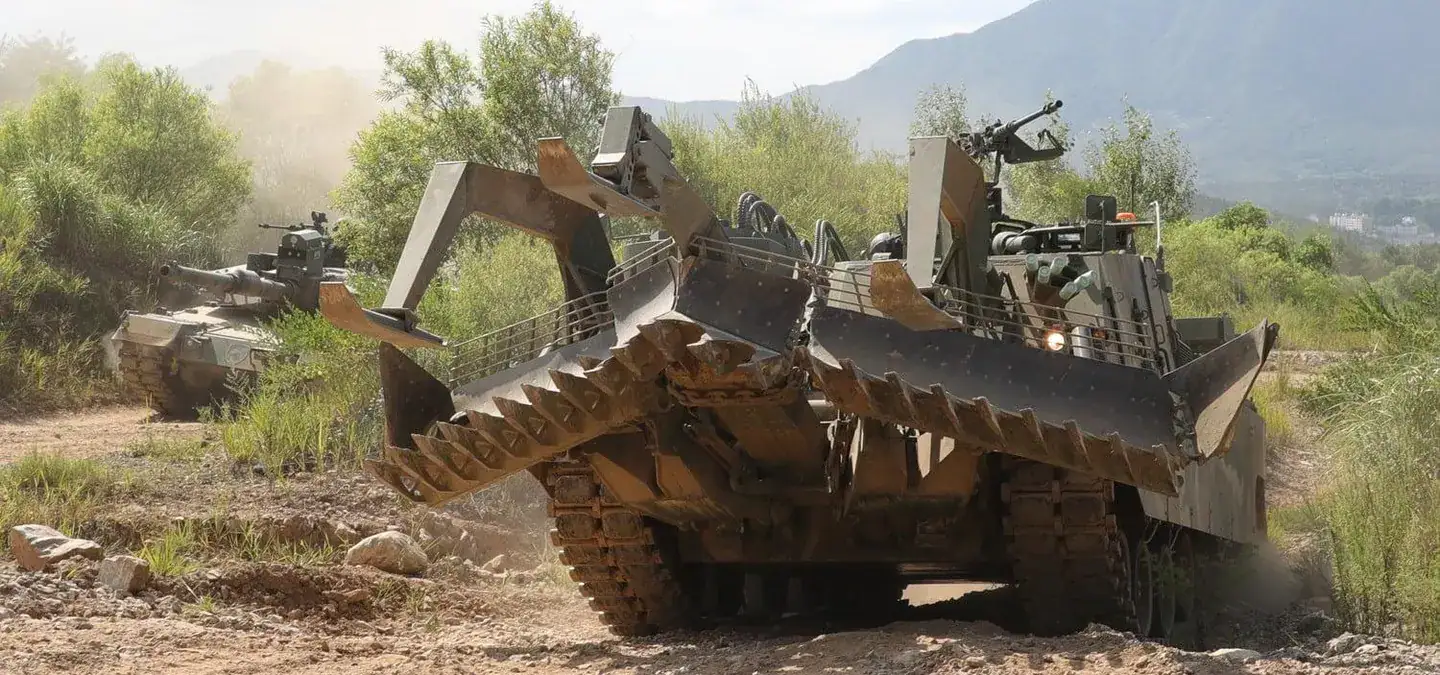
 Hyundai Rotem has won a contract to supply additional K600 Rhino combat engineer vehicles to the South Korean military. (ROK MND)
Seoul has awarded Hyundai Rotem a contract for additional K600 Rhino combat engineering vehicles (CEV). Deliveries are scheduled to run through to the end of December 2029.
The contact awarded by South Korea’s Defense Acquisition Program Administration on 9 December is valued at KRW250 billion (US$175 million), and it will see an unspecified number of vehicles delivered to both the Republic of Korea Army (ROKA) and ROK Marine Corps.
This latest production batch of tracked K600s will incorporate a number of improvements identified by soldiers. These include a commander’s station seat with greater flexibility and movement, and a reduced vibration in rear-view mirrors.
First introduced to the ROKA in 2020, the Rhino is a multirole CEV capable of mine clearance, excavating positions, moving soil and assisting in vehicle recovery. It is based on the K1A1 main battle tank chassis, but with the turret removed.
Either a Pearson Engineering V-shaped mine plough or a straight earthmoving blade can be fitted to the front of the hull. In addition, the hull has an excavator arm on the right side that can be employed to dig ditches or remove obstacles. The vehicle also has magnetic influence mine disruptors to detonate magnetic-activated mines in front of the vehicle.
Furthermore, there are lane marker dispensers for minefield clearance installed on the rear flanks. These automatically emplace marker poles to delineate a 3.8m-wide cleared lane for following vehicles. The K600 is also capable of being remotely operated from a distance of 5km.
 The ROK Army previously fielded the K600 in mechanised units, but this latest buy will distribute them to both army and marine units. (ROK MND)
Two K600s have also been provided to the Ukrainian Army, where the critical value of mine clearance and obstacle breaching capabilities is being vividly demonstrated. However, the threat of mines and obstacles is perhaps nowhere greater than in the Demilitarized Zone between the two Koreas.
Previous K600s have already been fielded to ROKA mechanised forces via an earlier contract. The implications of this expanded armoured combat engineering capability are relevant beyond the equipment itself, as these specialised vehicles assure manoeuvre and rapid response to developing tactical situations. Such equipment reinforces the concept that, in the future, combat mobility and maintaining the initiative will be primary to battlefield survivability and success.
It will be interesting to see whether any international customers that have already acquired Hyundai Rotem main battle tanks will similarly recognise the importance of the K600 CEV. Poland and recently Peru are fielding the K2 tank but, to date, neither has chosen to purchase this K600 mine-clearing/obstacle breaching version.
by Stephen W. Miller