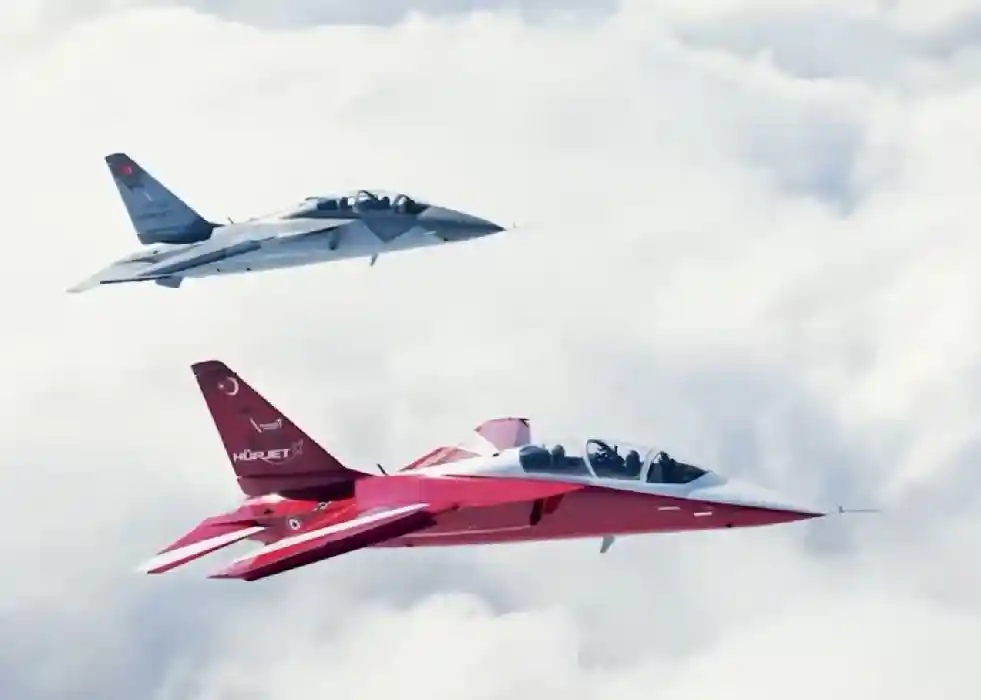
Türkiye’s Defence Industry President Haluk Görgün has formally announced the export of the HÜRJET jet trainer via social media, confirming a landmark development for the country’s defence industry. With this agreement, Türkiye has, for the first time, secured the sale of an aircraft to a country that is both a European Union and NATO member.
Under the agreement, HÜRJET has been selected by the Spanish Air and Space Force as part of a 30-aircraft procurement package. The programme carries a total project value of €2.6 billion, with deliveries planned to begin in 2028.
The contract goes well beyond the sale of aircraft alone. It encompasses an integrated advanced pilot training architecture, including ground-based simulation and training systems, a comprehensive maintenance and sustainment infrastructure, and long-term operational support elements. In this respect, the HÜRJET programme represents a high value-added, multi-dimensional defence export rather than a conventional platform sale.
The induction of a jet trainer designed and produced entirely with national resources into the inventory of a European and NATO air force underlines the level Türkiye has reached in aircraft design, manufacturing, system integration, certification, and long-term sustainability. It also reflects growing international confidence in the maturity of Türkiye’s aerospace ecosystem.
No specific figures were provided in the announcement regarding Türkiye’s realised defence exports for 2025. However, should the financial value of the HÜRJET programme be reflected in that year’s export statistics, Türkiye would be positioned to surpass the $10 billion defence export threshold in 2025. This places the agreement not only as a symbolic milestone, but as one with potentially transformative macro-economic impact.
With HÜRJET, Türkiye continues its transition into a country capable of developing, producing, and exporting high-technology air platforms, while its defence exports advance to a new qualitative and quantitative level. Defence Industry President Haluk Görgün credited the achievement to the engineers and technicians involved, as well as the Turkish Aerospace Industries family and all contributing stakeholders.