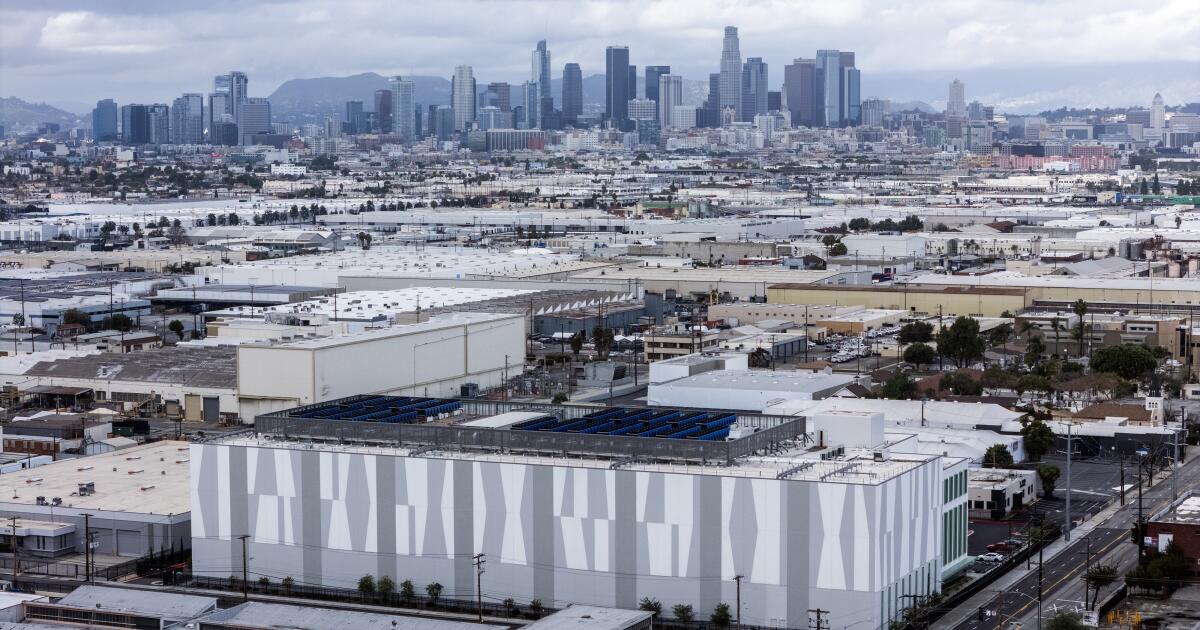
Five miles south of downtown Los Angeles, a single industrial block in Vernon is drawing as much electricity as a small town.
Inside a three-story, 242,000-square-foot building known as LAX01, rows of advanced artificial intelligence chips hum across six data buildings, consuming enough electricity to power more than 26,400 homes for a year. The processors are part of a fast-growing network of data centers reshaping this rusty industrial corner of L.A. County.
Vernon has a little over 200 residents and a long, colorful history arising from its industrial roots. Over the years, it has grappled with corruption scandals and environmental pollution charges.
It was once on the verge of being unincorporated amid accusations that it had been controlled for decades by a small cadre of families and their associates. Its history helped inspire a season of the HBO crime drama “True Detective.”
Today, Vernon is becoming an unlikely hub for Southern California’s AI infrastructure.
“The race toward superintelligence is reshaping infrastructure requirements across every industry,” said Michael Wall, executive vice president at Prime Data Centers, which built the Vernon data center. “We’re working to give businesses the foundation they need to build and deploy the next generation of AI models — faster, more efficiently and at massive scale.”
Prime and other developers, including Goodman Group, CoreSite, and Digital Realty, are planning hundreds of megawatts of new data center capacity in Vernon, said Darren Eades, managing director of JLL, who specializes in data centers.
Companies are snapping up Vernon properties and upgrading them, adding advanced cooling systems to old office buildings and filling a shuttered slaughterhouse that once housed hogs, with advanced chips.
“We haven’t seen new data center development in a long time in Southern California,” Eades said. “There’s a new wave that’s hitting the coast, primarily driven by AI.”
The build-out is happening across the country.
In 2025, Google, Amazon, Microsoft and Meta invested $465 billion in building out computing and networking infrastructure for AI, according to Goldman Sachs.
One Harvard economist estimated that without data center investments, America’s gross domestic product growth could have come to a near standstill this year.
Los Angeles has more than 70 data centers. The hub for them has long been the One Wilshire building in downtown Los Angeles. It is the destination for massive undersea cables that connect the U.S. to Asia.
Every major telecom operator is located within the building, creating a dense ecosystem of data centers for providers such as Netflix, Amazon and Microsoft.
As One Wilshire has become increasingly crowded, data center companies have been setting up in Vernon, attracted by its independent, relatively inexpensive power and proximity to One Wilshire.
Vernon operates its own publicly owned utility that delivers electricity, water, gas and fiber-optic internet to customers. Through this, the city can offer excess power capacity at rates as low as half those of other Southern California providers.
Vernon is also attractive because of its lack of NIMBYism.
Its population is so low that there are few neighbors around to notice or protest any potential noise pollution or other environmental effects from the data centers.
Across the nation, communities have blocked or delayed billions of dollars of planned investment in data centers, worried that they could use up too much water and trigger higher electricity rates.
Opposition occurs in both red and blue counties and affects both urban and rural communities. One local example is an ongoing delay over a proposed data center in Monterey Park.
Vernon responded to a request for comment by sharing a frequently asked questions document stating that the build-out won’t affect electricity prices or water availability for residents or businesses.
“No additional power or water purchases are needed to support the new electrical load and water demand — costs that, in other utility jurisdictions, often lead to rate increases,” the document states.
“To date, the City has not received any objections from the community,” a spokesperson said in an email.
Some analysts say that the increased demand for power, along with the rising cost of building infrastructure to deliver it, will inevitably lead to higher electricity rates.
California already is the country’s third-largest data center hub, after Texas and Virginia. Power consumption is set to hit a record due to data center-led electricity demand. Utilities such as Pacific Gas & Electric plan to spend $73 billion to upgrade transmission lines.
A Bloomberg analysis shows that in five years, electricity costs soared by as much as 267% in areas located near data centers
California has historically been a market that data centers have tried to avoid when possible because of the state’s high land and power costs and its onerous legislation.
Eades of JLL pointed out that local legislation limits projects to 49.9 megawatts of power to avoid excessive paperwork and licensing requirements for larger facilities. That is one of the reasons the proposed data centers in Vernon are below that threshold.
Still, the demand for AI continues to grow. If this continues, even Vernon’s excessive power, analysts said, might be reaching its limit due to the influx of new data centers.
“We didn’t use to speak in megawatts when we thought of data centers; we used to think in terms of just kilowatts,” Robert Brooks, vice president of sales at Lambda, a cloud computing firm that leased a majority of the LAX01 data center.