To say 2025 was unpredictable would be an understatement.
For the Canadian construction industry, it meant constantly having to pivot to deal with an ever-changing environment. Whether it was, and is, watching to see the latest move the Donald Trump administration makes south of the border regarding tariffs; adjusting to a completely new regime back home with the Mark Carney minority government; adapting to the rapidly changing world of AI, with the added detail of data centres; and continuing to try and come up with solutions to the housing crisis, the industry has had its hands full.
The Daily Commercial News and Journal of Commerce have followed along every step of the way. We are taking a look back at these 2025 trends, which will inevitably surface again in 2026.
Part one looked at the never-ending tariff saga and the Mark Carney government. Part two dives into the world of AI and data centre construction as well as Canada’s continued housing crisis.
THE FUTURE IS NOW: AI, DATA CENTRES AND CONSTRUCTION
In many ways artificial intelligence (AI) and data centres go hand in hand.
More importantly, how they impacted constructed in 2025 was a source of many headlines.
As Alex Carrick wrote in May: “ No one ever heard of data centres back in the day. Now, they make up a big part of the commercial building category, especially given the drop-off in office tower assemblies, with a shift to working from home sending vacancy rates to unprecedentedly high levels in many cities.”
So how are the two shaping this new age of construction?
AI advancements
2025 could arguably be coined the year of AI, with Time Magazine even naming the “Architects of AI” the Person of the Year.
For construction the AI impact impact has been multi-faceted, with some AEC companies expecting AI to be part of skillsets going forward. What’s more, AI is also showing how it can reduce time for some menial tasks.
Delegates attending the recent Buildings Show in Toronto heard how agentic AI is rapidly emerging as construction’s third wave, moving beyond Large Language Models and automated workflows to create a world of autonomous systems that plan, monitor and update project tasks and write code.
The federal government has even launched a public registry to keep Canadians in the loop on its growing use of AI. The registry lists more than 400 areas where AI is currently being explored, developed, implemented or deployed within the government.
According to a November report from KPMG in Canada, most companies have begun to roll out AI in some form, but only a small fraction have seen any return on their investments so far. Of more than 750 business leaders across the country, 93 per cent said their organizations are using AI, significantly up from 61 per cent last year.
During the inaugural Engineering Roundtable discussion at the Buildings Show AI was described as being “transformational” for that profession for things such as site review reports and searches on technical issues.
But, at the end of the day, AI is only as good as the human behind it.
Data centre dominance
Across Canada and the U.S., data centre conversations swirled in 2025 followed by a surge in activity.
A September report from ConstructConnect shows Canada leads with $12.4 billion in planned energy construction, followed by southern U.S. states at $6.8 billion.
In Canada, one planned start in Alberta is valued at $750 million.
Both Ontario and Alberta have announced initiatives aimed at data centre activity.
The Ontario government announced it will prioritize and accelerate approvals for data centres that deliver measurable benefits to both local communities and to the province’s long-term competitiveness. The current load of data centres requesting to be connected to Ontario’s grid represents approximately 30 per cent of the province’s peak demand in 2024.
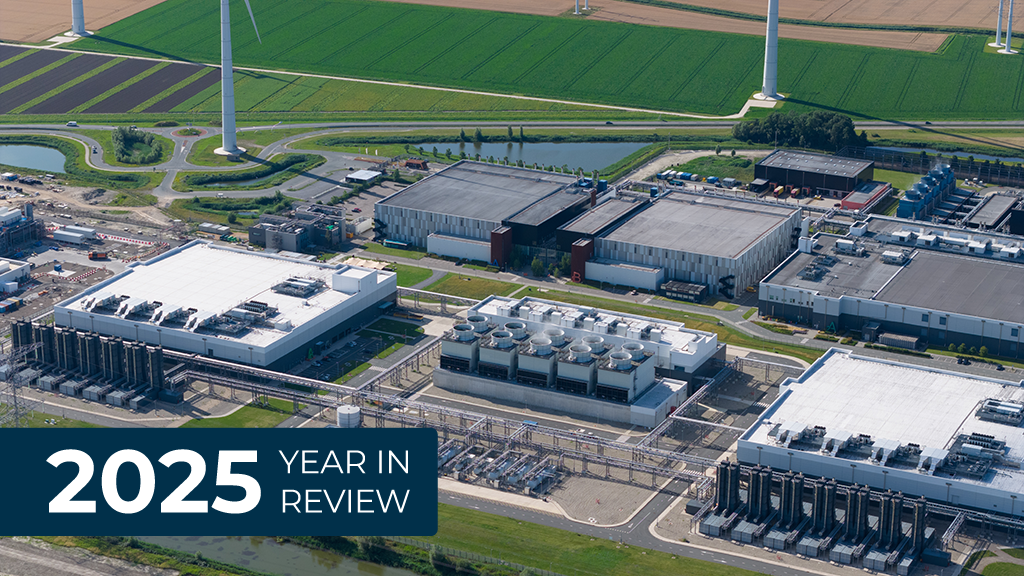
 FILE PHOTO — Data centres in both Canada and the U.S. showed a surge in activity in 2025.
Alberta introduced Bill 8, the Utilities Statutes Amendment Act, 2025, which would see energy-intense data centres that bring their own generation prioritized, accelerating the approval process and supporting their connection to the grid.
For the U.S., a follow-up report in December from ConstructConnect showed total data centre construction starts amounted to $10.8 billion in spending for October 2025, spread across 23 projects. This marks a significant year-over-year increase from October 2024, when 22 projects totalled $2.9 billion.
It appears data centre projects are only going to power ahead in 2026.
THE CRISIS CONTINUES: HOUSING IN 2025
Housing hurdles continued throughout 2025 despite several attempts by all levels of government to try and bolster supply and affordability.
Holes continues to grow larger for Canada’s three largest cities, with a new report showing they are lagging behind the rest of the country.
The assessment by the University of Ottawa’s Missing Middle Initiative graded each of the provinces across 36 indicators related to housing.
New Brunswick and Prince Edward Island each scored an overall A- grade, while Ontario finished last with a D, behind B.C.’s score of C- and Quebec’s C+. Alberta, Newfoundland and Labrador, Saskatchewan, Manitoba and Nova Scotia were all graded in the B+ to B- range.
Ontario has the slowest municipal approvals in Canada, with Toronto averaging about 25 months, the report noted. It also has among the highest development charges for both low-rise and highrise projects.
 SHUTTERSTOCK — Tasked with figuring out just where Canada’s housing enabling infrastructure stands, the Canadian Infrastructure Council published the country’s first National Infrastructure Assessment in November.
One speaker at a Residential Construction Council of Ontario housing summit said “there’s not a chance in hell” the province is going to meet its promise to build 1.5 million homes between 2023 and 2031.
On the national spectrum, the first-ever National Infrastructure Assessment, which examined three public “housing-enabling” infrastructure sectors, showed overall more than $126 billion of infrastructure is in “poor or very poor condition,” with 11 per cent of water and wastewater assets and more than 13 per cent of public transit assets listed as in the same boat.
While there are significant challenges, the year was not all doom and gloom.
The federal budget did include several measures including a previous promise to eliminate the GST for first-time buyers at or under $1 million; reducing the GST for first-time home buyers on new homes between $1 million and $1.5 million; launching the new Build Canada Homes agency; and $12 billion over 10 years for housing enabling infrastructure.
In December it was noted that Build Canada Homes is projected to add 26,000 units to the total housing supply across the country over the next five years, half of which would be affordable homes for low-income Canadians.
The federal government also finally unveiled the Canada Housing Design Catalogue, born out of the latter days of the Justin Trudeau administration that recalled the Canada Mortgage and Housing Corporation catalogues of home designs first published in 1947.
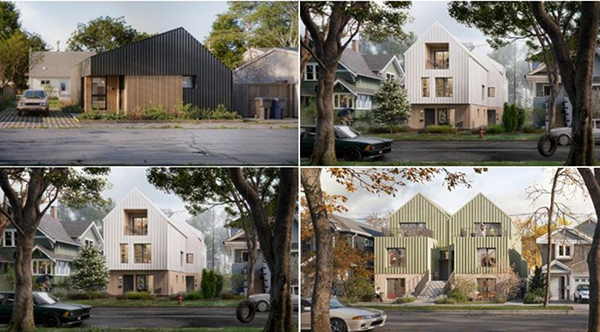 CMHC — The 50 designs presented in the Canada Housing Design Catalogue offer a range of accessory dwellings, duplexes, fourplexes and sixplexes suited to specific areas in Canada.
Among the 50 individual designs offered are multiple choices for accessory dwellings for existing lots, duplexes and multi-plexes.
Each design is suited to specific areas of Canada, based largely on climatic differences as well as code variations.
Will we see more of these projects pop up across the country in 2026? Time will tell.