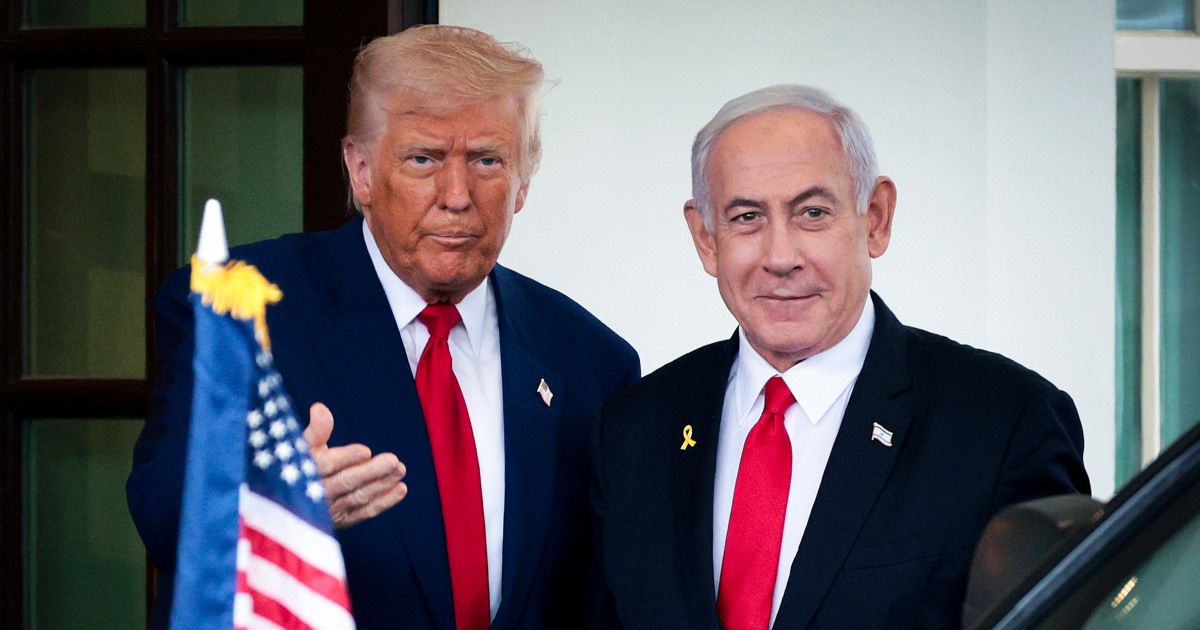
President Donald Trump issued new warnings against Iran and Hamas after a meeting with Israeli Prime Minister Benjamin Netanyahu in Florida on Monday to try to advance the ceasefire deal that Trump brokered in Gaza.
Trump threatened Iran with unspecified consequences, saying Iran “may be behaving badly” and suggesting it was trying to rebuild nuclear sites after the U.S. struck three of them this year.
“If it’s confirmed, look, there will be consequences,” he said. “Consequences will be very powerful, maybe more powerful than last time.”
Iran swiftly responded to Trump’s remarks.
President Masoud Pezeshkian said Monday in a post on X that his country’s response to “any aggresive action would be harsh and regrettable.”
A similar warning was issued by Ali Shamkhani, an adviser to Iran’s supreme leader, Ali Khamenei, who was quoted by the state-run Nour News agency as saying that Iran’s response would go “beyond what the attacker expects.”
Trump also said Hamas would have “hell to pay” if it didn’t disarm to advance the U.S.-brokered peace plan, as he seeks to move into its second phase. He said Hamas, which didn’t agree to the demilitarization of Gaza that Trump laid out as a key point in his peace plan, will be given a “very short period of time” to disarm.
If it doesn’t, Trump said, the consequences will be “horrible.” He suggested that other countries — not necessarily the U.S. or Israel — would take action against the perpetrators of the Oct. 7, 2023, attack on Israel, in which 1,200 people were killed and about 250 were abducted.
“If they say they’re not going to disarm, those same countries will go and wipe them out,” Trump said.
Israeli attacks in Gaza have killed more than 70,000 people since the war started, the Palestinian Health Ministry said in late November. The death toll has continued to rise despite the ongoing ceasefire.
Trump was overwhelmingly supportive Monday of Israel’s efforts to advance the peace plan. He said that Israel had “lived up to the plan 100%” and that he wasn’t concerned “about anything that Israel is doing.”
Asked moments later whether he was concerned that Israeli settler violence could undermine the peace plan, Trump said he and Netanyahu weren’t on the same page about the West Bank.
“We have had a discussion, big discussion, for a long time on the West Bank. And I wouldn’t say we agree on the West Bank 100%. But we will come to a conclusion on the West Bank,” he said.
Trump didn’t elaborate on what the leaders’ differences were, but he said he believes Netanyahu will “do the right thing.”
Ahead of their closed-door meeting at his Mar-a-Lago estate in Florida, Trump told reporters that they would discuss the need for Hamas to disarm, Iran’s ballistic missile and nuclear programs, and Syria’s new government.
Standing alongside him at the top of the meeting, Netanyahu praised Trump.
“I’ll say it again and again and again, we’ve never had a friend like President Trump in the White House. It’s not even close,” he said. “And I think you can judge that by not merely by the frequency of our meetings, but by the content and the intensity.”
Trump responded: “Well, I just want to say that it’s very important who the prime minister and president of Israel is. We have a great relationship.
“He can be very difficult on occasion, but you need a strong man,” Trump added. “If you had a weak man, you wouldn’t have Israel right now. Israel would have been, you know, Israel, with most other leaders, would not exist today.”
Netanyahu reiterated his praise of Trump after their meeting, announcing that Israel would award him the Israel Prize, the country’s highest honor. Netanyahu said it would be the first time the prize has been awarded to a non-Israeli.
Monday’s meeting comes one day after Trump hosted Ukrainian President Volodymyr Zelenskyy at Mar-a-Lago as part of the U.S. bid to negotiate a peace deal with Russia.
While Trump has been working for an end to the war in Europe, progress in the Middle East has stalled.
The Israel-Hamas truce went into effect in October, ending the two-year conflict in Gaza that followed the Oct. 7 Hamas-led terrorist attack on Israel.
But there has been little movement on the more complex second phase of the peace process, raising concerns that both sides are failing to take action to carry out the next phase.
More than 400 people have been killed in the Palestinian enclave since that agreement, local officials say, while Israel has accused Hamas of ceasefire violations, including the delayed return of hostage remains — with one body still to be handed over.
The U.N. Security Council gave its approval to Phase 2 of Trump’s 20-point peace plan last month, under which Israeli forces would withdraw from Gaza and Hamas would give up its weapons.
But few details have been publicly confirmed about the “Board of Peace” headed by Trump, which would help oversee the territory’s governance, or the International Stabilization Force that would be deployed to Gaza.