Laundry is a fact of life—and so are the microfibers it leaves behind.
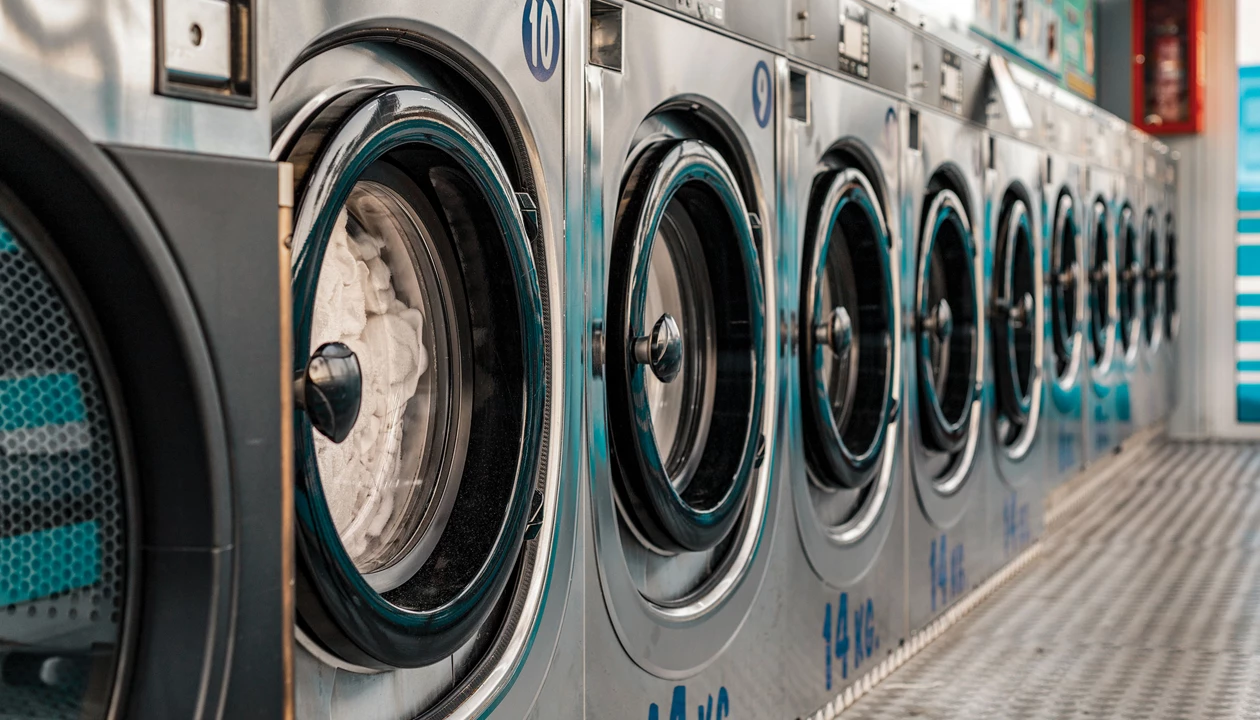
Washing machines are a major source of the ubiquitous fibers, which come from both synthetic and natural fabrics. Commercial dryers, like those used in laundromats, are also responsible for a hefty portion, new research shows. Just one laundromat can release 8 million–47 million microfibers (weighing a few grams) each week from its dryer vents into the environment.
“Combined over a whole year, it’s actually a pretty big amount,” says Lisa Erdle, an ecotoxicologist at the 5 Gyres Institute, a nonprofit organization that researches plastic pollution in the environment.
Several years ago, 5 Gyres scientists discovered that stormwater in San Francisco harbored significantly more microfibers than the city’s wastewater. Many of these superfine microfiber threads are also considered microplastics because they come from synthetic materials such as polyester. But cotton and other natural fibers can shed microfibers as well. Wastewater treatment plants are a major point at which fibers enter the environment, thanks to waste streams from washing machines and textile production. Erdle wanted to understand why there were more microfibers in the stormwater, which suggested that the fibers were already lurking in the environment. Because previous studies found that household dryer vents are a source of microfibers, Erdle and her colleagues decided to investigate commercial dryers at laundromats.
The team looked for airborne microfibers down- and upwind of 10 laundromats in San Francisco (Environ. Res. Commun. 2025, DOI: 10.1088/2515-7620/ae188d). They stationed sticky platforms near laundromat vents to catch microfibers drifting on the breeze. They also sampled microfibers directly from several vents by capturing lint as it blew out. Significantly more microfibers showed up downwind, and the study estimates that one laundromat can release billions of microfibers from its vents over a year. On a San Francisco–wide scale, that could mean the city’s estimated 148 laundromats release up to 1.1 quadrillion microfibers annually from dryers. Household dryers also release ample amounts of fibers, although it’s hard to compare which source contributes more, Erdle says. One study estimates that a household dryer spits out around half a million cotton and polyester microfibers within 15 min (Environ. Sci. Technol. Lett. 2022, DOI: 10.1021/acs.estlett.1c00911).
The open-air method for collecting samples means that not all dryer microfibers can be accounted for and that fibers from other sources can land on them, notes marine biologist Dimitri Deheyn, a microplastics expert at the Scripps Institution of Oceanography at the University of California San Diego. Regardless, “this study was definitely needed and shows what was expected,” he says.
Dryer vents trap coarse fibers—like those collected in lint traps—but small fibers are free to fly. Particularly those smaller than 0.1 mm, Erdle says. “It’s the smaller ones that are scary.” Those itty-bitty threads end up in the environment and in the bloodstreams and organs of both humans and animals. Scientists are still unraveling the medical impact of microfibers, but studies have shown a link between problems such as endocrine disruption and intestinal damage.
Secondary lint filters and filters with smaller mesh can make a dent in the problem, though. In a separate study, Erdle and colleagues found that a secondary filter could capture up to 80% of microfibers from household dryers (Environ. Toxicol. Chem. 2025,DOI: 10.1093/etojnl/vgaf260). Using additional filters on dryer exhaust “is a no-brainer. Very feasible,” Deheyn says. “The question will then be what to do with the filters when they are full.”
Chemical & Engineering News
ISSN 0009-2347
Copyright ©
2025 American Chemical Society