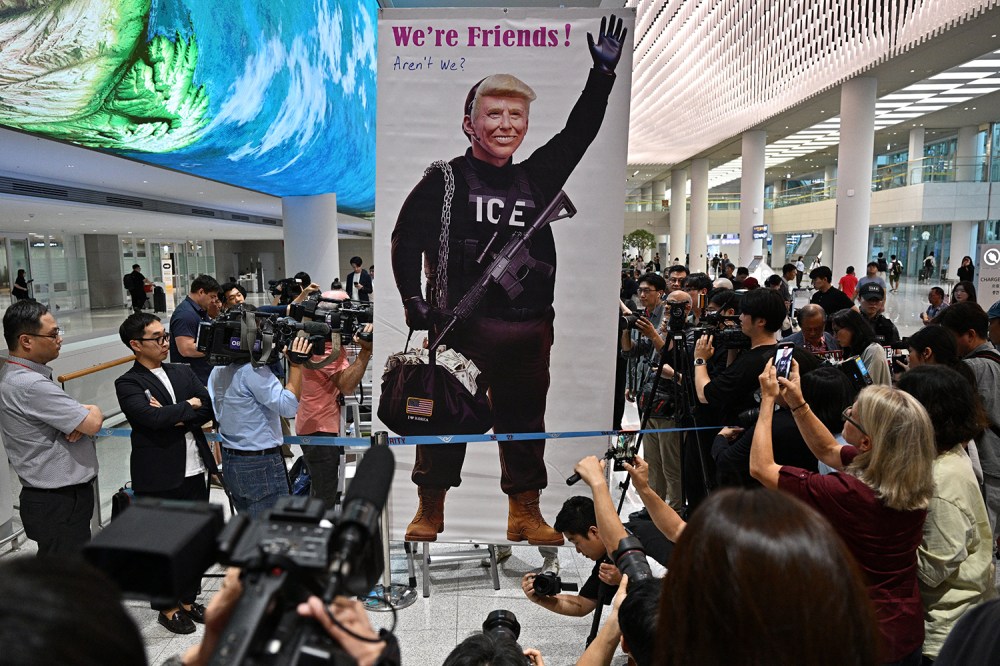
There were many Trump surprises in 2025, including several that affected the world of business. One particular incident surprised and shocked executives: The U.S. Immigration and Customs Enforcement’s detention of nearly 500 Hyundai and LG workers in Georgia in September.
The workers, you’ll recall, included 317 South Koreans who had come to Georgia to help set up a new plant that belonged to the two South Korean manufacturing giants. Setting up a complex modern factory involves specialized skills, and Hyundai and LG couldn’t find such expertise in Georgia on the quick. There was urgency, too: Trump had just imposed a 25 percent tariff on U.S. imports from South Korea, and Seoul was eager to please the White House by showing how much its companies could invest in the United States. The notoriously long wait involved in getting a H-1B or similar work visa threatened to derail this effort. As reported by the New York Times, the South Koreans arrived in the United States on B-1 visas for short-term business visitors and the ESTA visa waiver program, which also allows short-term business visits. That didn’t suit ICE, which detained them.
There were many Trump surprises in 2025, including several that affected the world of business. One particular incident surprised and shocked executives: The U.S. Immigration and Customs Enforcement’s detention of nearly 500 Hyundai and LG workers in Georgia in September.
The workers, you’ll recall, included 317 South Koreans who had come to Georgia to help set up a new plant that belonged to the two South Korean manufacturing giants. Setting up a complex modern factory involves specialized skills, and Hyundai and LG couldn’t find such expertise in Georgia on the quick. There was urgency, too: Trump had just imposed a 25 percent tariff on U.S. imports from South Korea, and Seoul was eager to please the White House by showing how much its companies could invest in the United States. The notoriously long wait involved in getting a H-1B or similar work visa threatened to derail this effort. As reported by the New York Times, the South Koreans arrived in the United States on B-1 visas for short-term business visitors and the ESTA visa waiver program, which also allows short-term business visits. That didn’t suit ICE, which detained them.
The news came as a shock to manufacturing executives who had been considering investing in the United States. With China becoming more hostile to the West, many Western manufacturers had made plans to “friendshore” to the United States, and Trump had them to do so in no uncertain terms (think tariffs) encouraged. Bringing industry back to the United States is, after all, the core of his economic program. The Trump shock that struck the executives was the realization that doing what he likes by setting up manufacturing in the United States could backfire against their businesses. That risk goes beyond ICE’s detention of workers. Any company manufacturing in the United States that uses parts from around the world—which is just about every major manufacturer today—now gets hit by multiple heavy tariffs.
In 2026, I wouldn’t be surprised if this Trump shock prompts executives to look at non-U.S. destinations for their facilities. From Vietnam to Quebec, countries and regions have been rolling out the welcome mat for companies seeking to diversify their production away from China, and these jurisdictions are likely to ramp up their efforts. The United States is still an attractive business location, but companies hate nothing more than uncertainty. Manufacturing includes many stages, complex supply chains, and investments planned for a long-term horizon. If any part malfunctions, experiences turbulence, or is suddenly disrupted by a new policy, the whole chain gets out of whack.
The China shock of the early 2000s caused wage depression and the loss of manufacturing jobs across the Western world. The upcoming Trump shock will be different: It will be executives’ awakening to the reality that a Trumpian United States is a very different place to do business from what they expected.